

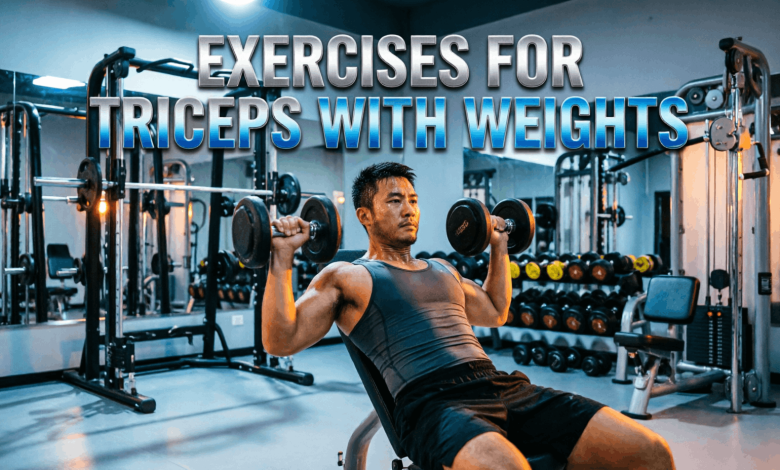
If you’ve spent months curling dumbbells and your arms still don’t look the way you want, there’s a good chance you’re skipping the muscle that actually makes up most of your upper arm. The triceps account for roughly two-thirds of your arm’s total mass, yet most lifters treat them as an afterthought tacked onto the end of a workout. That’s a mistake, and it’s one of the easiest ones to fix.
This guide breaks down the five most effective dumbbell tricep exercises, how to perform each one correctly, and how to build them into a real training plan. Whether you’re brand new to lifting or you’ve hit a frustrating plateau, these movements will get your arms growing again.
Why Dumbbells Work So Well for Triceps
Dumbbells give you something barbells and cable machines simply can’t: a full range of motion combined with independent arm movement. Because each arm has to control its own weight, your stabilizer muscles get pulled into the work, and your triceps end up firing harder as a result. You’ll also notice strength imbalances much faster — if one arm is lagging behind, dumbbell training exposes it immediately instead of letting your stronger side compensate.
There’s also a practical upside. You can change your grip, adjust your angle, and move through paths that suit your own joints, which means less strain and more pain-free training over the long run. And unlike a lot of gym equipment, dumbbells are cheap, widely available, and easy to use at home.
1. Dumbbell Skull Crushers
Skull crushers are about as close to a gold standard as tricep isolation gets. Lying flat on a bench, you press a dumbbell in each hand up over your chest, then lower them by bending only at the elbows until they hover near your forehead — which, unsurprisingly, is exactly where the name comes from.
How to perform it: Lie back on a flat bench with your feet planted firmly on the floor. Press the dumbbells straight up until your arms are almost locked out, then keep your elbows fixed in place as you lower the weights in a slow arc toward your head. Pause briefly at the bottom, then press back up by fully extending your elbows.
Control is everything here. Take two to three seconds on the way down, pause for a beat, and drive back up over roughly a second. Rushing the movement or letting momentum take over is the fastest way to turn a great exercise into a mediocre one.
Why it works: Few exercises combine a deep stretch at the bottom with a hard contraction at the top the way skull crushers do, and that combination is a major driver of muscle growth. Because your chest and shoulders barely assist, nearly all the work lands squarely on your triceps.
Pro tip: Set your bench to a slight incline — somewhere around 20 to 30 degrees — to take pressure off your shoulders. If you’re newer to the movement, start light and focus on feeling the muscle work rather than chasing weight. Any elbow pain is usually a sign you’re either too heavy or letting your elbows flare outward.
2. Single-Arm Dumbbell Tricep Extension
This one doesn’t get nearly enough credit. Training one arm at a time builds real unilateral strength and does an excellent job of correcting imbalances that two-arm exercises tend to hide.
How to perform it: Stand with your feet shoulder-width apart and your core braced. Press one dumbbell straight overhead with your elbow pointing forward rather than flaring to the side. Slowly lower the weight behind your head by bending at the elbow, going as deep as your shoulder mobility comfortably allows, then extend back to the top. Keep your upper arm still throughout — only your forearm should move. Finish all your reps on one side before switching.
Why go single-arm: Without help from the other side, your core and shoulder stabilizers have to work overtime just to keep the weight under control. This also makes it obvious, fast, if one arm is weaker than the other, so you can add extra volume where it’s actually needed.
On range of motion: Go as deep as you can without forcing it. A deeper stretch generally means more muscle growth over time, but tight shoulders will limit that at first — and that’s fine. Mobility improves gradually; forcing depth too early is how shoulder injuries happen.
3. Dumbbell Lying Tricep Extension (Decline Version)
Think of this as skull crushers’ close cousin, performed on a decline bench instead of flat. That small change in angle shifts the load and challenges your triceps slightly differently.
How to perform it: Set a bench to a 30–45 degree decline and lie back with a dumbbell in each hand pressed above your chest, arms nearly straight. Lower the weights by bending at the elbows until they come down on either side of your head, feeling a solid stretch through the triceps, then press back up.
Because of the decline angle, gravity fights you harder on the way down, which makes the lowering phase — arguably the most important part for muscle growth — noticeably more demanding.
When to use it: If flat skull crushers irritate your elbows or shoulders, this variation is often more comfortable while still delivering the same stimulus. It’s a smart addition once you’ve got standard skull crushers dialed in and want to hit the muscle from a fresh angle.
4. Dumbbell Kickbacks
Kickbacks get a bad reputation, mostly because so many people do them wrong. Done properly, they’re a fantastic high-rep finisher that keeps constant tension on the triceps.
How to perform it: Hold a dumbbell in each hand with a slight bend in your knees, then hinge forward at the hips until your torso is close to parallel with the floor. Keep your back flat and your core tight. With your elbows bent to about 90 degrees, extend them to kick the dumbbells back behind you, squeezing hard at the top, then return to the starting position under control. Your upper arms shouldn’t move at all — the motion comes entirely from the forearm.
Skip the momentum. Don’t swing the weights, don’t let your elbows drift away from your body, and use lighter dumbbells than you think you need. Strict form beats heavy weight every time with this exercise.
Why they’re underrated: Kickbacks keep tension on the triceps through the entire range of motion, with no real break at any point. That constant tension makes them excellent for metabolic stress — one of the key mechanisms behind muscle growth.
Sets and reps: Aim for 12 to 15 reps per side, and save this one for the end of your workout as a finisher after heavier compound lifts.
5. Dumbbell Close-Grip Press
This is your compound movement — technically a chest exercise, but bring your grip in and your triceps take on a much bigger share of the load.
How to perform it: Lie on a flat bench with a dumbbell in each hand held at chest level, hands closer together than a standard press — about shoulder-width or slightly narrower. Press straight up until your arms are fully extended, then lower back down under control. Keep your elbows at roughly a 45-degree angle to your torso rather than flaring straight out, and find a grip width that doesn’t put strain on your wrists.
Compound vs. isolation: Because multiple muscle groups share the load, you can push heavier weight here than with isolation moves, building raw strength on top of size. Pair it with something like skull crushers to get both the strength foundation and the fine-tuned detail work in the same program.
Putting It All Together: A Sample Tricep Program
You don’t need to cram all five exercises into a single session. Spread them across the week and you’ll get better recovery and better results.
Frequency: Train triceps two to three times per week, aiming for roughly 9 to 15 total sets across those sessions. That number includes indirect work from pressing movements, so it adds up faster than you’d expect.
A simple weekly split:
Day 1 — Heavy Strength (low reps) Dumbbell close-grip press: 3 sets of 4–6 reps Dumbbell skull crushers: 3 sets of 6–8 reps
Day 2 — Hypertrophy (moderate reps) Single-arm dumbbell extensions: 3 sets of 8–10 reps Dumbbell lying tricep extensions: 3 sets of 8–10 reps
Day 3 — Volume and Burnout (high reps) Dumbbell kickbacks: 3 sets of 12–15 reps per arm, plus a finisher of your choice
Rotating angles, rep ranges, and stimulus types like this tends to produce faster, more consistent gains than doing the same two exercises on repeat.
Progressive overload: Every week or two, try to add a rep, a small amount of weight, or simply tighten up your form. None of it needs to be dramatic — small, consistent progress compounds over months.
Mistakes That Are Quietly Killing Your Gains
Going too heavy. This is by far the most common tricep-training mistake. Once the weight is too much to control, momentum takes over and your triceps stop doing the work. Lighter weight with clean form will always beat heavy weight with sloppy form.
Letting your elbows drift. For nearly every tricep exercise, your elbows need to stay locked in one position. Once they flare or drift, the load shifts onto your shoulders instead of your arms.
Cutting your range of motion short. Partial reps feel heavier and can trick you into thinking you’re working harder, but without a full stretch and a full contraction, you’re leaving growth on the table.
Neglecting your weaker side. With single-arm work, it’s easy to unconsciously shortchange your non-dominant side. Match your reps and effort exactly on both arms, or the imbalance will only get worse.
Recovery and Nutrition Matter Just as Much as the Workout
Showing up to train is only half the equation. Your triceps actually grow while you’re resting, not while you’re lifting, so sleep and nutrition deserve just as much attention as your exercise selection.
Aim for seven to nine hours of sleep a night — poor sleep throws off the hormone balance your body needs to build muscle. Leave at least a full day between hard tricep sessions so the tissue has time to repair.
On the nutrition side, target roughly 0.8 to 1 gram of protein per pound of bodyweight each day. You don’t need to overcomplicate it: chicken, fish, eggs, dairy, beef, or plant-based proteins eaten consistently throughout the day will get you there.
Frequently Asked Questions
How often should I train triceps?
Two to three times per week is the sweet spot. More isn’t automatically better — three poorly recovered sessions will get you fewer results than two well-planned ones.
Can I build noticeably bigger triceps with just dumbbells?
Yes. Dumbbells are one of the most effective tools for tricep development, and a bench plus a pair of dumbbells is genuinely enough to build serious arm size and strength.
What weight should I start with?
Start conservatively. If you can’t complete eight clean reps on your last set, the weight is too heavy. Progress gradually over the following weeks rather than jumping up too fast.
Should tricep work come before or after other exercises?
Do compound movements like the close-grip press first, while you’re fresh. Save isolation moves like kickbacks and skull crushers for later in the session, when a bit of fatigue actually works in your favor.
How long before I notice results?
Most people feel stronger within a couple of weeks, but visible muscle growth typically takes four to eight weeks of consistent training and proper nutrition.
Is it okay to train triceps every day?
No. Daily training doesn’t allow enough recovery time and tends to lead to overuse injuries rather than faster gains. Stick to two or three sessions a week with rest days built in.
Are dumbbells better than barbells for triceps?
Both have their place. Dumbbells offer more range of motion and help correct imbalances, while barbells let you move heavier total weight. If you only have access to one, dumbbells give you more flexibility overall.
How do I know if my form is right?
You should feel the burn in your triceps, not your elbows or shoulders. If the movement feels jerky or relies on momentum, slow down and lighten the load. Recording yourself or having someone check your form can help catch issues you can’t feel in the moment.
The Bottom Line
Your triceps make up most of your arm — training them properly isn’t optional if you want real size and strength. The five exercises above are proven, accessible, and don’t require anything beyond a bench and a set of dumbbells. Pick two or three, master the form, and build them into a consistent routine.
Consistency and gradual progress will do more for your arms than any advanced technique. Show up, train with good form, add a little weight or a rep when you can, eat enough protein, and sleep well. Give it a few months, and the difference will be obvious.