

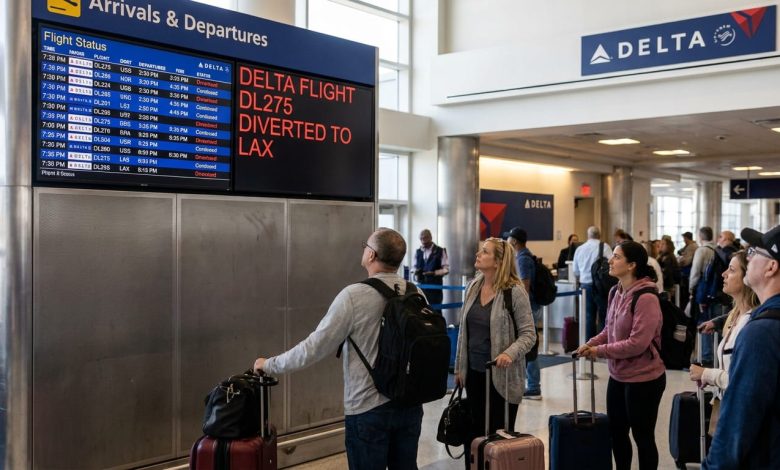
You’re tracking a flight on FlightRadar, watching the little plane icon glide over the Bering Sea, and then it just turns around. That’s what happened to people watching Delta flight DL275 diverted LAX on its way from Detroit to Tokyo. The plane had been in the air for hours, closing in on Japan, when it reversed course and headed straight for Los Angeles instead. If you’re trying to figure out why this happened, whether anyone was hurt, or what it means for future Delta flights on this route, you’re in the right place. Here’s the full story, told in plain terms.
What Happened to Delta Flight DL275
Delta flight DL275 left Detroit Metropolitan Wayne County Airport on schedule, bound for Tokyo Haneda Airport on an Airbus A350-900. Registered as N508DN, the aircraft is one of Delta’s newer long-range jets, built specifically for routes that cross large stretches of open water. For several hours, the flight looked completely normal. Passengers settled in for the roughly 13-hour trip, cabin service ran as expected, and the plane climbed to its cruising altitude without incident.
Then, while flying over the Bering Sea at around 38,000 feet, the flight crew got an indication tied to the engine’s anti-ice system. Instead of pushing on toward Japan, the pilots made the call to turn back and land at Los Angeles International Airport. The aircraft touched down safely on runway 06R after roughly five hours of flying back across the Pacific and North America.
Why Did Delta Flight DL275 Divert to LAX
The short answer: an anti-ice system indication, not an engine failure and not a mid-air emergency. Pilots treated it as a precaution, and that distinction matters a lot when you’re trying to understand what really went on.
The Engine Anti-Ice System Explained
At cruising altitude, outside air temperatures can drop well below negative 50 degrees Celsius. Engines rely on an anti-ice system, which pulls hot air from the compressor, to stop ice from building up on inlet components. When a sensor or valve tied to that system throws a warning, it doesn’t mean the engine has failed. It means something needs to be checked before the aircraft commits to hours of flying over remote ocean with no nearby airport.
That last part is the real reason DL275 didn’t just keep going. Long routes like Detroit to Tokyo fall under ETOPS rules, which govern how far twin-engine jets can fly from a suitable diversion airport. Once the crew saw the anti-ice indication, continuing across the Bering Sea and the North Pacific stopped being the safe option. Turning back while still near a usable airport made far more sense.
Delta Flight DL275 Japan Diversion Timeline
Here’s how the flight actually unfolded, based on tracking data and reporting on the incident:
- The aircraft departed Detroit on schedule for Tokyo Haneda.
- Several hours in, while over the Bering Sea, the crew received the anti-ice system indication.
- Rather than continuing across the Pacific or turning back to Detroit, the crew chose LAX as the diversion point.
- The flight covered roughly five hours to reach Los Angeles.
- N508DN landed without issue on runway 06R in the early morning hours.
- The aircraft stayed on the ground at LAX for close to 18 hours while engineers inspected and repaired the system.
- No injuries were reported at any point, and the aircraft remained fully controllable throughout the diversion.
Why LAX Was the Right Choice for This Diversion
Pilots don’t pick a diversion airport at random. LAX made sense for a few concrete reasons. It’s one of Delta’s major hubs, so ground staff, gates, and rebooking options were already in place. It also has certified maintenance support for the Airbus A350, along with 24/7 parts and engineering coverage for the Rolls-Royce Trent XWB engines that power the aircraft.
On top of that, LAX offers long runways built for wide-body jets landing heavy with fuel, clear weather at the time, and full customs facilities for a flight that started as an international departure. With multiple daily Delta flights running between LAX and Tokyo, rebooking passengers onto a later departure was also far simpler than it would have been almost anywhere else on the West Coast.
What Happened to Passengers After Landing
Once the plane reached the gate, ground crews got to work. Passengers deplaned normally, and Delta staff handled rebooking onto later flights to Tokyo, since the route runs multiple times a day out of LAX. Travelers with tight connections in Japan were the most affected, and some were offered hotel stays or meal vouchers depending on how long their new itinerary took to arrange.
Cabin crew reportedly kept things calm throughout the diversion, and several passengers who posted about the flight online mentioned that the pilots communicated clearly about what was happening, even before full details were confirmed. That kind of communication tends to matter more to passengers than the technical cause itself.
Was Delta Flight DL275 Diverted LAX Today an Emergency
No. This is worth repeating because a lot of the early chatter around the flight assumed the worst. The crew did not declare an emergency, and there was no cabin depressurization, no engine shutdown, and no mechanical failure mid-flight. What happened was a precautionary diversion triggered by a system indication, exactly the kind of decision pilots are trained to make well before a small issue becomes a bigger one.
That distinction is a big part of why the aircraft was back in the air within a day. Engineers inspected the anti-ice system, made repairs, and cleared the plane to return to service once everything checked out.
How Common Are Diversions Like This
More common than most travelers realize. Long-haul, over-water flights operate under strict rules that push crews toward caution rather than risk. A sensor fault, a medical situation, or even a stray warning light can be enough to trigger a diversion, especially on ETOPS routes where the nearest airport might be hours away.
Airlines would rather land a plane early and lose a day of schedule than gamble on a system that might not hold up over open ocean. Seen that way, the DL275 diversion wasn’t a failure of the aircraft or the airline. It was the safety process working exactly as designed.
Frequently Asked Questions About Delta Flight DL275 Diverted LAX
What caused Delta flight DL275 to divert to LAX?
An indication involving the aircraft’s engine anti-ice system while flying over the Bering Sea prompted the crew to divert. It was treated as a precaution rather than an emergency, and the aircraft remained fully controllable throughout the flight.
Was Delta flight DL275 diverted LAX today an emergency landing?
No emergency was declared. The pilots chose to divert as a standard safety precaution after receiving a system indication, following normal procedures used on long-haul ETOPS routes rather than emergency protocols.
What aircraft was used on the Delta DL275 Japan diversion?
The flight was operated by an Airbus A350-900, registered N508DN, powered by two Rolls-Royce Trent XWB engines. Delta uses this aircraft type regularly on its longer international routes, including Detroit to Tokyo.
Where was Delta flight DL275 headed before it diverted?
The flight was traveling from Detroit Metropolitan Wayne County Airport to Tokyo Haneda Airport. It diverted mid-route while flying over the Bering Sea and landed instead at Los Angeles International Airport.
Were any passengers injured during the DL275 diversion?
No injuries were reported. Passengers experienced a calm and orderly diversion, and cabin crew kept everyone informed as the aircraft made its way back across the Pacific to LAX.
How long was Delta flight DL275 on the ground at LAX?
The aircraft remained at LAX for close to 18 hours while engineers inspected and repaired the anti-ice system. It returned to service once maintenance teams confirmed the issue was resolved.
Why didn’t Delta flight DL275 turn back to Detroit instead?
By the time the crew received the indication, the aircraft was already closer to the West Coast diversion options than to Detroit. LAX also offered maintenance support, rebooking options, and facilities that made it the more practical choice.
Did Delta flight DL275 passengers get compensation?
Passengers with disrupted connections were offered rebooking onto later Tokyo flights, and some received hotel stays or meal vouchers. Exact compensation depends on individual circumstances and Delta’s standard diversion policies.
What To Do If Your Delta Flight Gets Diverted
Delta flight DL275 diverted LAX because of a precautionary anti-ice indication over the Bering Sea, not a mechanical failure or emergency, and everyone on board landed safely. If you’re ever on a flight that diverts, stay put, listen to crew instructions, and check your airline’s app for rebooking options as soon as you’re on the ground. Want to understand more about what goes on behind the scenes on long-haul flights? Check out our related guides on reuterings.com below.