Short Back and Sides: What to Ask For and How to Avoid a Bad Cut

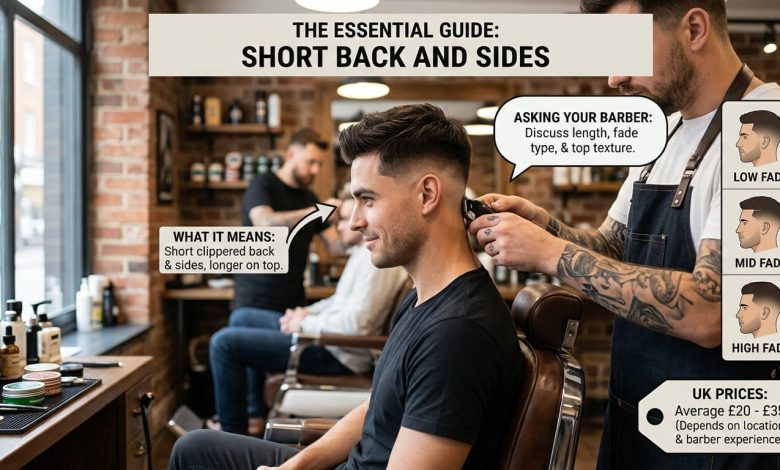
A short back and sides is the most requested men’s haircut in the UK, and also the most misunderstood. The phrase describes a family of styles with short hair at the back and sides and longer hair on top, not a single fixed cut . That ambiguity is why so many people leave the barber with something they did not want. This guide explains what the term actually covers, how to specify the details that matter, what it costs in the UK, and the difference between this classic cut and a modern fade.
What Short Back and Sides Actually Means
Collins Dictionary defines the cut simply: hair “cut very short at the back and sides with slightly thicker, longer hair on the top of the head” . That is the whole definition. It tells you nothing about how short the sides should be, how the back should finish, or what the top should look like.
Pall Mall Barbers makes the point bluntly: “Short back and sides” is not a haircut on its own, but a term to describe a style that is long at the top and shorter at the sides and back . Within that description sit a pompadour, a crew cut, a textured crop, and a dozen other variations. Elvis wore a short back and sides. So does David Beckham. They do not look alike .
The practical consequence is that saying “short back and sides” in a barber’s chair is a starting point, not a full instruction. The barber will make decisions for you unless you specify further.
How to Ask for a Short Back and Sides Properly
British GQ consulted barber TJ Hunt of Ruffians on how to get the cut right . His advice breaks down into six practical steps.
Bring a Photo
There is no single short back and sides. A photo communicates what words cannot. Hunt suggests scrolling through Google Images or TikTok before your appointment so you know what you want the end result to look like . This is not cheating. It is the fastest way to avoid crossed wires.
Decide Between Clippers and Scissors
Clippers give a crisp, even finish. Scissors give a looser, more textured look. Hunt notes that a scissor cut is “often a little less precise” but works well if you want texture rather than sharpness . Most good barbers use both: clippers for the baseline shape and scissors for refinement.
Ask for a Gradual Blend
The cut should move from shortest at the ears and neckline to longer at the crown. Hunt says this “results in a more structured aesthetic, which looks better both right away and during the grow out” . A blunt transition between the short sides and the longer top is harder to maintain and looks harsher as it grows.
Request a Tapered Neckline, Not a Blocked One
This is the single most useful piece of advice in the GQ guide. A hard, squared-off neckline grows out badly and can make the cut look “helmet-like” . A taper blends the hair down to nothing at the nape, looks better immediately, and grows out cleanly. If you say nothing else to your barber, say this.
Specify the Edges
Natural, soft edges grow out better. Sharp, crisp lines look fresher but require more upkeep . If you work in a formal environment or want a clean finish, ask for sharp lines. If you want longevity between cuts, ask for natural edges.
Choose Round or Square
Where the sides connect to the top determines the silhouette. A higher connection creates a rounder shape. A lower connection allows a squarer shape. Hunt notes that round cuts flatter sharper features, while square cuts give structure to softer ones .
Short Back and Sides vs Fade: The Key Difference
These two terms get used interchangeably, but they describe different things. The distinction matters because a fade requires more frequent maintenance and produces a different look.
A fade is a gradual, blended transition in length from short at the bottom to longer at the top, with no harsh lines. A short back and sides does not have this blended, blurred effect as a key feature . The sides and back may have some tapering, but the defining characteristic of a fade, the smooth gradient from skin to length, is absent.
The practical implication is maintenance. A high skin fade looks its best for about a week to ten days and noticeably grows out within two to three weeks. A low taper or a classic short back and sides with more length can go four to six weeks and still look intentional . If you want a cut that survives a busy month, the classic version is more forgiving.
There is also a middle option: the taper. A taper is a short, conservative graduation usually limited to the sideburns and neckline, while the rest of the sides keep visible length . It is the softer, lower-maintenance cousin of the fade.
What It Costs in the UK
Prices vary by region and by whether you are specifying a full restyle or just a tidy-up. The figures below are from UK barbershops listed online in 2025 and 2026, and they should be treated as a guide rather than a national average.
| Service | Price | Location / Source |
| Short Back & Sides (traditional, 30 min) | £16.00 | Serenity Barbers, Falkirk |
| Back & Sides Only (20 min) | £14.00 | Georges Barber Shack |
| Haircut (back and sides with trim on top) | £14.30 | Barber Trev’s |
| Skinfade Back & Sides Only (30 min) | £16.00 | Georges Barber Shack |
| Skin Fade (with trim on top) | £17.00 | Barber Trev’s |
The pattern is clear. A straightforward short back and sides sits around £14 to £16 in many UK shops. A skin fade costs slightly more because it takes longer and requires more precision. If you are paying significantly less than £12, you are likely in a very basic shop or a training environment. If you are paying more than £25, you are paying for location, reputation or a senior barber, not the cut itself.
Common Mistakes and How to Avoid Them
Saying only “short back and sides.” This is the root of most bad haircuts. The phrase is a category, not a specification. Add at least one detail: the clipper grade you want on the sides, the length you want on top, or the neckline finish.
Asking for a blocked neckline. A hard horizontal line at the nape is difficult to cut straight and grows out into a visible band of stubble within a fortnight. Ask for a taper instead .
Confusing a fade with a short back and sides. If you want a fade, say “fade.” If you want a classic cut with even length on the sides, say “short back and sides” and specify that you do not want a fade. The barber will otherwise assume you want the modern version.
Letting the barber decide the top. The top is what makes the cut yours. If you wear it pushed back, side-parted or forward, say so. The barber cuts in the direction you will style it .
Frequently Asked Questions
What is a short back and sides haircut?
A short back and sides is a men’s haircut with short hair at the back and sides and longer hair on top. The term describes a family of styles rather than a single fixed cut. It can include a pompadour, a crew cut or a textured crop, depending on how the top is cut and styled .
What is the difference between a short back and sides and a fade?
A fade has a gradual, blended transition in length from short at the bottom to longer at the top, with no harsh lines. A short back and sides does not have this blended, blurred effect as a defining feature. The sides and back may be tapered, but the smooth gradient of a fade is absent .
How much does a short back and sides cost in the UK?
Prices typically range from £14 to £17 depending on the barbershop and location. A straightforward short back and sides at Serenity Barbers in Falkirk is £16 . Barber Trev’s charges £14.30 for a haircut with a trim on top . Skin fades cost slightly more, around £16 to £17 .
What should I ask my barber for a short back and sides?
Bring a photo. Specify whether you want clippers or scissors. Ask for a gradual blend and a tapered neckline rather than a blocked one. Say how long you want the top and how you style it. If you want sharp edges, ask for them; if you want a natural finish that grows out well, say that instead .