
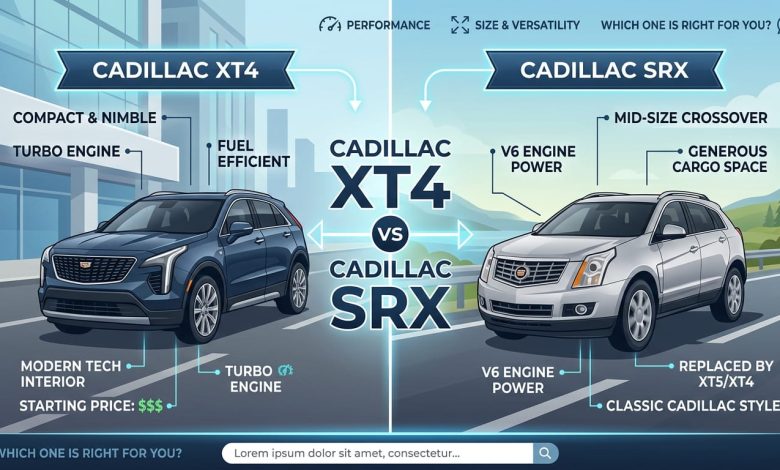
You’re cross-shopping a used Cadillac SRX against a newer XT4 and wondering if you’re even comparing apples to apples. That confusion makes sense, since Cadillac XT4 vs Cadillac SRX isn’t really a same-generation matchup. This guide breaks down how these two SUVs actually differ, from size and power to reliability and price, so you can figure out which one fits what you actually need from a vehicle.
These Two SUVs Come From Different Eras
The Cadillac SRX was produced from 2004 to 2016, spanning three generations, starting as a mid-size crossover before shifting to a more compact platform for its final generation. Cadillac replaced it with the XT5 in 2016, and the XT4 arrived later, in 2019, as a separate, smaller entry into the lineup.
That means anyone comparing these two today is almost always comparing a used, discontinued SRX against a current or recent-model XT4, not two competing options on a new car lot. Understanding that context matters for setting expectations around price, technology, and long-term reliability.
Size and Class
Compact vs Mid-Size
The XT4 is classified as a subcompact luxury crossover, Cadillac’s smallest SUV offering, built for buyers who want a manageable footprint for city driving and parking. The SRX, particularly in its earlier generations, targeted the mid-size luxury SUV segment, with more interior space and cargo capacity.
If passenger and cargo room matter more to you than modern tech, the SRX’s larger footprint (especially pre-2010 models with an optional third row) may actually outsize the XT4 despite being the older vehicle.
Engine Power and Fuel Efficiency Compared
| Spec | Cadillac SRX (final generation) | Cadillac XT4 |
| Base engine | 3.6L V6 | 2.0L turbo I4 |
| Horsepower | 308 hp | 235 hp |
| Fuel type | Regular gasoline | Premium unleaded |
| Average fuel economy | Around 19 mpg | Around 26 mpg |
| Transmission | Automatic | 9-speed automatic |
| Drivetrain options | FWD or AWD | FWD or AWD |
The SRX wins on raw horsepower, which makes sense given its larger V6 engine, but that power comes with a real fuel economy tradeoff. The XT4’s smaller turbocharged four-cylinder trades outright power for meaningfully better mileage, which adds up over years of ownership.
Interior Technology and Comfort
The XT4 benefits from roughly a decade of technology advancement, including a modern touchscreen infotainment system, Apple CarPlay and Android Auto support, and improved noise cancellation for a quieter cabin. The SRX’s infotainment and connectivity features, while advanced for their time, feel dated by current standards.
Both models offer leather upholstery and a genuinely comfortable ride, so the difference here comes down to how much modern connectivity actually matters to your daily use. If smartphone integration and current safety tech are priorities, the XT4 has a clear advantage.
Price and Value Considerations
A used SRX from its final production years typically runs in the range of $8,000 to $20,000 depending on mileage and condition, while a recent XT4 sits considerably higher, often in the $40,000 to $52,000 range for later model years. That gap reflects the difference between buying an older, depreciated used vehicle and a much newer one, not necessarily a difference in build quality.
If your priority is the lowest upfront cost and you’re comfortable with older technology, a well-maintained SRX offers real value. If you want current safety features, better fuel economy, and a manufacturer warranty, the XT4’s higher price reflects that added peace of mind.
Reliability and Long-Term Ownership
Both models come from Cadillac’s mainstream SUV lineup rather than a performance-focused trim, and reliability varies more by specific model year and maintenance history than by nameplate alone. A used SRX approaching or past 100,000 miles carries the typical risks of an aging vehicle, including wear on suspension components and aging electronics.
The XT4, being a newer vehicle, generally comes with fewer accumulated miles and the remainder of its factory warranty if bought new or as a certified pre-owned unit. That said, always check a specific vehicle’s maintenance records and any open recalls before buying either model.
FAQs
Is the Cadillac SRX the same size as the XT4?
No. The SRX, especially in its earlier generations, was a mid-size crossover, while the XT4 is Cadillac’s subcompact entry, positioned as the smallest SUV in the current lineup.
What replaced the Cadillac SRX?
The Cadillac XT5 replaced the SRX when SRX production ended in 2016. The XT4 arrived later, in 2019, as a separate, smaller model rather than a direct SRX successor.
Which has better fuel economy, the SRX or the XT4?
The XT4 gets better fuel economy, averaging around 26 mpg compared to the SRX’s roughly 19 mpg. The SRX’s larger V6 engine trades efficiency for more horsepower.
Is a used Cadillac SRX a good value compared to a new XT4?
A used SRX offers a significantly lower purchase price, often under $20,000, compared to a recent XT4’s $40,000-plus price range. The tradeoff is older technology, higher mileage, and the absence of a manufacturer warranty on most used SRX listings.
Does the Cadillac XT4 have more horsepower than the SRX?
No. The SRX’s base V6 engine produces more horsepower (308 hp) than the XT4’s turbocharged four-cylinder (235 hp), though the XT4 makes up for it with better fuel efficiency and modern turbocharged torque delivery.
Can the Cadillac SRX seat more passengers than the XT4?
Early SRX models (2004 to 2009) offered an optional third-row seat for up to seven passengers, a configuration the XT4 doesn’t offer at all. Later SRX generations and the XT4 both seat five passengers.
Which is more reliable, the SRX or the XT4?
Reliability depends heavily on the specific model year, mileage, and maintenance history rather than the nameplate alone. A well-maintained SRX can be reliable, but its age means more accumulated wear compared to a newer XT4.