

You spotted a cluster of small, pale, wriggling things near your kitchen trash or a rotting piece of wood, and now you’re stuck trying to figure out what you’re actually looking at. Getting termite larvae vs maggots right matters, since one points to a structural pest problem and the other usually just means a fly got to your garbage before you did.
This guide walks through the physical differences, where each one typically shows up, and how to confirm which pest you’re dealing with before you call anyone or reach for a spray.
What Termite Larvae Actually Look Like
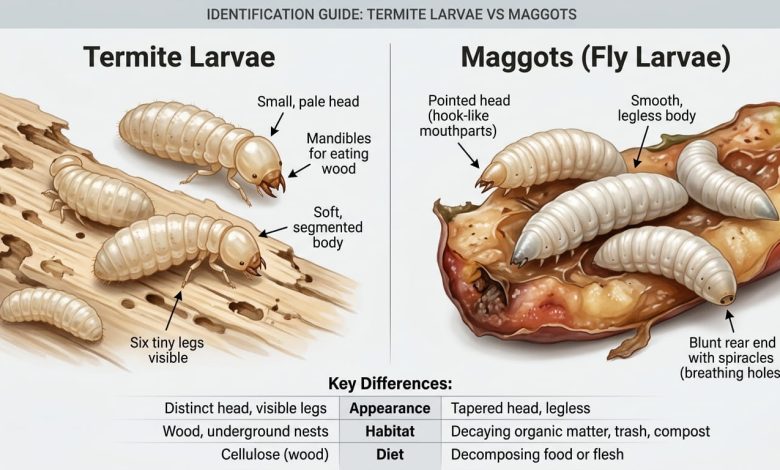
Termite larvae are small, soft-bodied, and pale white to cream colored, usually somewhere between 1 and 3 millimeters long right after hatching. They have six legs and a segmented body, and under close inspection you can make out a distinct head with visible antennae.
Unlike maggots, termite larvae don’t move much on their own. Worker termites feed and groom the larvae directly, so you’ll typically find them clustered inside a mud tube, a damaged wood gallery, or near the colony’s nest rather than crawling around in the open.
Where You’ll Find Termite Larvae
Termite larvae stay hidden almost the entire time. They live inside wood, soil tunnels, or mud tubes built by worker termites, protected from light and open air. Finding termite larvae exposed on a surface is rare, and if you do see them out in the open, it usually means a nest or gallery got disturbed nearby.
What Maggots Actually Look Like
Maggots are fly larvae, and they look noticeably different once you know what to check for. They’re typically cream to yellowish white, legless, and taper to a point at one end, giving them a distinct cone-shaped body compared to a termite larva’s more uniform, segmented shape.
Maggots move constantly and visibly, wriggling and inching across whatever surface they’re on. That constant motion, combined with the total absence of legs, is one of the fastest ways to rule out termites on sight.
Where You’ll Find Maggots
Maggots show up wherever flies have laid eggs on decaying organic material. Common spots include trash cans, rotting food, animal carcasses, and compost piles. Unlike termite larvae, maggots are frequently found out in the open, since flies lay eggs directly on exposed food sources rather than hiding them inside structural wood.
Termite Larvae vs Maggots: Quick Comparison
| Feature | Termite Larvae | Maggots |
| Legs | Six legs, visible | No legs |
| Body shape | Segmented, uniform width | Tapered, cone-shaped |
| Color | Pale white to cream | Cream to yellowish white |
| Movement | Minimal, cared for by workers | Constant, visible wriggling |
| Typical location | Hidden in wood, soil, mud tubes | Exposed on decaying food or waste |
| What they signal | Active termite colony | Fly infestation, decaying organic matter |
Moth Larvae vs Maggots:
Moth larvae, often called caterpillars in their early stage, get confused with maggots almost as often as termite larvae do. Indian meal moth larvae, a common pantry pest, are typically off-white with a faint pinkish or greenish tint and have visible legs along their body, unlike the legless maggot.
Moth larvae also tend to leave behind silk webbing in stored food, a telltale sign maggots don’t produce. If you’re finding small worm-like pests in a cereal box or bag of flour, moth larvae are the more likely culprit over either termites or flies.
Why This Distinction Actually Matters
Confusing a termite larva with a maggot isn’t just a minor identification mistake. Termites can cause thousands of dollars in structural damage over time, and catching an active colony early makes a real difference in treatment cost and scope.
Maggots, on the other hand, usually clear up once you remove the decaying material attracting flies and clean the area thoroughly. Treating a maggot problem with termite-specific pest control wastes money, and treating a termite problem like a simple fly issue lets structural damage continue unchecked.
How to Confirm What You’re Looking At
If you’re still unsure after checking the physical traits above, a few quick checks can settle it:
- Check for legs. Termite larvae have six visible legs. Maggots have none.
- Look at the location. Termite larvae stay hidden in wood or mud tubes. Maggots show up on exposed decaying material.
- Watch the movement. Maggots wriggle constantly. Termite larvae stay mostly still, tended by worker termites.
- Look for related evidence. Mud tubes, hollow-sounding wood, or discarded wings point to termites. Rotting food or a source of decay points to maggots.
If mud tubes, damaged wood, or actual termite activity turn up alongside the larvae, it’s worth having a licensed pest control professional confirm the species and treatment plan rather than guessing further.
FAQs
What is the difference between termite larvae and maggots?
Termite larvae have six visible legs, a segmented body, and stay hidden inside wood or mud tubes. Maggots have no legs, taper to a point, and typically show up on exposed decaying food or organic waste.
Do termite larvae move like maggots?
No. Termite larvae stay mostly still and are fed and groomed by worker termites. Maggots move constantly, wriggling visibly across whatever surface they’re on.
Can maggots be mistaken for termites?
Yes, especially by someone unfamiliar with either pest, since both can appear pale and worm-like at a glance. Checking for legs and location quickly clears up the confusion, since termite larvae have legs and maggots don’t.
What do termite maggots look like?
There’s technically no such thing as a “termite maggot,” since maggots are specifically fly larvae, not termite larvae. People commonly use the term loosely, but true termite larvae have legs and a segmented body unlike any maggot.
How do I know if I have a termite infestation and not just maggots?
Look for mud tubes, hollowed or damaged wood, and discarded termite wings near windows or doors. Maggots won’t produce any of these signs, since they’re tied to decaying food rather than structural damage.
What attracts maggots to a home?
Maggots show up wherever flies find a source of decay to lay eggs on, including trash cans, rotting food, pet waste, or an unnoticed dead animal. Removing the decaying material and cleaning the area typically resolves the problem.
How do moth larvae differ from both termite larvae and maggots?
Moth larvae have visible legs like termite larvae but often leave silk webbing behind, especially in stored food, which neither termite larvae nor maggots produce. Their coloring also tends to carry a faint pink or green tint compared to the plain white of maggots.