

You just got offered a job paying $20 an hour and you’re staring at the number, trying to figure out what it actually means for your bank account. Or maybe you’re already earning $20 an hour and want a clear picture of your yearly income before you sign a lease, apply for a car loan, or plan your budget. Either way, $20 an hour is how much a year comes down to simple math once you know the formula, plus a few real-world details that change the final number.
This guide breaks down your gross pay, your take-home pay after taxes, how $20 an hour compares to other wages, and what kind of lifestyle it can support depending on where you live.
$20 an Hour Is How Much a Year (Gross Pay)
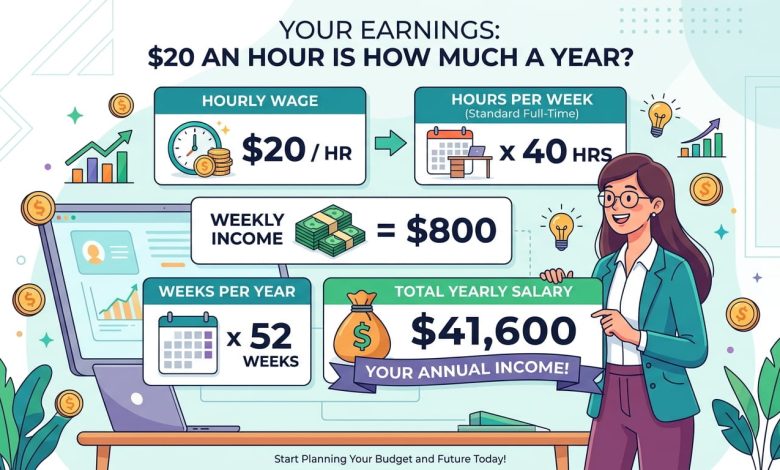
At $20 an hour, working a standard 40-hour week, you’d earn $41,600 a year before taxes. This assumes you work all 52 weeks of the year with no unpaid time off.
Here’s the math: 40 hours a week times 52 weeks equals 2,080 working hours a year. Multiply that by $20, and you land on $41,600.
If you take two weeks of unpaid vacation, your working hours drop to 2,000 for the year. That brings your gross pay down to $40,000. Paid time off doesn’t change this number, since you’re still getting paid during those weeks.
Quick Reference Table
| Pay Period | Amount |
| Hourly | $20 |
| Daily (8-hour shift) | $160 |
| Weekly | $800 |
| Biweekly | $1,600 |
| Monthly | $3,466.67 |
| Yearly (2,080 hours) | $41,600 |
| Yearly (with 2 unpaid weeks off) | $40,000 |
How Much Is 20 Dollars an Hour Annually After Taxes
Your gross pay isn’t what lands in your checking account. Federal income tax, Social Security, Medicare, and state income tax (if your state has one) all take a cut before your paycheck reaches you.
For a single filer earning $41,600 a year in 2026, a rough breakdown looks like this:
- Federal income tax: Roughly 8-10% of gross income after the standard deduction, depending on filing status and deductions claimed
- Social Security tax: 6.2% of gross wages
- Medicare tax: 1.45% of gross wages
- State income tax: Ranges from 0% (Texas, Florida, Nevada, and other no-income-tax states) to over 9% in states like California or Oregon
Put together, most workers earning $20 an hour take home somewhere between $32,000 and $35,000 a year after taxes, depending on their state and filing status. That works out to roughly $2,700 to $2,900 a month, or about $625 to $675 a week.
Your actual number will shift based on your filing status, whether you have dependents, pre-tax deductions like a 401(k) or health insurance, and local taxes in some cities. A paycheck calculator that uses your specific state and filing status will give you a more precise figure than any general estimate.
20 an Hour Salary Broken Down by Hours Worked
Not everyone works a clean 40-hour week. Part-time schedules, overtime, and seasonal work all change your final number. Here’s how $20 an hour plays out at different weekly hour counts.
- 20 hours a week: $20,800 a year
- 25 hours a week: $26,000 a year
- 30 hours a week: $31,200 a year
- 35 hours a week: $36,400 a year
- 40 hours a week: $41,600 a year
- 45 hours a week (with overtime): Roughly $47,320 a year, since hours past 40 typically pay time-and-a-half under federal overtime rules
- 50 hours a week (with overtime): Roughly $53,040 a year
If your job pays overtime, those extra hours at 1.5x your rate ($30 an hour) add up fast. A worker who regularly puts in 45-hour weeks earns meaningfully more than someone sticking to a strict 40.
How $20 an Hour Compares to Other Common Wages
Seeing $20 an hour next to nearby pay rates helps put it in context, especially if you’re comparing job offers or wondering how a raise would affect your budget.
| Hourly Wage | Annual Pay (40 hrs/week) |
| $15/hour | $31,200 |
| $18/hour | $37,440 |
| $19/hour | $39,520 |
| $20/hour | $41,600 |
| $22/hour | $45,760 |
| $25/hour | $52,000 |
| $30/hour | $62,400 |
For reference, the federal minimum wage is $7.25 an hour, so $20 an hour pays nearly triple that rate. Many states and cities set their own minimum wage well above the federal floor, which narrows the gap in places like California, Washington, and New York.
Can You Live Comfortably on $20 an Hour?
This depends heavily on where you live, whether you’re supporting anyone besides yourself, and what debt you’re carrying. $41,600 a year stretches much further in a small town in Ohio than it does in San Francisco or Manhattan.
A common budgeting guideline is the 50/30/20 rule: 50% of take-home pay toward needs (rent, groceries, utilities, insurance), 30% toward wants, and 20% toward savings or debt payoff. On $2,800 a month after taxes, that breaks down to roughly:
- $1,400 for needs
- $840 for wants
- $560 for savings or debt
In lower cost-of-living areas, this budget covers a modest apartment, groceries, a car payment, and some savings. In high cost-of-living cities, rent alone can eat past the $1,400 needs category, leaving little room for anything else. Someone earning $20 an hour in a rural or midsize city often has more breathing room than someone with the same wage in a major metro area.
Household size matters too. A single person can often make $20 an hour work comfortably, while a family of four supported by one $20-an-hour income will likely need to budget carefully or bring in a second income.
How to Increase Your Income Beyond $20 an Hour
If $41,600 a year doesn’t quite cover your goals, a few practical paths can raise your income without requiring a total career change.
- Ask for a raise with data. Research what your role pays in your city using sites like Glassdoor or the Bureau of Labor Statistics, and bring specific numbers to the conversation.
- Pick up overtime or a side gig. Even 5-10 extra hours a week at time-and-a-half can add thousands to your yearly total.
- Learn a skill that pays more. Certifications in trades, healthcare support, IT, or project coordination often move workers from the $18-20 range into the $25-30 range within a year or two.
- Negotiate benefits alongside pay. Health insurance, 401(k) matching, and paid time off all add real value even when the hourly number stays flat.
- Switch employers strategically. Workers who change jobs every few years often see faster pay growth than those who stay put and wait for internal raises.
Frequently Asked Questions About $20 an Hour Is How Much a Year
How much is $20 an hour annually?
$20 an hour comes out to $41,600 a year for a full-time worker putting in 40 hours a week, 52 weeks a year. If you take unpaid time off, the total drops by $800 for every week you’re not working.
How much a year is 20 dollars an hour after taxes?
After federal, state, and payroll taxes, most workers take home between $32,000 and $35,000 a year from a $41,600 gross salary. The exact figure depends on your state, filing status, and any pre-tax deductions.
Is $20 an hour a good salary?
$20 an hour sits above the federal minimum wage and covers a modest, single-person budget comfortably in most lower and mid cost-of-living areas. In expensive cities, it often requires roommates, a smaller apartment, or a second income to keep up.
How much is $20 an hour biweekly?
Working 80 hours over two weeks at $20 an hour comes out to $1,600 before taxes. After typical payroll deductions, expect a biweekly paycheck somewhere around $1,250 to $1,350.
How much is $20 an hour monthly?
$20 an hour averages out to about $3,466.67 a month before taxes, based on 2,080 working hours spread across 12 months. After taxes, monthly take-home pay typically lands between $2,650 and $2,900.
What is $20 an hour for a part-time worker?
A part-time worker putting in 20 hours a week at $20 an hour earns $20,800 a year before taxes, half of the full-time total. Actual take-home pay depends on tax withholding and whether the job offers benefits.
How many hours a week is $20 an hour to make $50,000 a year?
To reach $50,000 a year at $20 an hour, you’d need to work about 48 hours a week for 52 weeks, or rely on overtime pay to close the gap. Without overtime, a straight 40-hour week caps out at $41,600.
Does $20 an hour include overtime pay?
Base pay of $20 an hour does not automatically include overtime unless you work more than 40 hours in a week. Federal law generally requires 1.5x pay, or $30 an hour, for eligible hourly workers who exceed 40 hours weekly.
Put Your $20 an Hour Salary to Work
$20 an hour breaks down to $41,600 a year before taxes, roughly $32,000 to $35,000 after taxes depending on your state, and about $3,466 a month in gross pay. Whether that feels comfortable or tight depends heavily on your location, household size, and spending habits.
Once you know your real take-home number, the next move is building a budget around it, checking how your state’s tax rate affects your paycheck, or comparing this wage against other job offers using a salary calculator. Any of those next steps will help you turn this number into an actual plan.