
You’re sitting at your desk somewhere outside the United States, watching LinkedIn fill up with six-figure software engineering roles at American tech companies, and wondering whether any of those jobs could actually be yours. The short answer is yes. Drovenio IT career tips USA have become one of the most searched topics among global tech professionals precisely because this path is real, it pays well, and it does not require a visa or a flight ticket.
This guide covers everything you need to move from job seeker to remote contractor with U.S. companies. You will find the right roles to target, the skills that get interviews, how to build a profile that stands out, and how to avoid the mistakes that quietly kill most applications.
What Drovenio Is and Why It Matters for Remote IT Careers
Drovenio is a platform and content resource that connects IT professionals with remote opportunities at U.S.-based companies. Think of it as a bridge between global talent and American employers who are actively struggling to fill technical roles.
The U.S. tech market currently has over one million unfilled IT positions. Companies in software development, cloud computing, cybersecurity, and data science cannot hire fast enough from their local talent pool. That gap is what makes platforms like Drovenio so relevant in 2026. They give employers access to skilled professionals regardless of geography, and they give those professionals access to salaries that would otherwise require relocating to San Francisco or New York.
Drovenio does not just list jobs. It tracks market trends, identifies what skills U.S. employers want most right now, and helps candidates understand how remote hiring with American companies actually works. That combination of job access and career intelligence is what sets it apart from a standard job board.
The Remote IT Job Market in the USA Right Now
Remote IT hiring in the United States has moved well past the “experiment” phase. After 2020, companies discovered that distributed teams could ship products, meet deadlines, and grow revenue just as effectively as office-based ones. That discovery changed hiring permanently.
In 2026, remote-first or hybrid-remote policies are standard at major tech employers including Google, Microsoft, Amazon, GitLab, and thousands of mid-size software companies. These organizations now run distributed teams across multiple time zones and actively recruit from countries like Pakistan, India, Nigeria, and the Philippines.
What changed more recently is the type of roles going remote. Early remote work was dominated by junior support tickets and simple bug fixes. Today, senior roles in cloud architecture, AI engineering, and cybersecurity analysis are available to candidates who can demonstrate real skills and clear communication, regardless of where they live.
Drovenio IT Career Tips USA: Roles That Are Actually Hiring
Before you spend months preparing for a role that has limited demand, it pays to know which positions U.S. employers are actively looking to fill through remote channels right now.
Software Developer
Software development remains the most in-demand remote IT role across the U.S. market. Developers who work with Python, JavaScript, Java, or TypeScript are getting contacted by recruiters constantly. Full-stack experience commands the best rates, but strong front-end or back-end specialists with real project history are not far behind.
Cloud Engineer
Cloud roles have become one of the fastest-growing categories in remote IT. U.S. companies are migrating off legacy infrastructure at a rapid pace, and they need engineers who understand AWS, Microsoft Azure, and Google Cloud Platform. If you can manage infrastructure as code, configure auto-scaling systems, and reduce downtime, you are walking into a very strong negotiating position.
Cybersecurity Analyst
Security is no longer a luxury budget line for American companies. It is a board-level priority. Cybersecurity analysts who can identify vulnerabilities, run penetration tests, and respond to incidents are among the highest-paid remote professionals in the market. This field rewards specialists more than generalists.
Data Scientist and Data Analyst
Data roles split into two tracks. Data analysts turn existing numbers into business decisions and tend to enter the field faster. Data scientists build predictive models and work more closely with machine learning systems. Both tracks are remote-friendly and pay well. Companies across e-commerce, finance, and healthcare are all hiring.
DevOps Specialist
DevOps engineers connect the development and operations sides of a software team. They automate deployments, manage CI/CD pipelines, and reduce friction in the release cycle. This role tends to pay at the senior end of the scale because it requires understanding both code and infrastructure. Most DevOps positions require two or more years of hands-on experience before U.S. companies will consider a remote hire seriously.
IT Support and Systems Administrator
These roles are the entry point for professionals who are still building their technical foundation. Pay is lower than engineering roles, but the learning opportunity is real, and many people use IT support roles to develop the troubleshooting habits and communication patterns that later transfer to higher-level positions.
Skills That Get You Hired for Drovenio Remote IT Jobs
Having a job title in mind is only the start. U.S. hiring managers reviewing remote candidates are looking for a very specific combination of technical proof and professional behavior.
Technical Skills That Matter Most Right Now
Python sits at the top of every in-demand list for 2026. It crosses over from web development into data science, automation, and AI tooling, which makes it one of the highest-return skills you can invest time into.
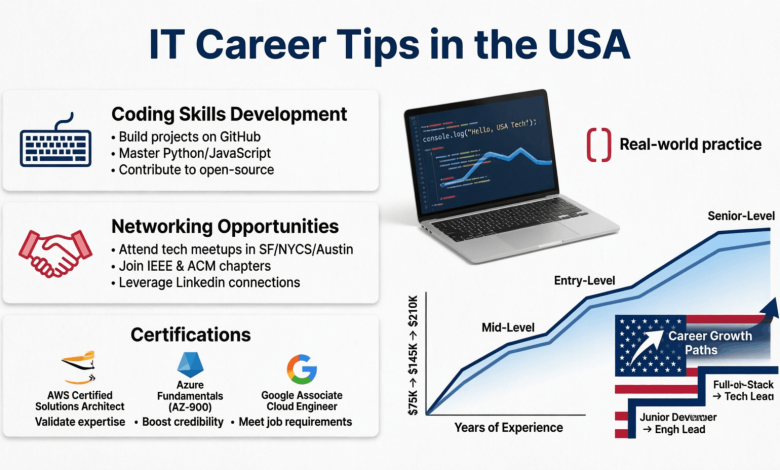
AWS certification is still the fastest single credential for moving from a mid-level salary offer to a senior one. The AWS Solutions Architect certification, in particular, signals to U.S. employers that you can handle real infrastructure at production scale.
Other technical areas with strong demand include:
- React and Node.js for web development roles
- Kubernetes and Docker for DevOps and cloud positions
- SQL and Python for data roles
- Linux administration for systems and security work
- Terraform and infrastructure as code for cloud engineering
Soft Skills That Remote Employers Prioritize
Here is where most international candidates underestimate the competition. American remote employers do not just need someone who can write code. They need someone who can communicate clearly in async environments, manage their own time without supervision, and flag problems before they become blockers.
Written communication is especially critical. Most remote teams run on Slack, Jira, and email threads. If you can write a clear status update, a well-structured bug report, or a concise pull request description, you will stand out in ways that purely technical candidates cannot match.
Time zone overlap matters too. Many U.S. companies prefer candidates who can be online during at least four to five hours of the U.S. East Coast or Pacific workday. If you are in a region with a large time difference, make it clear in your application that you can accommodate overlap hours.
How to Build a Portfolio That U.S. Employers Actually Notice
Your resume tells a story. Your GitHub proves it. For Drovenio remote IT jobs in the USA, your portfolio is the single most important asset you can build before you start applying.
What Your GitHub Profile Needs
Three to five substantial projects pinned to the top of your profile. Each one should have a clear README that explains what the project does, what problem it solves, what tech stack it uses, and how to run it locally.
Avoid tutorial projects. Employers see hundreds of to-do app clones and weather widgets. Build something that solves a real problem, even a small one. A tool that automates a tedious workflow, a web scraper that pulls data your local community actually finds useful, or a small SaaS prototype all carry more weight than a completed Udemy course certificate.
If you are just starting out and have nothing to show yet, build these five projects in order:
- A REST API with authentication using Python and FastAPI
- A full-stack CRUD app with a React front end and Node.js backend
- An automated data dashboard pulling from a public API
- A command-line tool that solves a specific personal workflow problem
- A deployment pipeline using GitHub Actions and a cloud provider of your choice
Your Resume for Remote U.S. Roles
Applicant tracking systems scan resumes before a human ever reads them. Use clear section headers, standard fonts, and keywords that match the job description directly. Avoid creative formatting, graphics, or multi-column layouts. They confuse automated parsing systems.
In the experience section, lead every bullet point with a measurable result. “Reduced API response time by 40% through query optimization” is stronger than “Worked on backend performance improvements.” U.S. hiring managers read dozens of resumes in a single session. Numbers stop the scroll.
Keep your resume to one page if you have fewer than five years of experience. Two pages are acceptable for senior candidates with substantial project history.
How to Apply for Drovenio Remote IT Jobs in the USA Step by Step
The application process for remote U.S. roles is more competitive than most candidates expect. A structured approach significantly improves your conversion rate from application to interview.
Step one: identify ten to fifteen roles that match your actual current skills, not your aspirational ones. Applying to senior roles before you have the portfolio to back them up wastes time you could spend on roles you are genuinely competitive for.
Step two: read the job description carefully and note every technical requirement. Then rewrite your resume summary and skills section to mirror that language naturally. Do not copy-paste the job description. Rephrase requirements as demonstrated abilities.
Step three: write a short cover note of three paragraphs maximum. Open with something specific about the company, like a product they recently launched or a technology shift they are clearly making. Explain in one paragraph why your skills fit what they are building. Close with a single sentence about your availability and time zone overlap.
Step four: apply through the company’s official career page rather than aggregator sites when possible. Your application lands directly in their ATS and does not compete with recruiter-filtered submissions.
Step five: connect with the hiring manager or a team member on LinkedIn within 24 hours of applying. Send a short, direct message that references the role and adds one specific detail about why you are interested. Keep it under five sentences.
Step six: follow up once, seven days after applying if you have heard nothing. One polite follow-up email is professional. More than one becomes noise.
Salary Ranges for Drovenio Remote IT Jobs in the USA
Pay varies widely by role, experience, and how you structure your engagement. Understanding the numbers before you negotiate puts you in a much stronger position.
Entry-level IT support and junior developer roles typically pay between $20 and $40 per hour on a contract basis. That works out to $40,000 to $80,000 annually at full-time hours, which already exceeds local salaries in most countries where remote workers are based.
Mid-level positions in software development, cloud engineering, and data science generally land between $70,000 and $120,000 per year. Your certification level, portfolio depth, and specialization all push this number up or down.
Senior roles and specialists in AI engineering, cloud architecture, and cybersecurity regularly reach $130,000 to $180,000. At this level, your negotiating position depends almost entirely on demonstrable results, not years of experience on paper.
Freelance contractors can sometimes exceed full-time equivalent pay by 20 to 30 percent because they absorb their own benefits costs. If you are working with multiple U.S. clients simultaneously, a $60 to $100 per hour rate is realistic for specialized work in cloud, AI, or security.
A Python or AWS certification can increase your initial offer by $10,000 to $20,000 immediately. If you are deciding how to spend the next three months of study time, that is a number worth taking seriously.
Common Mistakes That Cost Remote Candidates Real Opportunities
Most applications fail for reasons that have nothing to do with technical skill. These patterns show up repeatedly among candidates who are stuck in the apply-and-wait cycle.
Applying to every job listed. Spray-and-pray applications produce weak, unthoughtful submissions. Hiring managers can tell when a resume was not tailored to their role. Focus on ten to fifteen roles at a time and personalize each one properly.
Using a generic LinkedIn profile. Your LinkedIn headline should not say “Software Developer.” It should say something like “Python Developer | AWS Certified | Available for Remote U.S. Roles.” Specificity attracts the right inbound attention.
Ignoring async communication norms. Many international candidates are used to communicating in real time. Remote U.S. teams often communicate asynchronously across time zones. Get comfortable writing thorough, self-contained messages that do not require an immediate response to move things forward.
Underpricing as a strategy. Some candidates lower their rate to increase their chances of getting hired. This usually backfires. U.S. employers associate unusually low rates with low-quality work. Research market rates and price within 10 to 15 percent of what a mid-level U.S. candidate would charge for the same role.
Skipping interview preparation. Most remote tech interviews include a technical screening, a take-home project, and one or two behavioral rounds. Practice on platforms like LeetCode for algorithmic questions and prepare clear answers to behavioral questions using specific examples from your actual work history.
Tools and Platforms to Find Drovenio Remote IT Roles
Job boards and platforms are not all equal. Some consistently list high-quality remote roles from U.S. companies. Others are full of low-paying gig work dressed up to look like career opportunities.
LinkedIn is the most effective single platform for remote IT job searching. Change your location filter to “United States” and enable the remote filter. Following hiring managers at target companies and engaging with their posts increases your visibility before you apply.
Wellfound (formerly AngelList Talent) lists startup roles in the U.S. and is particularly strong for developers who want equity alongside salary.
We Work Remotely and Remote.co both list remote-specific roles with strong filters for IT and development positions.
Toptal and Gun.io are harder to get into because they vet candidates before introducing them to clients. Getting accepted takes time but dramatically improves pay rates and client quality.
Drovenio.io itself aggregates job leads and career resources specifically for the U.S. remote IT market. Use it alongside LinkedIn rather than instead of it.
What the Best Remote IT Candidates Do Differently
The professionals who consistently land strong remote roles with U.S. companies share a few specific habits that most job seekers overlook.
They invest in their online presence before they need it. A strong LinkedIn profile, active GitHub, and occasional writing about technical topics on platforms like Medium or Dev.to builds recognition over time. When a recruiter searches for your skills, they find someone with a track record rather than an empty profile.
They specialize early. Generalists compete with everyone. Specialists compete with a much smaller pool. If you are a Python developer who also knows AWS and has built two production machine learning pipelines, you are a different candidate than a Python developer alone. The more specific your skill set, the fewer people you are competing with for each role.
They treat certifications as tools, not trophies. Getting an AWS certification to display on your resume without understanding the underlying concepts will not get you past a technical interview. Get certified because you actually learned the material and can speak to it confidently.
They communicate in writing the way they would in code. Clean, structured, unambiguous. U.S. managers reading applications from dozens of countries quickly learn to trust candidates who write clearly and distrust those who write vaguely. Every written interaction is an audition.
Frequently Asked Questions About Drovenio IT Career Tips USA
What exactly is Drovenio and how does it help with IT jobs in the USA?
Drovenio is a platform and content resource that helps global IT professionals understand the U.S. remote job market. It connects skilled candidates with American companies hiring remotely, and provides guidance on the skills, application strategies, and salary ranges that actually move careers forward without relocation.
Do I need to be located in the USA to get remote IT jobs through Drovenio?
No. Remote IT roles with U.S. companies are available to professionals globally, including candidates in Pakistan, India, Nigeria, the Philippines, and beyond. The requirement is skills, reliable internet, and the ability to overlap with U.S. work hours for at least part of the day.
What skills do I need to start applying for Drovenio remote IT jobs in the USA?
The most in-demand skills are Python, JavaScript, cloud platforms such as AWS or Azure, and cybersecurity fundamentals. Entry-level candidates can start with IT support or junior development roles while building toward more specialized positions. Communication and async work habits are just as important as technical ability.
How much can I earn working remotely for U.S. tech companies?
Entry-level remote IT roles typically pay between $40,000 and $80,000 per year on a contractor basis. Mid-level developers and cloud engineers earn $70,000 to $120,000. Senior specialists in AI, cloud architecture, and cybersecurity regularly reach $130,000 to $180,000. Freelance rates can push higher depending on specialization.
Do I need a U.S. work visa for remote IT jobs?
No. Remote contractor roles with U.S. companies generally do not require a visa because you are not physically working in the United States. You will typically work as an independent contractor and manage your own local tax obligations. Always confirm the structure of any contract before signing, and check your local regulations around foreign income.
Is AWS certification worth getting for remote U.S. roles?
Yes. AWS certification is one of the fastest ways to increase your starting salary offer. The AWS Solutions Architect certification, in particular, signals production-level cloud competency to U.S. hiring managers and can raise initial offers by $10,000 to $20,000. Pair it with real project experience for maximum impact.
How do I stand out against hundreds of applicants for the same remote role?
Tailor every application to the specific job description. Build a GitHub portfolio with three to five substantial projects. Write a cover letter that references something specific about the company rather than restating your resume. Connect with the hiring manager on LinkedIn after applying. Follow up once, professionally, if you hear nothing after a week.
What platforms should I use to find remote IT jobs for U.S. companies?
LinkedIn with the remote filter set to United States is the most effective starting point. Supplement with We Work Remotely, Remote.co, Wellfound, and Drovenio.io. For higher-end contracts, consider applying to Toptal or Gun.io once you have a solid portfolio and at least two years of experience.
What is the biggest mistake international candidates make when applying for U.S. remote IT roles?
Applying to too many roles without tailoring their applications, and underpricing their services to seem more attractive. Both strategies tend to backfire. U.S. employers associate low rates with low quality, and generic applications do not pass ATS screening. Focus on fewer, better-matched roles and price your skills at market rate.
Can beginners with no professional experience get remote IT jobs through Drovenio?
Yes, at the entry level. Junior IT support roles and junior developer positions are available to candidates who can demonstrate skills through a portfolio rather than a job history. Build real projects, get one certification relevant to your target role, and apply for roles that explicitly say “entry-level” or “junior.” Expect to spend six to twelve months building your foundation before applying seriously.
Your Next Move in the Remote IT Job Market
The path to a remote IT career with U.S. companies is specific and learnable. Pick one technical specialization, build a portfolio that proves your ability in that area, price your skills at market rate, and apply to roles strategically rather than broadly. Drovenio IT career tips USA point consistently in the same direction: the professionals who get hired are the ones who prepare seriously, communicate clearly, and show up with proof rather than promises.
If you are ready to go deeper, check out our guide on remote work tools that boost productivity for distributed teams, or read our breakdown of how to negotiate your first remote tech contract with a U.S. company.