
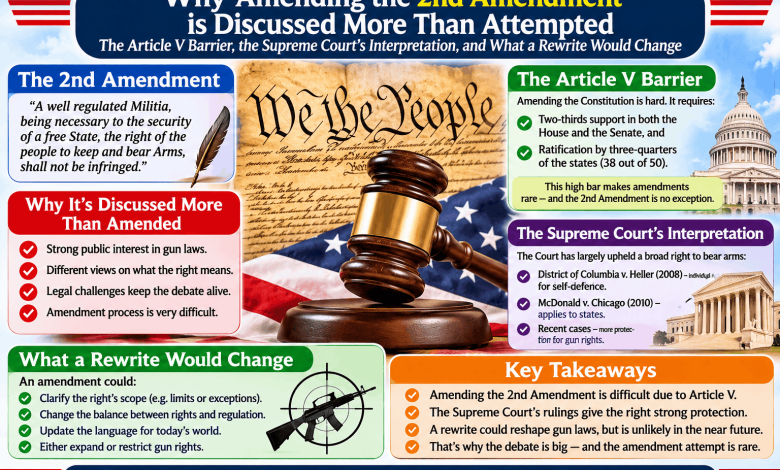
Amending the 2nd Amendment is discussed far more often than it is attempted, and the reason is structural. Article V of the US Constitution requires two-thirds majorities in both houses of Congress to propose an amendment, followed by ratification by three-quarters of the states, which is 38 out of 50 . Only 27 amendments have been ratified since 1789, and the last one took more than two centuries to complete . At the same time, the Supreme Court has expanded the individual right to bear arms through District of Columbia v. Heller (2008) and New York State Rifle & Pistol Association v. Bruen (2022), which has narrowed the space for legislative action . This guide explains the legal landscape, the procedural barrier, and what a rewrite would and would not change.
The Current Legal Interpretation: An Individual Right
Any discussion of amending the Second Amendment has to start with what the courts currently say it means. For most of American history, the Supreme Court addressed the Second Amendment only occasionally. That changed in 2008.
In Heller, the Court held that the Second Amendment protects an individual right to possess a firearm unconnected with service in a militia, and to use that arm for traditionally lawful purposes such as self-defence within the home . The decision was reaffirmed and applied to the states in McDonald v. City of Chicago (2010).
The more recent and more consequential decision is Bruen (2022). The Court established a new test: for a firearm regulation to be constitutional, the government must demonstrate that it is consistent with the nation’s historical tradition of firearm regulation . This “history and tradition” test has led to a flood of challenges against gun restrictions and has relaxed regulations regarding high-capacity magazines, age limits and more .
The practical effect is that legislatures seeking to pass gun control measures have seen their options shrink sharply. The ABA Journal notes that “no area of constitutional law is generating more litigation than the Second Amendment,” and that lower courts have “come to conflicting conclusions on virtually every consequential Second Amendment issue” . This is the context in which amending the Second Amendment is discussed: as a way to override the Court’s interpretation and restore legislative flexibility.
The Procedural Barrier: Article V
The Constitution’s amendment process is set out in Article V. There are two routes.
The congressional route. Congress can propose an amendment with a two-thirds majority in both the House and the Senate. The amendment then must be ratified by three-quarters of the states, which is 38 out of 50 . This is the route used for all 27 existing amendments.
The convention route. Two-thirds of state legislatures (34 states) can call a constitutional convention to propose amendments . Any amendments produced by the convention must then be ratified by three-quarters of the states. This route has never been used .
The last amendment to be ratified was the 27th, which was proposed in 1789 but not ratified until 1992, a gap of more than two centuries . That history illustrates how difficult the process is even for uncontroversial measures.
What a Rewrite Would and Would Not Change
Even if an amendment were passed, it would not settle the gun debate. It would shift it.
The current conflict is partly about the text of the Constitution and partly about what that text means in practice. An amendment with language like “reasonable regulations” would move the argument from “does the Constitution allow this?” to “what is reasonable?” That is a different question, but not a simpler one. Courts would still interpret the new language, and the same political divisions would re-emerge in a different forum.
A proposal in a Hawaii Senate resolution from 2018 illustrates the range of views. It urged Congress to consider whether the Second Amendment should be repealed or amended “to clarify that the right to bear arms is a collective, rather than individual, constitutional right” . That is a direct attempt to reverse Heller. But the resolution is a statement of opinion, not a live amendment.
The Bruen test has also created a practical problem that an amendment would not automatically solve. The Court’s reliance on historical analogues from 1791 means that modern regulations with no historical precedent face an uphill struggle. An amendment could override that, but it would replace one interpretive battleground with another.
Frequently Asked Questions
Can the 2nd Amendment be amended?
Yes, in theory. Article V requires a two-thirds majority in both houses of Congress and ratification by three-quarters of the states (38 out of 50) . The alternative is a constitutional convention called by two-thirds of state legislatures, which has never been used . In practice, achieving those majorities on a subject as polarised as gun rights is extremely difficult.
Why is it so hard to amend the 2nd Amendment?
The procedural threshold is deliberately high. Two-thirds majorities in both houses of Congress are rare on any subject, and 38 state ratifications require broad national consensus. The last amendment was ratified in 1992, and it had been proposed in 1789 . On gun rights, the political divisions are deep and the Supreme Court has entrenched an individual-right interpretation that any amendment would have to overcome.
What has the Supreme Court said about the 2nd Amendment?
In Heller (2008), the Court held that the Second Amendment protects an individual right to possess a firearm for lawful purposes such as self-defence in the home . In Bruen (2022), the Court established that gun regulations must be consistent with the nation’s historical tradition of firearm regulation . In Rahimi (2024), the Court upheld a federal law disarming people subject to domestic violence restraining orders, clarifying that the historical test requires a “relevantly similar” law rather than a “historical twin” .
Has anyone proposed amending the 2nd Amendment?
Yes. A 2018 Hawaii Senate resolution urged Congress to consider repealing or amending the Second Amendment to clarify that the right to bear arms is a collective rather than individual right . This was a statement of legislative opinion, not a formal amendment proposal. There is no active congressional effort to amend the Second Amendment in the search results.