Definition of Neanderthal: The Species, the Insult and Why the Two Are Different

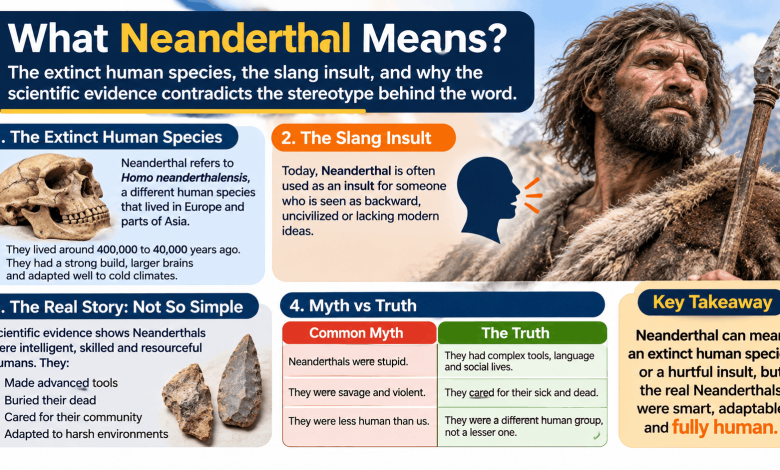
The definition of Neanderthal splits into two distinct meanings. The first is scientific: a member of an extinct species of human, Homo neanderthalensis, who lived in Europe and western Asia between roughly 200,000 and 30,000 years ago . The second is a slang insult: a crude, old-fashioned or reactionary person, especially a man . The two meanings share a spelling but not a judgement. This guide explains the scientific definition, the history of the insult, and the evidence that has made the scientific picture far more complex than the insult suggests.
The Scientific Definition: Homo neanderthalensis
Neanderthals are our closest extinct human relatives . They lived across Europe, northern Africa and western Asia, and the most recent estimates place their extinction around 30,000 years ago, though the dating is debated .
Physically, they were stockier and more heavily built than modern humans, with thick, short lower arm and leg bones that conserved body heat in cold climates . Their skulls had a large middle face, angled cheekbones and a very large nose, adaptations for warming and humidifying cold, dry air . Their brains were as large as ours, and often larger relative to their body size .
The first specimen, Neanderthal 1, was discovered in 1856 in the Neander Valley in Germany. The name comes from that valley: Neander was a German hymn writer, and thal means valley in German . The species was formally named Homo neanderthalensis in 1864 .
The Slang Definition: A Crude or Backward Person
The insult is not new. Vocabulary.com notes that around 1926, “neanderthal” became popular British slang for a “big, brutish, stupid person” . Collins Dictionary defines the disapproving use as describing someone whose ideas or behaviour are “very old-fashioned and uncivilized” . Merriam-Webster’s learner’s definition is blunt: “a man who is stupid and rude,” or “a person who has very old-fashioned ideas and who does not like change” .
A 2023 academic analysis of the term in online media found that it is used to disparage violence, antisocial behaviour and sexist masculinity. One Scottish judge described an assault as “the sort of behaviour you’d expect from Neanderthal cave-dwellers.” In relationship writing, “Neanderthal men” are portrayed as misogynistic and out of step with modern values .
The insult works because it implies that the person being described is less evolved. That implication is scientifically unjustified, which is the irony the next section addresses.
What the Science Actually Says About Neanderthals
The insult relies on a picture of Neanderthals as primitive and brutish. The fossil and archaeological record does not support that picture.
Neanderthals made and used a diverse set of sophisticated tools, controlled fire, lived in shelters, made and wore clothing, and were skilled hunters of large animals . They used the Mousterian stone tool industry, which involved preparing a stone core so that flakes of a predetermined shape could be removed, a technique more advanced than earlier tool traditions . They hunted with thrusting spears, and their bones show a high frequency of fractures similar to those of rodeo riders, suggesting close contact with dangerous animals .
There is evidence that Neanderthals deliberately buried their dead and occasionally marked graves with offerings such as flowers . No earlier human species is known to have practised this symbolic behaviour.
Perhaps most significantly, they interbred with modern humans. Most living people outside Africa have inherited about 1% to 2% of their DNA from Neanderthals, and a 2024 study in Science found that Neanderthals also received up to 10% of their genome from modern humans, with evidence of mating episodes more than 200,000 years ago and again around 105,000 to 120,000 years ago . The boundary between “us” and “them” is far blurrier than the insult implies.
Why the Insult Persists Despite the Evidence
The insult is not really about Neanderthals. It is about using a prehistoric name as a shorthand for backwardness. The name has become detached from the science, the way “Trojan” can mean a computer virus rather than an ancient city.
The academic analysis of the term notes that calling someone a Neanderthal is “a way of disparaging qualities deemed unfit for the modern world” . The insult says more about the speaker’s contempt for the target than about any actual Neanderthal.
The practical point for a writer or speaker is this: the word is available as an insult, and its meaning will be understood. But using it that way repeats a stereotype that the evidence does not support. If you mean “crude” or “old-fashioned,” those words are more precise and less misleading.
Frequently Asked Questions
What is the simple definition of Neanderthal?
A Neanderthal is a member of an extinct species of human, Homo neanderthalensis, who lived in Europe and western Asia until about 30,000 years ago . In informal disapproving use, it means a crude, old-fashioned or reactionary person, especially a man .
Where does the word Neanderthal come from?
It comes from the Neander Valley in Germany, where the first specimen was discovered in 1856. The valley was named after Joachim Neander, a German hymn writer. Thal is an old spelling of Tal, meaning valley .
Why is calling someone a Neanderthal offensive?
It equates a person with an extinct species that the insult frames as primitive and brutish. The implication is that the person is less evolved, less intelligent or less civilised. The scientific evidence does not support that framing, but the insult relies on the stereotype rather than the evidence .
Were Neanderthals actually primitive?
No, in the sense the insult implies. They made sophisticated tools, controlled fire, wore clothing, hunted large animals, buried their dead and interbred with modern humans. Their brains were as large as ours. The insult reflects a stereotype, not the archaeological record .