

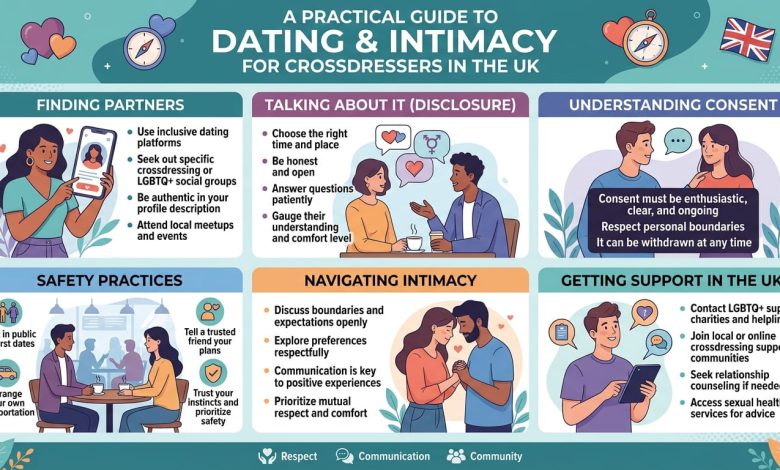
Sex for crossdressers is a search that usually sits on top of a different question: how do I find someone who accepts this part of me, and how do I talk about it without ruining the moment? The answer is not a list of techniques. It is a set of practical skills: knowing what you want, communicating it clearly, choosing the right people, and staying safe. This guide covers the dating and relationship side of crossdressing for adults in the UK, with an emphasis on consent, honesty and emotional wellbeing.
Start With What You Actually Want
Before you look for a partner, it helps to be clear about what you are looking for. Crossdressing can be connected to sexual pleasure, to gender identity, to relaxation, to performance, or to none of those things. Sometimes it is several at once.
The practical questions to ask yourself are these. Do you want a sexual partner, a romantic partner, or both? Do you want someone who participates in the dressing, or someone who accepts it as part of you? Do you want it to be private, or are you comfortable being seen? Do you want a one-off experience, or a relationship where this is an ongoing part of your life?
There is no correct answer. But knowing your own answer makes the next steps much easier, because you will be looking in the right places and asking for the right things.
Dating and Meeting People
There are several routes, and each has different trade-offs.
Mainstream dating apps. Apps like OkCupid and Feeld allow you to state your interests openly in your profile. OkCupid has historically been more inclusive of diverse gender expressions, and Feeld is explicitly designed for people exploring non-traditional relationships and identities. Being upfront in your profile filters out people who are not interested before you invest time in a conversation.
Specialist communities. There are online forums and social groups for crossdressers and their partners. These spaces can be useful for advice and friendship, but they are not primarily dating sites. Treat them as communities first and dating opportunities second.
In-person social events. In larger UK cities there are social groups and events for crossdressers and trans people. These are usually alcohol-free or low-pressure social spaces rather than hookup events. They are a way to meet people who understand the context without having to explain it from scratch.
Sex-positive events. Some cities have club nights and socials that are explicitly welcoming of diverse gender expression. These are adult environments with clear consent norms, and they suit people who want to explore in a space where the etiquette is already established.
Whichever route you choose, the principle is the same: be honest about what you are offering and what you are looking for. The people who are interested will find you. The people who are not will self-select out, which saves everyone time.
How to Talk About Crossdressing With a Partner
The conversation is usually the hardest part, and it is the part that determines whether the experience is good or bad. A few principles help.
Choose the right moment. Do not raise it in the middle of a sexual encounter with someone who does not know. Do not raise it in an argument. Choose a calm, private moment when neither of you is rushed.
Be specific about what it means to you. “I like wearing women’s clothes sometimes” is vague. “I like to dress at home, and I would like you to be there sometimes, but I do not want to go out in public” is specific. Specificity reduces fear, because the other person knows what they are being asked.
Separate the dressing from the sex. Some partners are comfortable with the dressing but not with sexual play involving it, or the other way round. Be clear about which parts you are asking for, and be prepared to hear a partial yes.
Give them time. A partner may need to think about it, ask questions, or read something. A rushed answer is not a real answer. If they say they need time, that is not a rejection.
Accept a no. If a partner is not comfortable, that is their right. Pressing the issue, or dressing without their knowledge after they have said no, is a breach of trust. The honest route is to accept the boundary and decide whether the relationship meets your needs.
Consent, Safety and the Law in the UK
Consent is the foundation of any sexual encounter, and it applies here exactly as it does anywhere else. Everyone involved must be an adult, must be capable of consenting, and must be free to change their mind at any point. Being crossdressed does not change that.
There are some specific safety points worth knowing.
Meeting strangers. If you meet someone from an app or a forum, meet in a public place first. Tell a friend where you are going. Do not send intimate images to someone you have not met, because they can be shared or used for sextortion. The National Crime Agency warns that organised crime groups target adults as well as teenagers, and the advice is not to pay, to stop communicating, and to report it.
Photography and recording. Never photograph or record someone without their explicit consent, and never allow yourself to be recorded unless you are certain the footage will not be shared. Under section 66B of the Sexual Offences Act 2003, sharing an intimate image without consent is a criminal offence carrying up to two years in prison. The Crime and Policing Act 2026 strengthened the framework with a 48-hour takedown requirement.
Discretion and blackmail. Some people keep their crossdressing private, which makes them vulnerable to threats. If someone threatens to expose you unless you pay or comply, that is blackmail, which is a criminal offence. Report it to the police. The Revenge Porn Helpline (0345 6000 459) can help if images are involved.
Health. Condoms and dental dams protect against sexually transmitted infections. Free STI testing is available through NHS sexual health clinics, and many offer postal testing kits. Regular testing is part of looking after yourself and your partners.
Emotional Wellbeing and Support
Crossdressing can be a source of joy and a source of stress, sometimes in the same week. Shame, secrecy and fear of rejection are common, and they are not a sign that something is wrong with you. They are a sign that you are navigating something that society does not always make easy.
Support is available. Mind (mind.org.uk) provides information on mental health and can signpost to local services. The Beaumont Society is a UK organisation for the transvestite and crossdressing community, offering support and social contact. The Gender Trust and Trans Unite provide information and community connections. Samaritans (116 123, free, 24 hours) is there if you are struggling and need to talk.
A therapist who is experienced in gender and sexuality can be useful if you want to work through shame, relationship issues or questions about identity. The British Association for Counselling and Psychotherapy (BACP) has a directory of accredited therapists, and you can filter for experience in gender and sexual diversity.
Frequently Asked Questions
How do I find a partner who accepts crossdressing?
Be upfront in your dating profile or in early conversations. Use apps that allow you to state your interests, such as OkCupid or Feeld. Look for specialist social groups and sex-positive events where diverse gender expression is welcomed. The people who are interested will respond, and the people who are not will filter themselves out.
How do I tell my partner about crossdressing?
Choose a calm, private moment and be specific about what it means to you and what you are asking for. Separate the dressing from the sex, and give your partner time to think. Accept a partial yes or a no, and do not dress without their knowledge after they have set a boundary.
Is crossdressing legal in the UK?
Yes. Crossdressing is legal in the UK. The law protects you from discrimination under the Equality Act 2010 in some circumstances, and it protects your intimate images from being shared without consent under the Sexual Offences Act 2003. Consent, age and privacy are the legal issues that matter in any sexual encounter.
Where can I get support as a crossdresser in the UK?
The Beaumont Society, the Gender Trust and Trans Unite offer community and support. Mind provides mental health information. Samaritans is available on 116 123, free, 24 hours a day. The BACP directory can help you find a therapist experienced in gender and sexual diversity.
