
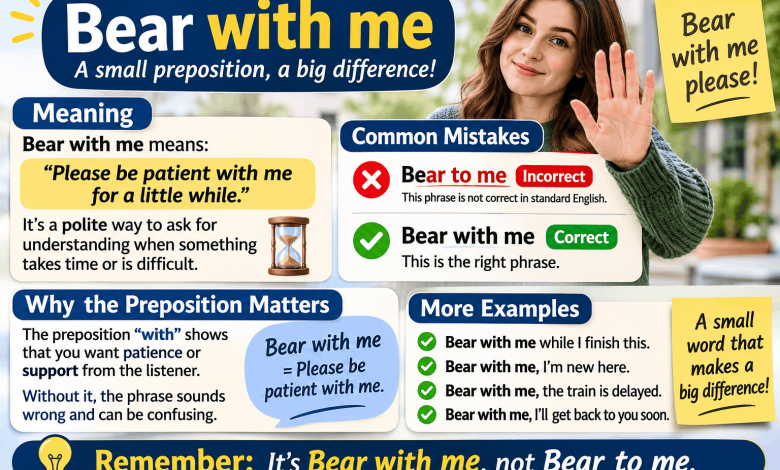
“Bear to me” is not a standard English phrase. If you have seen it written or heard it spoken, it is almost certainly a mistake for “bear with me”, which means “please be patient with me” or “wait for me while I do something” . The confusion arises because “bear” and “bare” sound identical, and because “to” feels like a natural preposition when you are directing a request at someone. But “bear to me” has no established meaning in British or American English. This guide explains the correct phrase, why the error happens, and the one context where “bear” and “to” can legitimately appear together.
The Correct Phrase: Bear With Me
The idiom you are looking for is “bear with me”. The BBC’s Learning English service defines it simply: you say it when you want someone to be patient and wait while you do something else . TheFreeDictionary describes it as a request to “remain patient and attentive, especially during a lengthy or problematic situation” .
Examples of correct usage:
- “Bear with me while I find the file.”
- “If you could just bear with me for a moment, I will find the address.”
- “Please bear with us during the update.”
The phrase is standard in both British and American English. There is no spelling difference between the two varieties . It is accepted in formal writing, business emails and everyday conversation.
Why People Say “Bear to Me” by Mistake
The error comes from two sources.
The homophone problem. “Bear” and “bare” are pronounced identically. Many people write “bare with me” when they mean “bear with me.” The word “bare” means to uncover or expose, so “bare with me” would literally mean “undress with me,” which is not the intended meaning . The same confusion can lead people to write “bear to me” when they are uncertain which preposition follows.
The preposition instinct. When you direct a request at someone, “to” feels natural. You say “come to me,” “speak to me,” “listen to me.” So “bear to me” feels like it should mean “be patient towards me.” But English idiom does not work that way. The fixed phrase is “bear with,” not “bear to” .
A language learning site that addresses this exact question states plainly: “Bear to me is not standard English” . The preposition is “with.”
The One Legitimate Use of “Bear” and “To”
There is a context where “bear” and “to” appear together, but it is not the phrase “bear to me.”
The verb “bear” can mean “to carry” or “to endure.” In a sentence like “She bore the news to me,” the “to” belongs to the verb “bring” or “carry,” not to “bear” as an idiom. You might say “He bore witness to me” or “The cost was borne by me.” But these are different constructions. They are not the phrase “bear to me” as a request for patience.
If you are writing and you are unsure, the test is simple. If you mean “be patient,” the phrase is “bear with me.” If you mean “carried to me” or “endured for me,” you are using “bear” as a regular verb, and the sentence will make that clear from context.
Bear vs Bare: The Related Mistake
The “bear to me” error is often part of a wider confusion between “bear” and “bare.” The table below sets out the difference.
| Phrase | Meaning | Correct? |
| Bear with me | Please be patient | Yes |
| Bare with me | Please undress with me (literal) | No, usually a mistake |
| Bear to me | No established meaning | No |
| Bare to me | No established meaning | No |
The word “bear” comes from the Old English beran, meaning to carry or endure. “Bare” comes from bær, meaning naked or uncovered . They are different words with different histories, and only “bear” belongs in the phrase about patience.
How to Use the Phrase Correctly
If you want to ask for patience, use “bear with me”. That is the form that will be understood everywhere English is spoken.
If you are writing a formal email or a business message, “bear with me” is acceptable, though some style guides suggest alternatives like “please allow me a moment” or “your patience is appreciated” for a more polished tone . But the phrase itself is not wrong in formal contexts. It is simply slightly informal in flavour.
If you are speaking, the contraction is common: “bear with me a sec” or “bear with me a moment.” The phrase is flexible, but the preposition is fixed.
Frequently Asked Questions
Is “bear to me” correct?
No. “Bear to me” is not standard English. The correct phrase is “bear with me”, meaning “please be patient with me” . The preposition is “with,” not “to.”
What does “bear with me” mean?
It means “be patient with me” or “wait for me while I do something.” You use it when you need someone to wait during a delay or a complicated explanation .
Why do people say “bear to me” instead of “bear with me”?
Because “to” feels natural when directing a request at someone, and because “bear” and “bare” are homophones that cause confusion. The error is a mix-up of preposition and spelling, not a recognised variant .
Is “bare with me” ever correct?
No, not in the sense of asking for patience. “Bare with me” literally means “uncover with me” or “undress with me,” which is almost never what the writer intends. The correct spelling for the patience phrase is always “bear” .