

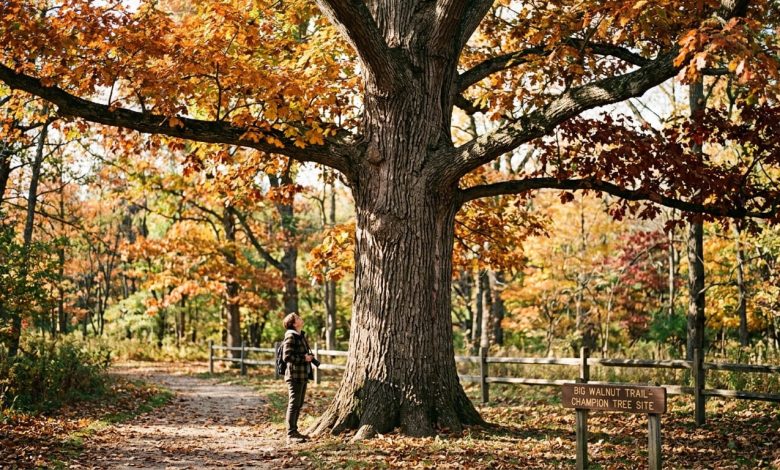
Drive east on Africa Road past Alum Creek State Park and you’ll pass a cottonwood tree with a trunk wider than most living rooms. Most people zoom right by it. That tree happens to hold the state record for its species, and it’s just one entry in Ohio’s long list of champion trees near Lewis Center, Ohio. This guide breaks down which trees hold the titles, why they matter, and where you can go see them for yourself.
You’ll get the actual measurements behind the records, the story of how Ohio tracks its biggest trees, and a practical list of spots near Lewis Center where oversized oaks, cottonwoods, and walnuts still stand. No fluff, just what a local nature lover would want to know before heading out.
What Actually Makes a Tree a “Champion” in Ohio
A champion tree isn’t just the tallest one you can find. Ohio’s Champion Tree Program, run through the Ohio Department of Natural Resources (ODNR) Division of Forestry, ranks trees using a points system that rewards overall size, not just height.
The formula is simple once you see it written out:
Points = trunk circumference (inches) + height (feet) + one-quarter of the average crown spread (feet)
A short, thick-trunked tree with a wide canopy can beat out a slender, towering one. That’s why a stubby-looking oak sometimes outranks a much taller tree standing right next to it. The program only compares trees against others of the same species, so an oak competes with oaks, not with sycamores or cottonwoods.
ODNR’s program has tracked Ohio’s biggest trees since the 1950s, and it depends almost entirely on volunteers. A Newark-based tree hunter named Marc DeWerth started the Big Trees Ohio group a few years back and has since logged more than a thousand trees statewide, feeding measurements directly to ODNR forester Alistair Reynolds for verification.
The Record-Setting Cottonwood at Alum Creek State Park
The clearest champion tied directly to the Lewis Center area is an eastern cottonwood growing at Alum Creek State Park, near the corner of Africa Road and Cheshire Road, just east of town. Reported measurements put it at roughly 380 inches in circumference (that’s over 31 feet around), about 122 feet tall, with a crown spread near 103 feet. Run those numbers through the scoring formula and you land close to 527 points, enough to hold the state title for its species.
That combination of a massive trunk, real height, and a wide crown is exactly what the Champion Tree Program rewards. It’s also a good reminder that “champion” doesn’t mean rare. Eastern cottonwoods aren’t unusual in Ohio; this one is simply the biggest known example.
If you want to see it, park at one of the Alum Creek State Park lots and walk the shoreline trails near the dam area. Floodplain trees like this one tend to grow largest close to water, where moisture and open sunlight give them room to spread out.
Other Notable Big Trees Reported Near Lewis Center
The cottonwood isn’t the only impressive tree in the area. Delaware County’s mix of glacial soil, river corridors, and protected parkland has produced several other standout specimens.
- A black walnut on private land near Lewis Center, reported at around 211 inches in circumference, 103 feet tall, with a crown spread over 100 feet. That combination puts it in the neighborhood of 340 points, a serious contender for its species.
- White oaks in Highbanks Metro Park, known locally for their broad, spreading crowns and thick, furrowed bark. Some specimens near the Olentangy River corridor are estimated at well over a century old.
- American sycamores along the Olentangy and Alum Creek watersheds, a species that regularly produces some of Ohio’s largest recorded trunks statewide.
Because many of these trees sit on private property or haven’t gone through full ODNR verification, treat the specific numbers as reported estimates rather than official state records. Only trees measured and confirmed through ODNR’s process make the official registry.
Where to Go Looking Near Lewis Center
You don’t need a permit or a guide to go tree hunting around Delaware County. A few spots consistently turn up the biggest specimens:
- Alum Creek State Park – home to the champion cottonwood, plus a mix of sycamore and oak along the shoreline.
- Highbanks Metro Park – old-growth sections with mature white oak, beech, and hickory along the Olentangy River bluffs.
- Preservation Parks of Delaware County properties – several preserves protect older woodlots that never got cleared for farmland.
- Older cemeteries and long-established neighborhoods – Preservation Parks notes that some of the county’s biggest trees turn up in places like this rather than formal trails, since they were often left standing when the surrounding land was developed.
Floodplain species like cottonwood and sycamore tend to grow largest right along the water, though storms and ice can damage the most exposed trees near open banks. The biggest, healthiest specimens are often set back slightly from the shoreline.
How to Nominate a Tree Yourself
Spotted something that looks bigger than anything on this list? Ohio’s Big Tree Program takes nominations from anyone, no forestry degree required.
- Identify the species. A photo of the leaves, bark, and overall shape helps confirm what you’re looking at.
- Measure the circumference at 4.5 feet above ground level, known as diameter at breast height.
- Estimate the height and crown spread as closely as you can, or ask a local arborist to help with more precise numbers.
- Note the exact location, including whether the tree sits on public or private land.
- Submit your nomination through the ODNR Big Tree Program with your measurements and photos attached.
A forester typically follows up to confirm the species and measurements before anything gets added to the official registry. If your tree beats the current champion, the old record holder isn’t erased. It stays on record as a former champion, and the new tree takes the title.
Why These Trees Are Worth Protecting
Champion status alone doesn’t give a tree any legal protection, even on public land. Private landowners are encouraged, not required, to preserve their champions. Some local municipalities have added tree preservation rules into their development codes, which can offer indirect protection during construction projects.
That matters more in a place like Lewis Center, where new subdivisions keep expanding into former farmland and woodlots. Builders and planners increasingly leave mature trees standing on purpose, since large shade trees raise property values and cut cooling costs for nearby homes. Protecting a tree during construction means fencing off the root zone and keeping heavy equipment away from the trunk, since compacted soil can slowly kill a tree years after the damage happens.
Beyond the practical value, these trees support wildlife most people never notice. Cavities in old trunks house cavity-nesting birds and bats. Wide canopies host insect populations that feed entire food chains. A single mature oak can support hundreds of caterpillar species alone, feeding songbirds through the summer months.
FAQS
What is the biggest champion tree near Lewis Center, Ohio?
The eastern cottonwood at Alum Creek State Park holds the clearest title tied to the area, with a reported circumference over 380 inches and a total score near 527 points, making it the state champion for its species.
How does Ohio decide which tree is a champion?
Ohio scores trees using circumference in inches, height in feet, and one-quarter of the average crown spread in feet, all added together. The tree with the highest total for its species wins the title.
Can anyone nominate a tree for Ohio’s Champion Tree Program?
Yes. Ohio’s Big Tree Program accepts nominations from residents, students, and visitors. You’ll need a species identification, basic measurements, and the tree’s location submitted through ODNR.
Does champion status protect a tree from being cut down?
No, not automatically. Champion designation doesn’t grant legal protection, even on public land. Some cities include tree preservation rules in their zoning codes, which can offer indirect protection.
What tree species are most common among Delaware County champions?
White oak, eastern cottonwood, American sycamore, silver maple, and black walnut show up most often among the county’s largest reported trees, largely thanks to the area’s river corridors and glacial soil.
Where can I see big trees near Lewis Center without trespassing?
Alum Creek State Park and Highbanks Metro Park both offer public access to areas with mature, oversized trees. Preservation Parks of Delaware County properties are another reliable option.
What happens if a bigger tree is found than the current champion?
The new tree takes the title once ODNR verifies the measurements. The previous champion stays on record as a former title holder rather than being removed from history.
How old are Ohio’s champion trees?
Ages vary widely by species, but many white oaks and cottonwoods in Delaware County are estimated at over a century old, with some local specimens rumored to exceed 200 years.
Is the Ohio Champion Tree Program the same as the National Champion Tree Program?
No, though they’re related. Ohio’s program is run through ODNR and feeds its top entries to the National Champion Tree Program, administered by American Forests, for national-level recognition.
Go Find Ohio’s Living Giants for Yourself
Lewis Center sits right in the middle of some of Ohio’s best big-tree territory, from the record cottonwood at Alum Creek State Park to the old oaks lining the Olentangy River at Highbanks Metro Park. Grab a tape measure and a camera, and you might spot the next name on Ohio’s champion tree registry.
Before you head out, check the current listings on ODNR’s Champion Trees of Ohio page to confirm a title hasn’t changed hands since this was written. And if you’re planning a weekend around it, pair your tree hunt with one of the hiking trails or park guides on reuterings.com to make a full day of it.