

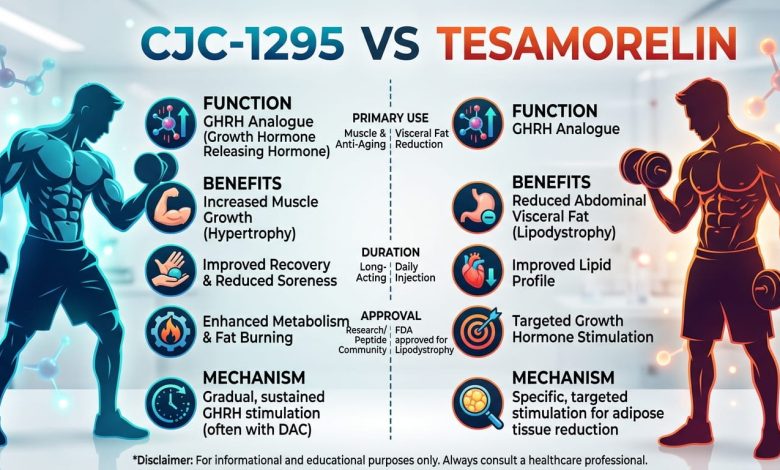
You’ve read about growth hormone peptides in a fitness forum or a wellness clinic’s website, and now two names keep coming up together: tesamorelin and CJC-1295. Both work through a similar pathway in the body, but they differ in regulatory status, how long they stay active, and what kind of evidence backs their use. This comparison breaks down tesamorelin vs CJC-1295 in plain terms, so you understand what separates them before you bring the topic to a doctor.
What Tesamorelin and CJC-1295 Actually Do
Both compounds are synthetic analogs of growth hormone-releasing hormone, or GHRH, the natural signal your pituitary gland uses to release growth hormone. They bind to the same receptor on pituitary cells and prompt the gland to release more growth hormone than it would on its own.
Where they diverge is in their engineering. Tesamorelin includes a modification that protects it from rapid breakdown, extending its activity to roughly 26 minutes compared to about 7 minutes for natural GHRH. CJC-1295 comes in two forms: one with a similar short half-life to tesamorelin, and one with an added drug affinity complex, or DAC, that stretches its half-life out to several days.
Regulatory Status: The Biggest Difference
Tesamorelin, sold under the brand name Egrifta, received FDA approval in 2010 specifically for reducing excess abdominal fat in adults with HIV-associated lipodystrophy. That approval came after large randomized controlled trials showing meaningful reductions in visceral fat.
CJC-1295 has no FDA approval for any use. It’s available primarily through compounding pharmacies and research chemical suppliers, and the clinical evidence behind it comes largely from smaller studies and mechanistic reasoning rather than the kind of large trials tesamorelin has behind it. Anyone considering either compound outside its approved indication should treat that gap in evidence as a real factor, not a technicality.
Comparing Tesamorelin and CJC-1295
| Factor | Tesamorelin | CJC-1295 |
| FDA approval | Yes, for HIV-associated lipodystrophy | No |
| Typical half-life | About 26 minutes | About 30 minutes (no DAC) or several days (with DAC) |
| Evidence base | Large Phase III randomized trials | Smaller studies, mostly Phase I/II |
| Primary studied use | Visceral fat reduction | Broader growth hormone support (studied less rigorously) |
| Availability | Prescription, through licensed providers | Compounding pharmacies, research suppliers |
| WADA status | Prohibited for competitive athletes | Prohibited for competitive athletes |
Why People Compare These Two Peptides
Most people researching tesamorelin vs CJC-1295 fall into one of two groups. Some have a specific medical concern, like visceral fat associated with HIV-related lipodystrophy, where tesamorelin has documented, FDA-reviewed evidence.
Others are exploring growth hormone optimization more broadly, often in the context of recovery, sleep, or general wellness goals. In that second group, CJC-1295 gets discussed more often because of its longer duration of action and lower cost, even though the supporting human evidence is thinner than tesamorelin’s.
What the Evidence Actually Shows
Tesamorelin’s pivotal trials enrolled several hundred participants and measured visceral fat reduction directly, with results reviewed by the FDA before approval. That’s a meaningfully different evidence bar than what exists for CJC-1295, where published human trials are limited and often smaller in scale.
This doesn’t mean CJC-1295 has no scientific basis. Its mechanism is well understood, and animal and small human studies support the idea that it increases growth hormone release. What’s missing is the kind of large, controlled human data that would confirm specific outcomes like fat loss or muscle gain at a population level.
Safety Considerations to Discuss With a Doctor
Both compounds affect a hormone system that influences metabolism, tissue growth, and other bodily functions, so neither should be approached as a simple wellness supplement. Tesamorelin’s FDA-approved label includes documented side effects and contraindications, since it went through formal review.
CJC-1295 lacks that same level of regulatory scrutiny, which means less standardized information exists on long-term safety, especially outside its studied medical contexts. A licensed provider can review your health history, run relevant bloodwork, and determine whether either option makes sense for your specific situation, along with appropriate monitoring if treatment moves forward.
FAQS
Is tesamorelin better than CJC-1295?
Tesamorelin has stronger clinical evidence and FDA approval for a specific condition, visceral fat reduction in HIV-associated lipodystrophy. CJC-1295 may work through a similar mechanism, but it lacks the same scale of human trial data, so “better” depends heavily on your specific goal and medical situation.
Can I use CJC-1295 without a prescription?
CJC-1295 isn’t FDA-approved and is generally intended for research or compounded medical use under provider supervision. Self-sourcing peptides without medical guidance carries real risk, since dosing, purity, and appropriateness for your health profile all require professional evaluation.
Do tesamorelin and CJC-1295 work the same way in the body?
Both bind to the GHRH receptor on pituitary cells and stimulate growth hormone release, so their core mechanism is similar. The main differences come from how long each stays active and how much clinical evidence supports their specific effects.
What is CJC-1295 with DAC?
CJC-1295 with DAC includes a drug affinity complex that extends its half-life to several days, compared to about 30 minutes for the non-DAC version. This changes how often it needs to be administered, though it doesn’t change the underlying evidence gap compared to tesamorelin.
Is tesamorelin approved for weight loss in general?
No. Tesamorelin’s FDA approval covers reduction of excess abdominal fat specifically in adults with HIV-associated lipodystrophy, not general weight loss or body composition goals in the broader population. Any other use is considered off-label.
Are tesamorelin and CJC-1295 allowed in competitive sports?
No. Both compounds fall under the peptide hormone category prohibited by the World Anti-Doping Agency for competitive athletes, regardless of FDA approval status for medical use.
What should I ask my doctor before considering either peptide?
Ask about your specific health goal, relevant bloodwork like IGF-1 levels, potential interactions with existing conditions or medications, and which option, if any, has evidence supporting your particular situation. A licensed provider can also explain monitoring requirements if treatment moves forward.