
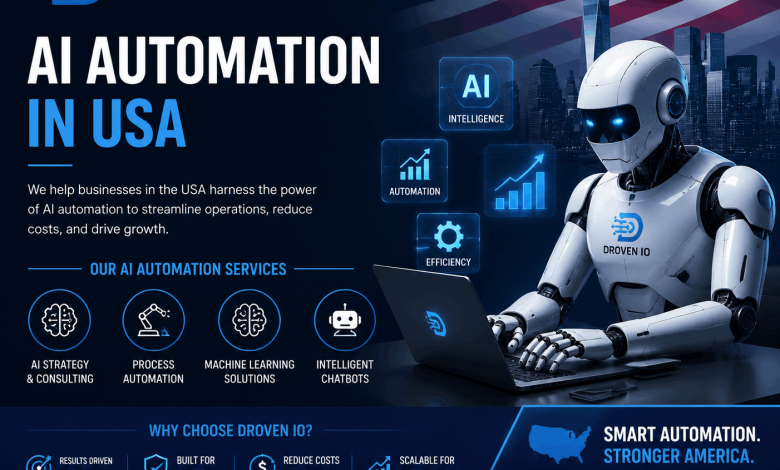
A small logistics company in Ohio spent three years running its scheduling, invoicing, and customer support through five different apps that never talked to each other. Someone had to copy data by hand between all of them, every single day. That’s the exact problem droven io ai automation in USA content was built to solve, and it’s a story playing out in offices across the country right now.
If you’ve heard the name Droven.io and wondered what it actually does, this guide breaks it down in plain terms: what the platform covers, how AI automation works in practice, and what you should watch out for before you commit budget to any tool.
What Is Droven IO AI Automation?
Droven.io is an educational knowledge platform, not a piece of software you install. It publishes guides on artificial intelligence, automation, machine learning, cloud computing, and cybersecurity, aimed at business owners and developers who want to understand a tool before they buy it.
Rather than selling automation software, Droven.io explains how different categories of tools work: workflow platforms, robotic process automation (RPA) systems, and AI agents that use large language models. The goal is to give readers a neutral starting point before they talk to a vendor.
How Droven.io Fits Into the Broader Automation Space
Think of Droven.io as a reference layer sitting between marketing demos and dense academic papers. It translates technical concepts into language a non-technical manager can act on.
That matters because most people researching automation aren’t developers. They’re operations managers, small business owners, or marketing leads trying to figure out where AI actually saves time and where it just adds complexity.
Why USA Businesses Are Turning to AI Automation Right Now
Labor costs keep climbing, and teams are being asked to handle more work with the same headcount. Manual data entry, repetitive email replies, and disconnected spreadsheets eat hours that could go toward actual growth work.
AI automation platforms solve a specific piece of this: they watch for an event (a new order, a support ticket, a form submission), process the information with an AI model, and trigger the next step without a person clicking buttons. Customer support, document processing, CRM updates, and lead qualification are the areas where companies see the fastest payoff.
7 Proven Ways Droven IO AI Automation Helps Companies in the USA
Here’s a look at where this category of tools actually earns its keep, based on how businesses are applying it today.
- Connecting software that was never built to talk to each other. Most companies run a patchwork of tools: a CRM, an accounting app, a support desk, a marketing platform. AI automation links them with APIs and webhooks so data moves on its own.
- Cutting down repetitive manual work. Copying an email address from one system into another sounds small until you multiply it by a hundred times a day. Automation removes that step entirely.
- Speeding up customer support. AI agents can read an incoming message, understand the intent, and either answer it directly or route it to the right person with context attached.
- Improving document processing. Invoices, contracts, and intake forms can be scanned, read, and sorted by AI models instead of a person typing the same fields over and over.
- Supporting smarter lead qualification. Instead of a sales rep manually scoring every lead, automation can flag the ones worth a phone call based on behavior and past patterns.
- Making cloud and security decisions less confusing. Droven.io’s content also covers data protection basics, which helps teams weigh automation against the risk of exposing sensitive information.
- Helping teams pick a stack without guessing. With so many tools on the market, a neutral comparison of categories saves a team from buying software that doesn’t match its actual workflow.
How to Start With AI Automation: A Step-by-Step Approach
- Map one process, not everything. Pick the single workflow that wastes the most hours each week. Trying to automate every department at once is the fastest way to stall a project.
- Clean up your data first. AI models make bad decisions when the underlying data is messy or inconsistent. Fix that before you connect anything.
- Choose tools based on what you need, not what’s popular. A no-code platform might solve a small team’s problem; a larger operation may need a custom-built agent.
- Build in a human checkpoint. Full autonomy sounds appealing, but a defined handoff point protects you the first time the system gets something wrong.
- Test on a small scale, then expand. Run the automation on one team or one product line before rolling it out company-wide.
- Review performance every quarter. Automations drift as your business changes, so revisit the setup regularly rather than leaving it untouched.
Common Mistakes Businesses Make With AI Automation
A lot of failed automation projects share the same root causes, and none of them are about the technology itself.
- Starting without a clear use case. Teams buy a tool first and figure out what to automate later, which almost always leads to wasted spend.
- No escalation path for customers. If the AI can’t hand off to a person when it gets confused, trust breaks fast.
- Ignoring data quality. Garbage in still means garbage out, no matter how advanced the model is.
- Chasing every new tool. Switching platforms every few months prevents any single workflow from actually maturing.
RPA vs. AI Agents vs. No-Code Platforms
| Category | Best For | Learning Curve | Human Oversight Needed |
| Traditional RPA | Repetitive, rule-based tasks with no variation | Moderate | Low, once rules are set |
| AI Agents (LLM-powered) | Tasks needing language understanding or judgment calls | Higher | Ongoing, especially early on |
| No-Code Automation Platforms | Small teams connecting apps without a developer | Low | Moderate |
Frequently Asked Questions About Droven IO AI Automation in USA
Is Droven.io a software company?
No. Droven.io is an editorial knowledge platform that explains AI and automation concepts. It doesn’t sell software, offer certifications, or hold affiliate deals with the vendors it writes about.
Is Droven.io free to use?
Yes. Its content is publicly available without a paywall, which is one reason it’s become a go-to reference for people researching automation before buying anything.
What industries use AI automation the most in the USA?
Customer service, finance, healthcare administration, and e-commerce lean on it heavily right now. Any industry with repetitive, rule-based tasks tends to see the quickest return.
How is AI automation different from traditional automation?
Traditional automation follows fixed rules with no flexibility. AI automation can understand language, summarize documents, and make judgment calls based on context, which lets it handle less predictable tasks.
Do small businesses need AI automation, or is it just for large companies?
Small businesses often see the biggest relative time savings, since a few hours saved per week matters more to a five-person team than a five-hundred-person one. The tools available today scale down well.
What’s the biggest risk with AI automation?
Handing over full autonomy without a human checkpoint. If a system makes a customer-facing mistake with nobody reviewing it, the damage to trust can outweigh the time saved.
How long does it take to see results from AI automation?
Simple workflows, like automated email routing, can show results within a week or two. Anything involving multiple systems or custom logic usually takes a few months to fully settle in.
Can AI automation replace human employees?
It typically replaces specific tasks, not entire roles. Most companies use it to free up staff for higher-value work rather than to cut headcount outright.
Where to Go From Here
AI automation works best when you start with one real problem, not a wish list of every task you’d like to hand off. Droven.io’s content is a solid starting point for understanding the categories of tools available before you commit any budget.
If you’re building out your automation stack, check out our related guides on workflow automation tools, no-code platform comparisons, and AI agent security basics on Reuterings for the next steps.