
If you’ve been browsing a smoke shop shelf or scrolling a hemp brand’s website, you’ve probably run into HHC carts sitting next to Delta 8 and Delta 9 products, and wondered how they’re actually different. This guide breaks down what HHC carts are, how the cannabinoid is made, what legal status looks like across the U.S., and what to check on a label before you buy one.
Quick Answer: HHC carts are vape cartridges filled with hexahydrocannabinol (HHC), a hydrogenated form of THC derived from hemp. Legal status varies significantly by state, and quality varies significantly by brand, so checking your state’s current hemp cannabinoid laws and requesting third-party lab results are the two most important steps before purchasing.
By the end of this, you’ll understand what sets HHC apart from other cannabinoids, how carts are typically made, the legal patchwork you’re operating in, and the specific things a reputable brand will always show you.
What HHC Actually Is
HHC, short for hexahydrocannabinol, is created by adding hydrogen atoms to a THC molecule through a process called hydrogenation. This is the same basic chemical reaction used to turn vegetable oil into margarine, just applied to a cannabinoid instead of a fat.
How It Differs From Delta 8 and Delta 9 THC
Delta 8 and Delta 9 are both naturally occurring cannabinoids with a double bond in their molecular structure. HHC removes that double bond and replaces it with hydrogen atoms, which changes how the molecule behaves and how stable it is over time. Many brands market HHC as having a longer shelf life than Delta 8 because the hydrogenated structure resists degradation from heat and UV light better.
Where the HHC in Carts Comes From
Most HHC sold in the U.S. is synthesized from CBD extracted from hemp, since naturally occurring HHC exists in cannabis plants only in trace amounts. The CBD is converted through a chemical process in a lab setting, then refined into a distillate that gets loaded into cartridges. This lab-dependent production is exactly why sourcing and testing transparency matter so much when picking a brand.
Is HHC Legal? A State-by-State Reality
Federal hemp law creates a gray area that individual states have interpreted very differently, which is why the same product can be legal in one state and banned two states over.
The 2018 Farm Bill legalized hemp and its derivatives at the federal level, provided the final product contains no more than 0.3% Delta 9 THC by dry weight. HHC produced from hemp-derived CBD has generally been sold under that framework, but a growing number of states have passed their own laws specifically restricting or banning HHC and other hemp-derived cannabinoids, regardless of federal hemp status.
States Where HHC Faces Restrictions or Bans
Laws change often enough that any specific list goes stale fast, so the more useful habit is checking your state’s current hemp or cannabinoid regulations directly before ordering, rather than relying on what a retailer’s website claims. States that have restricted or banned HHC and similar hemp-derived cannabinoids in recent years include several in the Midwest, South, and Northeast, often through emergency rulings or updated controlled substance schedules.
Why Legal Status Can Shift Without Warning
State legislatures and health departments have been actively revisiting hemp cannabinoid rules on a rolling basis since 2023, sometimes reclassifying a compound within a single legislative session. A product that’s legal to ship to your address today isn’t guaranteed to stay that way, so it’s worth checking your state’s current rules each time you reorder rather than assuming last year’s answer still holds.
What to Check Before Buying an HHC Cart
A reputable brand makes certain information easy to find. If any of the following is missing or vague, treat that as a warning sign rather than a minor gap.
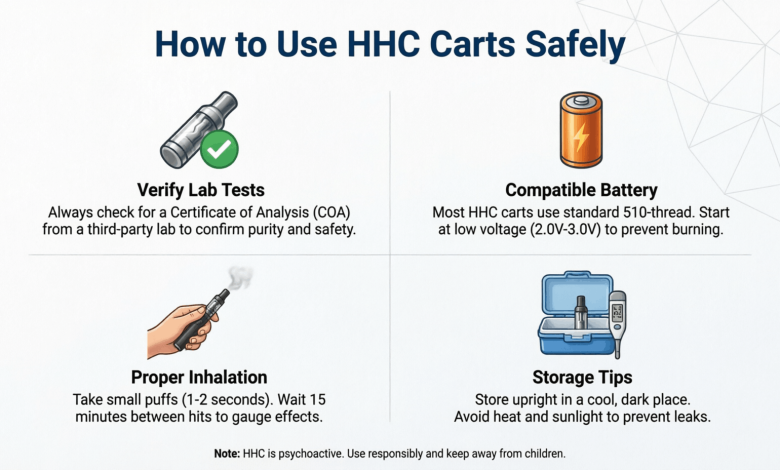
- Third-party lab test results (a Certificate of Analysis) specific to the batch you’re buying, not a generic one pulled from the brand’s homepage
- Confirmation that Delta 9 THC content stays under the 0.3% federal threshold
- A full list of what’s in the cartridge beyond HHC, including any cutting agents or added terpenes
- Hardware details, since a cart’s battery compatibility and heating element affect both the vaping experience and safety
- A clear expiration or best-by date, since cannabinoid potency degrades over time even with HHC’s relative stability
HHC Carts vs. Delta 8 Carts vs. Delta 9 Carts
Shoppers new to hemp-derived cannabinoids often land on HHC by process of elimination once they’ve compared it against the two more familiar options.
| Product | Source | Federal Legal Basis | Typical Availability |
| HHC carts | Lab-converted from hemp CBD | 2018 Farm Bill, hemp derivative | Varies by state, restricted in several |
| Delta 8 carts | Lab-converted from hemp CBD | 2018 Farm Bill, hemp derivative | Varies by state, restricted in several |
| Delta 9 carts | Extracted or synthesized, capped at 0.3% by dry weight | 2018 Farm Bill for hemp-derived versions only | Widely available in hemp-legal states, separate rules apply to marijuana-derived Delta 9 |
Safety and Quality Considerations
Vaping any cannabinoid product carries inhalation risks that differ from other consumption methods, and the hardware quality matters as much as what’s in the cartridge itself.
Reading a Certificate of Analysis
A real Certificate of Analysis lists the specific batch number, testing date, and an independent lab’s name and accreditation, not just a cannabinoid percentage. It should also screen for contaminants like heavy metals, pesticides, and residual solvents left over from the extraction or conversion process, since these show up in poorly regulated products more often than potency numbers alone would suggest.
Cartridge Hardware Matters Too
Cheap, unbranded cartridge hardware has been linked to overheating and degraded vapor quality in independent testing across the broader vape industry, not just HHC products specifically. Ceramic coil carts from established hardware manufacturers tend to heat more evenly than the lowest-cost metal-coil alternatives.
Who Should Avoid HHC Carts Entirely
Anyone under the legal age in their state (typically 21), pregnant or breastfeeding individuals, and people with a history of adverse reactions to THC-family cannabinoids should avoid HHC products altogether. If you’re taking prescription medications, it’s worth checking with a doctor or pharmacist first, since cannabinoids can interact with certain drugs.
Frequently Asked Questions
What does HHC feel like compared to Delta 9 THC?
Users commonly describe HHC’s effects as similar to Delta 9 THC but somewhat milder, though individual response varies widely based on tolerance, dose, and the specific product. Because HHC potency and quality vary a lot between brands, the same product can feel noticeably different from one batch to the next.
Will HHC show up on a drug test?
Standard THC drug tests are designed to detect THC metabolites, and there’s meaningful evidence that HHC use can trigger a positive result on these tests. Anyone subject to drug testing for employment or other reasons should treat HHC as a real risk for a positive THC screen, not an exception to it.
Is HHC the same as Delta 8?
No, HHC and Delta 8 are chemically distinct cannabinoids, even though both are commonly derived from hemp CBD through lab processing. HHC’s hydrogenated structure gives it different stability characteristics and a different legal treatment in some states compared to Delta 8.
Can I legally order HHC carts online and have them shipped to my state?
It depends entirely on your state’s current cannabinoid laws, which change often enough that a shipping confirmation from a retailer isn’t proof of legality. Check your state’s health department or attorney general’s page on hemp-derived cannabinoids before ordering, since some states restrict possession even if a retailer will still process the sale.
How long do HHC carts stay potent once opened?
Most brands report a shelf life of one to two years unopened when stored away from heat and direct light, though potency starts declining gradually once a cartridge is opened and exposed to air. Storing an open cart upright in a cool, dark place slows that decline the most.
Are HHC carts safer than Delta 8 or Delta 9 carts?
No cannabinoid vape product has a long enough research history to make a confident safety comparison between HHC, Delta 8, and Delta 9 carts. Product safety depends far more on manufacturing quality, third-party testing, and cartridge hardware than on which specific cannabinoid is inside.
What’s the difference between a disposable HHC vape and a refillable HHC cart?
A disposable vape comes pre-filled with a built-in battery and gets discarded once empty, while a refillable cart screws onto a separate reusable battery and can sometimes be swapped once emptied. Refillable carts generally give buyers more visibility into which specific hardware they’re using, since the battery is a standalone purchase they can research separately.