

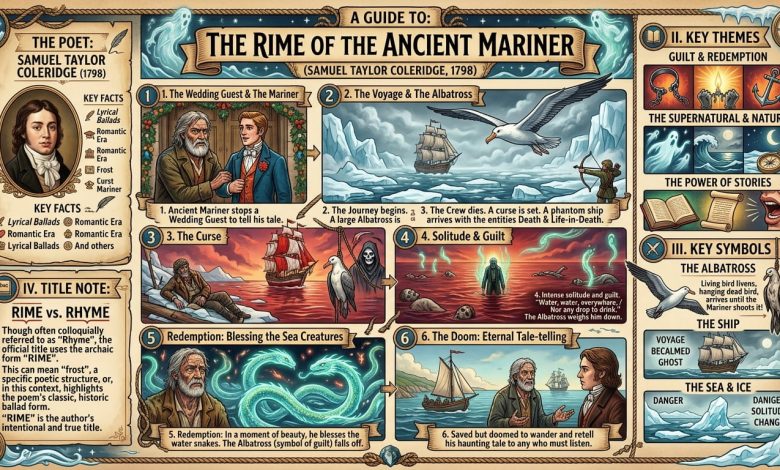
The rhyme of the ancient most likely points to Samuel Taylor Coleridge’s The Rime of the Ancient Mariner, one of the most anthologised poems in English literature. The poem’s rhyme scheme is deceptively simple: it borrows the ballad form, with its alternating four-beat and three-beat lines and its abcb pattern, but Coleridge bends and breaks that pattern throughout. This article explains how the rhyme works, where it departs from convention, and why those departures matter for anyone reading the poem closely.
The Ballad Stanza and Its Rhyme Pattern
The Rime of the Ancient Mariner was first published in 1798 in Lyrical Ballads, the collection Coleridge produced with William Wordsworth . It was written in 1797 and 1798, and Coleridge continued revising it for years afterwards .
The poem’s basic building block is the ballad stanza. In its standard form, this is a four-line unit where the first and third lines have four stressed beats, the second and fourth have three, and only the second and fourth lines rhyme . The pattern is conventionally described as abcb.
Here is how that looks in practice, from the opening of the poem:
It is an ancient Mariner,
And he stoppeth one of three.
‘By thy long grey beard and glittering eye,
Now wherefore stopp’st thou me?’
The second line and the fourth line rhyme (“three” and “me”). The first and third do not. That is the balladic norm Coleridge inherited.
A Loose and Varied Form
Coleridge did not stick rigidly to four-line stanzas. The poem contains stanzas of varying lengths, including five-line and six-line units, and the rhyme schemes shift accordingly . In a five-line stanza, for instance, the first, third and fourth lines might rhyme, with the second and fifth forming another pair. The result is a poem that feels traditional without being mechanically repetitive.
The meter is similarly loose. Odd lines are generally tetrameter (four beats) and even lines generally trimeter (three beats), but Coleridge introduces variations, including spondaic feet (two stressed syllables together) that slow the reading and create a heavier, more ominous feel at key moments .
What Makes the Rhyme of the Ancient Mariner Distinctive
The rhyme scheme is not the poem’s most striking feature. That honour probably belongs to its imagery and its supernatural machinery. But the rhyme does important work, and it is worth noticing where Coleridge deviates from the ballad template.
Internal Rhyme and Repetition
Coleridge frequently uses internal rhyme and repetition to heighten the incantatory quality of the verse. The famous lines about water illustrate this:
Water, water, every where,
And all the boards did shrink;
Water, water, every where,
Nor any drop to drink.
The repetition of “water” and the rhyme of “shrink” and “drink” create a claustrophobic, hypnotic effect. This is not the plain ballad rhyme of the opening stanzas. It is something more deliberate and more musical.
Rhyme as a Source of Unease
In places, the rhyme draws attention to itself in ways that unsettle the reader. Coleridge’s use of archaic spellings and obsolete words, especially in the original 1798 version, was driven partly by the need to achieve rhymes . Words like “eftsoons” and “swound” appear not because they are natural to the eighteenth-century reader but because they fit the pattern. The first reviewers found the style bewildering, with one critic complaining that it resembled “the extravagance of a mad German poet” rather than the simplicity of an ancient ballad .
That reaction is instructive. The rhyme of the poem is not invisible. It is part of the experience, and for some early readers it was an obstacle.
The Rime Versus the Rhyme
A small spelling note is worth adding, because the keyword “rhyme of the ancient” suggests some uncertainty. The poem’s title uses “Rime”, not “Rhyme”. In Coleridge’s time, “rime” was an archaic spelling of “rhyme”, and its use in the title was part of the poem’s deliberate antiquarian flavour. The word also carries a secondary meaning: a rime is a frost, a coating of ice. Given the poem’s Antarctic setting and its preoccupation with cold and ice, the double meaning is almost certainly intentional.
Modern editions often retain “Rime” in the title, though some readers and search engines conflate the two spellings. If you are looking for the poem, searching either “Rime” or “Rhyme” will usually find it.
Why the Rhyme Matters for Reading the Poem
The rhyme scheme of The Rime of the Ancient Mariner is not a technical curiosity. It shapes how the poem feels. The ballad form gives it a deceptively simple, song-like surface. The variations, the internal rhymes, the forced archaic rhymes, and the occasional metrical disruptions all work against that simplicity. The reader is lulled by the familiar pattern and then unsettled by its distortions.
This is consistent with the poem’s broader method. It takes a traditional form, the ballad, and fills it with strange, dreamlike, morally ambiguous content. The rhyme is part of the same strategy: familiar enough to draw you in, strange enough to keep you off balance.
Frequently Asked Questions
What is the rhyme scheme of The Rime of the Ancient Mariner?
The poem follows the ballad stanza, typically abcb, where the second and fourth lines rhyme and the first and third do not. Coleridge varies this with stanzas of different lengths and occasional internal rhymes. The meter alternates between tetrameter and trimeter, with deliberate disruptions throughout. The pattern is regular enough to be recognisable but loose enough to avoid monotony.
Is it “Rime” or “Rhyme” in the title?
The poem’s title uses “Rime”, an archaic spelling of “rhyme”. Coleridge chose it partly to give the poem an antique, ballad-like feel. “Rime” also means frost or ice, which resonates with the poem’s frozen setting. Modern editions usually keep “Rime” in the title, though both spellings are commonly searched for.
Why did Coleridge use archaic words in the poem?
He used archaic spellings and obsolete words partly to mimic the style of old ballads and partly to achieve rhymes. The original 1798 version was heavily criticised for this, with reviewers finding the language confusing. Coleridge later revised the poem, modernising around 40 spellings and terms and cutting 46 lines . The 1817 version is the one most modern editions follow.
What is the moral of The Rime of the Ancient Mariner?
The poem is often read as teaching the duty of kindness to all living creatures, after the Mariner shoots the albatross and brings suffering on himself and his crew. Coleridge himself reportedly called the moral “too plain” . But the poem resists a single tidy interpretation, and the Mariner’s compulsion to repeat his story suggests that the lesson is as much about the burden of guilt as about kindness to birds.
A Reading Suggestion
If you want to hear the rhyme of the ancient mariner at work, read the poem aloud. The ballad rhythm is designed for the ear, and the rhymes that look awkward on the page often land differently when spoken. The 1817 text is the most accessible starting point. Read the opening stanzas, then skip to the water, water section and the dice game. The shifts in rhyme and rhythm will tell you more about what Coleridge was doing than any critical summary can.