
Sensei Def: The Meaning, Origin and Correct Usage of the Japanese Title

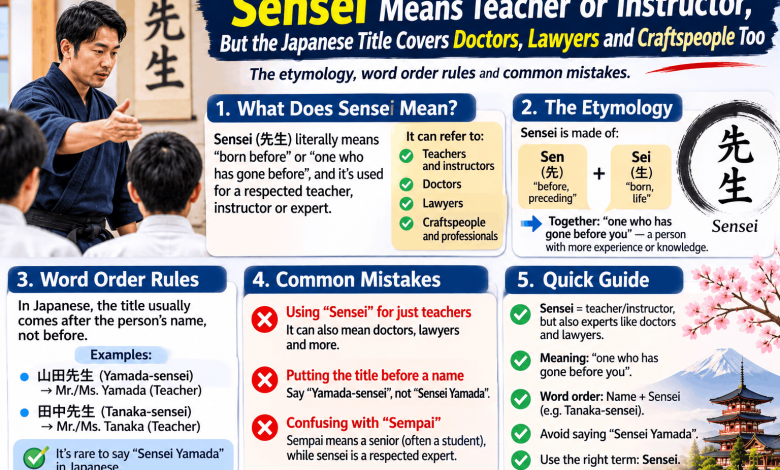
The simplest definition of sensei is “teacher” or “instructor,” and in English it is most often used for a Japanese martial arts teacher such as a karate or judo instructor . But the word means more than that. It is written with two Japanese characters meaning “one who was born before,” and in Japan it is a title of respect used for doctors, lawyers, priests, politicians, authors and master craftspeople as well as schoolteachers . If you have seen the word in an anime, a martial arts class or a book and want to know exactly what it means and how to use it correctly, this guide covers the definition, the etymology, the correct word order and the mistakes English speakers most often make.
The Basic Definition of Sensei
Dictionaries give a narrow English definition and a broader Japanese one. Merriam-Webster defines sensei as “a teacher or instructor usually of Japanese martial arts (such as karate or judo)” . Collins describes it as “a Japanese title for a teacher, master, or professional; (in English) used esp for a martial arts teacher” . These definitions reflect how the word entered English through martial arts culture in the late 19th and 20th centuries.
In Japanese, the scope is wider. Oxford Reference lists the term as a general title of respect accorded to university lecturers, martial arts instructors, and priests of certain Buddhist traditions . A De Gruyter Brill academic source explains that schoolteachers from kindergarten to university are all sensei, “but so are doctors, lawyers, calligraphy instructors, master artisans, Buddhist and Shinto priests, and even experienced makers of tofu, car mechanics, or anyone teaching his or her trade to an apprentice” .
The common thread is not the classroom. It is respect for someone who has gone before you in a body of knowledge or skill.
The Etymology: “One Who Was Born Before”
The word sensei is written in Japanese as 先生. The first character, 先 (sen), means “before” or “previous.” The second, 生 (sei), means “life” or “born” . Together they mean literally “one who was born before oneself.”
The International Judo Federation explains the etymological meaning as jibun yori saki ni umareta hito, which translates as “person who was born before oneself.” This notion is close to “elder” . The logic is Confucian: seniority in age correlates with priority in knowledge and experience. The sensei is not necessarily smarter or more talented than you. They have simply walked the path longer.
A practical consequence follows from this. In Japanese tradition, age alone is not enough to make someone a sensei. The IJF notes that “not anyone can become a teacher and age is not enough to make anyone a judo master.” The title carries responsibility for transmitting knowledge in a way that allows students to grow .
How to Use Sensei Correctly
The definition is simple. The usage rules are where English speakers go wrong.
Word Order: Name First, Then Sensei
In Japanese, titles follow the name. You say Tanaka-sensei, not “Sensei Tanaka.” A usage guide on the word notes that putting the title first is “the single most common mistake English speakers make with the word, and it reverses the Japanese order” .
Used on its own as a form of address, sensei stands alone. A student might call out “Sensei!” to get a teacher’s attention, just as an English speaker might call out “Teacher!” . As a common noun, you can say “our sensei,” “the sensei” or “a sensei at the dojo.”
Never Use It for Yourself
Sensei is a title other people give you. It is not one you claim. Introducing yourself as “Sensei Smith” sounds presumptuous, in the same way that calling yourself “the master” would . This is a matter of politeness, not just grammar.
Spelling and Pronunciation
The correct spelling is sensei. The pronunciation is /ˈsɛnseɪ/, roughly “SEN-say” . The common misspelling “sensai” has no dictionary entry and breaks the word’s structure. The “-ai” ending is an English speaker’s attempt to spell the “ay” sound they hear .
What Sensei Is Not
Several misunderstandings are worth clearing up.
“Sensei means master.” It is often translated that way in martial arts contexts, but the IJF notes that the concept is “a little more complex than it seems” . The literal meaning is “born before,” not “master.” A sensei is someone ahead of you on the path, not necessarily a supreme authority.
“Sensei is only for martial arts.” In English, that is the most common usage. In Japanese, it covers doctors, lawyers, teachers, priests, authors and craftspeople . If you watch anime and hear a character call a doctor “sensei,” this is why.
“Sensei is masculine.” It is not. A woman teacher is sensei just as a man teacher is, and there is no feminine form . English speakers sometimes assume a martial arts title must be masculine, but the assumption is wrong in both Japanese and English usage.
“Sensei is a pronoun.” It is not a pronoun in English. It functions as a title or a noun. In Japanese, the title has historically been used in place of personal pronouns as a mark of respect, but that is a feature of Japanese grammar, not English .
Frequently Asked Questions
What does sensei mean in English?
Sensei is a Japanese title meaning “teacher” or “instructor.” In English it is most commonly used for martial arts teachers such as karate or judo instructors . In Japanese it is a broader title of respect used for doctors, lawyers, priests, authors and other professionals .
Is sensei a master or a teacher?
It is usually translated as “teacher” or “master,” but the literal meaning is “one who was born before.” The title implies experience and seniority rather than supreme mastery. In judo, the IJF notes that not anyone can be a sensei, and age alone is not enough .
How do you use sensei in a sentence?
Put the name first: “Tanaka-sensei.” Do not say “Sensei Tanaka.” Used alone, it is a form of address: “Sensei, may I ask a question?” As a common noun: “Our sensei is very patient.” Never use it for yourself .
Is “sensai” a correct spelling?
No. The correct spelling is sensei. “Sensai” has no dictionary entry and is a phonetic misspelling based on the pronunciation “SEN-say.” Use sensei in all contexts .