
You get a text. It says “you’re late asl” no question mark, no context. Or maybe someone slides into your DMs with a plain “asl?” and you’re not sure if that’s rude, flirty, or just weird.
ASL meaning depends entirely on where you see it and how it’s used. The same three letters can mean three completely different things depending on whether you’re texting a friend in 2026 or scrolling back through old AIM chat logs from 2003. This guide breaks down every meaning of ASL in text the Gen Z version, the old-school internet version, and the formal one so you always know exactly what someone means.
What Does ASL Mean? The Three Definitions
ASL has three distinct meanings in modern use, and they don’t overlap at all.
- “As Hell” (most common in 2026) In modern texting and on social media, ASL is shorthand for “as hell.” It’s used to intensify a statement the same way you’d say “very” or “extremely,” but faster and more casually. You’ll spot it after an adjective at the end of a sentence.
- “I’m tired asl” = “I’m tired as hell”
- “That was funny asl” = “That was funny as hell”
- “It’s hot asl outside” = “It’s hot as hell outside”
- “Age/Sex/Location” (old-school internet slang) The original internet meaning and the one your older siblings might remember. Typed as a standalone question (often “ASL?” or “a/s/l?”), it was shorthand for asking someone three personal details at once: how old they are, their gender, and where they live. It was a staple of chatrooms in the late 1990s and early 2000s.
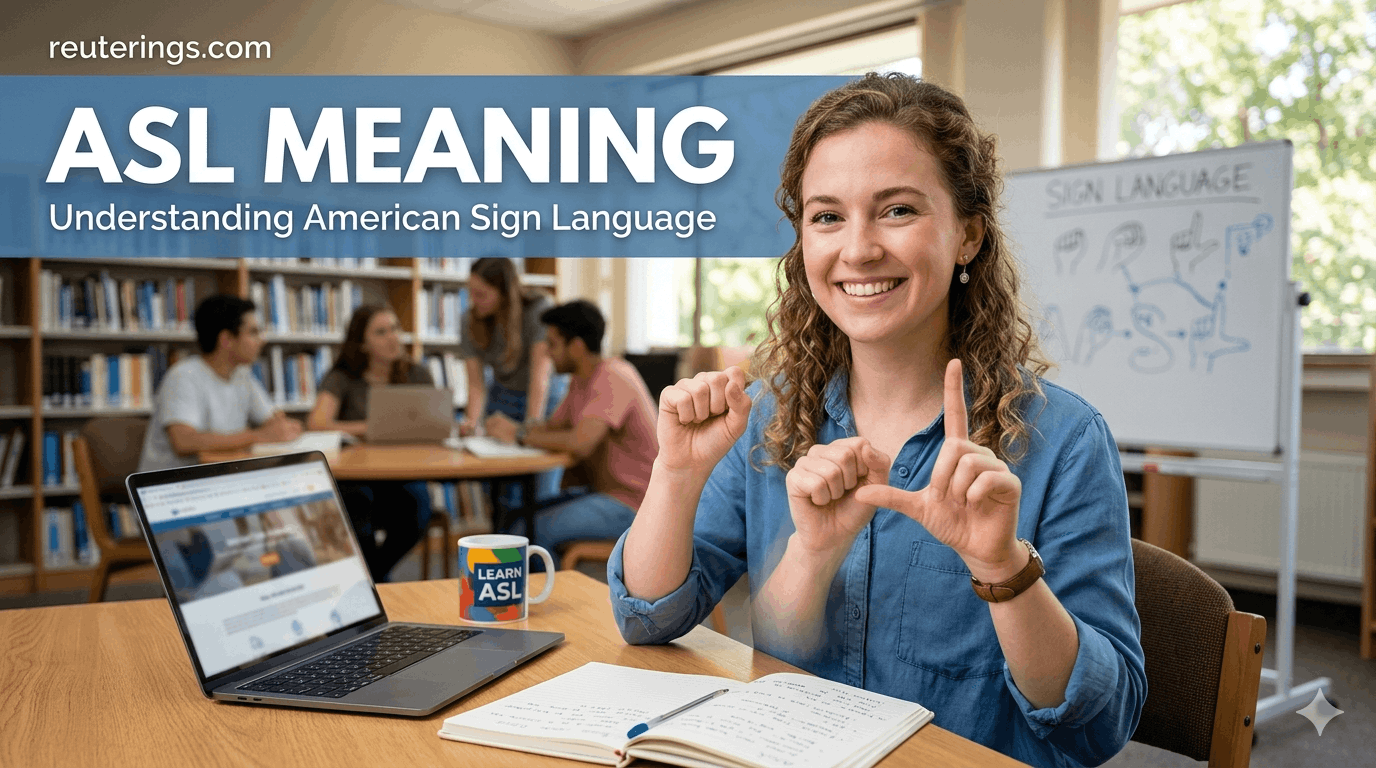
- American Sign Language In educational, medical, accessibility, and community contexts, ASL stands for American Sign Language the primary sign language used by Deaf and hard-of-hearing communities in the United States and Canada. This meaning has nothing to do with internet slang and is never used casually in texts.
How to Tell Which ASL Meaning Someone Is Using
Context does all the heavy lifting here. Two questions help you figure it out instantly.
Is it in a sentence or standing alone?
If “asl” appears at the end of a sentence without a question mark, it’s almost certainly the “as hell” intensifier. No one writes “she’s mad asl?” the question mark and standalone format are signatures of the age/sex/location question.
If it’s a standalone message just “asl?” or “a/s/l?” with nothing else that’s the old chatroom ask for personal information.
Is it lowercase or uppercase?
This is one distinction most people miss. Lowercase “asl” is Gen Z’s “as hell” typed fast, no caps, used in casual sentences. Uppercase “ASL?” standing alone is more likely the personal information question, or possibly a reference to American Sign Language in a relevant context. It’s not a hard rule, but it tracks the majority of actual usage.
Who sent it and where?
A 17-year-old on TikTok or Snapchat saying “that’s wild asl” is using it as an intensifier. A stranger in a gaming lobby or anonymous chat asking “ASL?” is asking for your age, location, and gender and that context matters for your safety.
The Origin of ASL Meaning in Text and Chat
Where “Age/Sex/Location” Came From
The age/sex/location version of ASL almost certainly originated alongside IRC (Internet Relay Chat) rooms in the late 1980s, then became truly widespread through AOL Instant Messenger, MSN Messenger, and Yahoo Chat in the 1990s. When people first started chatting online at scale, there were no profile photos, no bios, no about sections. You knew nothing about the person on the other end of the conversation.
Typing “ASL?” was the internet’s version of “nice to meet you who are you?” Three pieces of information, one three-letter question. A typical chatroom exchange looked exactly like this:
User1: asl? User2: 16/f/California User1: 14/m/Texas
That was a complete self-introduction. In March 2002, “ASL” was formally added to the Internet Acronyms Dictionary, cementing its place in early digital culture.
By the mid-2010s, the question faded. Facebook and Instagram meant everyone had a public profile. There was no longer a reason to ask the information was already there. But the term never fully disappeared; it just went underground into anonymous platforms like Omegle and certain gaming chats.
How Gen Z Turned ASL Into “As Hell”
The slang reinvention happened gradually across the early-to-mid 2010s and picked up serious momentum around 2018. Younger users, particularly on Twitter and early TikTok, were looking for a fast way to express intensity without profanity. “AF” (as f***) was already common. “ASF” followed. Then “asl” emerged as a softer alternative that carried the same punch but without the explicit word.
TikTok accelerated everything. Comments scroll at speed during live streams and viral videos. Short, punchy intensifiers get more use than full sentences. “Tired asl,” “cute asl,” “funny asl” these fit perfectly into the rhythm of quick, casual reactions.
By the early 2020s, “as hell” was the dominant meaning for anyone under 25. The old “age/sex/location” definition became something you’d only encounter in memes mocking early internet culture, or in random anonymous chatrooms.
What Does ASL Mean on Different Platforms
The meaning shifts depending on where you see it. This breakdown covers the platforms where ASL appears most often.
| Platform | Most Common ASL Meaning |
| TikTok (comments/captions) | “As hell” used as an intensifier |
| Snapchat DMs with friends | “As hell” casual emphasis |
| Snapchat (stranger messages) | “Age/sex/location” ask for personal info |
| Instagram comments | “As hell” reactions and opinions |
| Discord gaming servers | Either, depends on the server and user age |
| Anonymous chats (Omegle-style) | “Age/sex/location” still used here |
| Text messages between friends | “As hell” same as TikTok usage |
| Educational/medical contexts | American Sign Language |
The pattern holds: if you’re on a platform where people know each other or follow each other, asl almost always means “as hell.” If you’re in an anonymous or semi-anonymous space a chat with strangers, a public gaming server, an anonymous forum the older meaning can still appear.
ASL Meaning on TikTok Specifically
TikTok is where the “as hell” definition lives most freely. You’ll see it in comment sections constantly:
- “That’s literally me asl 💀”
- “Bro is confident asl”
- “I was crying asl at that ending”
The abbreviation fits TikTok’s culture of fast reactions. Nobody is writing full sentences in a comment section that scrolls past in two seconds. Lowercase “asl” adds emphasis without slowing anyone down.
One thing worth knowing: TikTok also has a significant Deaf creator community that uses ASL (American Sign Language) in videos. If you’re watching a video where someone is signing, the ASL in that context means sign language the context makes it obvious, but it’s worth keeping in mind when you see the abbreviation in a video description or caption that has nothing to do with texting slang.
What Does A/S/L Mean? (The Slash Version)
The slashed version a/s/l or A/S/L is strictly the old chatroom question. Nobody writes “tired a/s/l” as a shorthand for “tired as hell.” The slashes are a visual indicator that this is the age/sex/location meaning.
If you see “a/s/l?” in a message, the person wants to know your age, your gender, and your general location. The question predates social media by a decade and comes with a lot of nostalgia for anyone who remembers dial-up internet.
ASL Meaning for Parents: What You Need to Know
If you’re a parent and your kid just received a message that says “ASL?” from someone they don’t seem to know, that’s worth paying attention to.
“As hell” used between friends in a sentence? No concern. Kids say “this homework is hard asl” the way they’d say “this homework is so hard.” It’s casual emphasis, nothing more.
The version to watch for is the standalone “ASL?” or “asl?” as a question especially from strangers. In anonymous chats, gaming platforms, and apps where kids interact with people they don’t know in real life, this question is a request for your child’s age, gender, and location. Child safety experts consistently point out that asking for this combination of personal details is one of the first steps in building a profile on a young person online.
If your child is asked their ASL by someone they don’t know:
- They shouldn’t answer.
- They don’t need to be polite about it. Closing the chat is the right move.
- Tell them that anyone worth talking to will get to know them through normal conversation not a three-letter info dump.
The flip side: if your kid sends “that was hilarious asl” in a text to a friend, that’s just modern slang. No alarm needed.
The “As Life” Variation A Third Slang Interpretation
This one barely gets covered anywhere, so it’s worth mentioning. Some users particularly in certain online communities and on Urban Dictionary define “asl” as short for “as life,” used in the same way as “as hell” or “as f***.” The meaning is identical: pure emphasis.
“He is tall asl” could technically mean “as life” or “as hell” both communicate the same thing. The “as life” reading is less common and less widely recognized, but if you come across it in a specific community that uses it that way, you’re not missing anything. The intensity is the same.
Real Examples of ASL in Text (Both Meanings)
Seeing the word in actual sentences is the fastest way to lock in which meaning applies.
“As hell” examples:
- “It’s cold asl in here, can you close the window?”
- “That movie was sad asl, I cried the whole time”
- “She’s tall asl, I had to look up the whole conversation”
- “Finals week has me stressed asl”
“Age/sex/location” examples:
- “Hey, asl?” (standalone message at the start of a chat)
- Responding to this: “22/F/New York” or “17/M/Chicago”
The difference is visual and structural. Sentence + no question mark = intensifier. Standalone + question mark = personal info request.
Frequently Asked Questions About ASL Meaning in Text
What does ASL mean in texting?
In most texts sent in 2026, ASL means “as hell” it’s placed after an adjective to add emphasis. For example, “I’m exhausted asl” means the person is very exhausted. The older meaning of “age, sex, location” still exists but is far less common in everyday texting between people who know each other.
What does ASL mean on TikTok?
On TikTok, ASL almost exclusively means “as hell.” It shows up in comments and captions as an intensifier: “that’s funny asl,” “she’s brave asl,” “I’m done asl.” It has nothing to do with the age/sex/location question in this context.
What does a/s/l mean?
A/S/L with slashes is the old-school internet shorthand for “age/sex/location.” It originated in chatrooms in the 1990s on platforms like AOL and MSN Messenger, where people asked strangers for these three details as a quick introduction. The slashed format is its own visual indicator; it’s never used as a replacement for “as hell.”
What does ASL mean on Snapchat?
On Snapchat between friends, it usually means “as hell” the same casual intensifier used on TikTok. If it appears as a question from someone your contact doesn’t know well, it may be asking for age, sex, and location. Context and the sender’s identity tell you which is which.
Is it safe to answer when someone asks your ASL?
It depends on who’s asking. If it’s a friend using it as slang in a sentence, there’s nothing to respond to it’s just emphasis. If a stranger is asking “ASL?” as a standalone question (especially in an anonymous chat, game, or app), you’re under no obligation to respond. Sharing your age, gender, and location with someone you don’t know online is not something anyone should feel pressured to do.
What does “tired asl” mean?
“Tired asl” means “tired as hell” the person is very, very tired. The “asl” is just an intensifier that replaces the words “extremely” or “so.” It’s one of the most common examples of this usage and appears frequently on TikTok, in texts, and in Discord chats.
What does “funny asl” mean?
“Funny asl” means something is extremely funny. If someone comments “that’s funny asl” on a video, they’re saying it genuinely made them laugh hard. It carries the same weight as “that’s hilarious” but in fewer characters.
What does ASL mean from a girl or a guy?
The meaning is the same regardless of who sends it. If it’s used in a sentence after an adjective, it means “as hell.” If it’s a standalone question, it’s asking for age, sex, and location. Gender of the sender doesn’t change the definition.
Did ASL always mean “as hell”?
No. The “as hell” meaning emerged in the mid-2010s and became dominant around 2018, driven largely by Gen Z usage on Twitter and TikTok. Before that, ASL was almost exclusively the age/sex/location abbreviation from 1990s chatrooms. The two meanings come from completely different eras of internet culture.
Is using ASL slang appropriate?
“Asl” as “as hell” is casual slang totally appropriate between friends in texts, social media, and informal chat. It’s not appropriate in professional emails, work messages, or formal communication. The age/sex/location version is generally considered outdated and, in many contexts, intrusive especially when directed at someone you don’t know.
Now You Know Your ASL
Three letters, three completely different meanings context is what separates them every time. If it’s sitting at the end of a sentence, someone is just adding emphasis: they’re very tired, very hungry, very amused. If it’s a standalone question with a question mark from someone unfamiliar, it’s asking for personal information that you don’t owe anyone.
The shift from “age/sex/location” to “as hell” maps neatly onto how internet culture changed from anonymous chatrooms full of strangers to social media where everyone’s already got a profile. The word stayed; the meaning evolved.
Want to stay fluent in how language moves online? Check out our guide to what NGL means in text, or read up on other Gen Z slang terms that are showing up in everyday conversations.
[META DESCRIPTION]
(158 characters)
[URL SLUG] asl-meaning
[META TITLE]
(60 characters)