

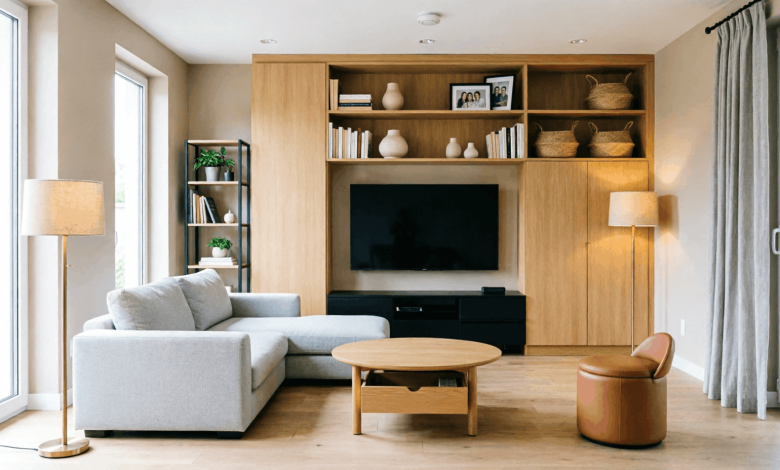
Your living room is supposed to feel like the most relaxed space in your home. But if your TV cables are trailing across the floor, your remotes disappear daily, and every surface is buried under stuff you don’t know where to put, relaxation stays out of reach. The right living room storage setup changes all of that.
This guide covers real, practical ideas for organizing the space around your TV — from finding the right TV stand for a 50 inch or 75 inch screen, to building out a full storage wall that looks like it came from an interior design magazine. You’ll find size guides, furniture types, styling tips, and answers to the questions most people are still searching for after reading the usual advice.
Why the TV Wall Is the Most Important Storage Zone in Your Living Room
Most people treat the TV wall as a display spot and nothing else. That’s a missed opportunity. The wall your television sits on is naturally the focal point of the room, which means the storage you build around it gets seen constantly. Done well, it looks intentional and puts everything you use daily within arm’s reach — remotes, game controllers, streaming devices, books, throws, even the router.
Done poorly, it becomes visual noise.
The goal is to make storage look like design. That starts with choosing the right base piece for your TV.
How to Choose the Right TV Stand for Your Screen Size
Getting the TV stand size wrong is one of the most common mistakes people make when setting up a living room. The stand should be wider than the TV, not the same width, and not narrower. A too-narrow stand makes a large screen look unstable. A too-wide one makes the room feel mismatched.
TV Stand Width for a 50 Inch TV
A 50 inch TV measures roughly 44 to 45 inches wide (that’s the screen, not including the bezel). Your TV stand should be at least 50 to 55 inches wide to give the screen visual breathing room on both sides and leave space for a soundbar or decorative objects.
A stand that’s 55 to 60 inches wide hits the sweet spot for a 50 inch TV. You get a stable base, surface space on either side, and the whole setup looks balanced rather than cramped.
Best TV Stands for a 75 Inch TV
A 75 inch TV screen runs about 66 to 67 inches wide. That means you need a TV stand that’s at least 70 inches wide, with 75 to 85 inches being the ideal range for the best visual balance.
When shopping for the best TV stands for a 75 inch TV, also pay attention to weight capacity. A 75 inch television can weigh anywhere from 80 to 130 pounds depending on the brand and model. Your stand needs to comfortably support that weight without flex or wobble. Look for stands rated to at least 150 pounds — the extra margin matters.
TV stands built for larger screens tend to have deeper shelves too, which is useful because 75 inch TVs are physically deeper than smaller models and need more support along the base.
Does Height Matter?
Yes, and more than most people realize. The ideal viewing height puts the center of your TV screen at eye level when you’re seated, which is roughly 42 to 48 inches off the floor for most sofas and seating heights.
A standard TV stand sits between 18 and 24 inches tall. Add your TV’s height and you’ll land close to that viewing range for most screen sizes. If your sofa sits very low or you prefer a relaxed, reclined position, a low TV stand (under 18 inches) can be a smart choice. More on that next.
The Case for a Low TV Stand
A low TV stand has become one of the most popular choices in modern and Scandinavian-influenced interiors — and for good reason. A lower profile keeps the visual weight of the room near the floor, which makes ceilings feel higher and spaces feel more open. It’s a simple optical effect that genuinely works.
Low TV stands typically sit between 12 and 18 inches tall. They work best in rooms where:
- You sit low on a floor cushion, a sectional with shallow seat height, or a modular sofa
- The room has low ceilings and you want to draw the eye down rather than up
- You’re going for a minimalist, Japanese-inspired, or mid-century modern look
The trade-off with a low TV stand is reduced storage depth on the shelves below. If you have a lot of components — a gaming console, cable box, Blu-ray player, and a soundbar — a low stand might not give you enough vertical shelf clearance. Measure the height of your tallest device before buying.
Brands like West Elm, CB2, and IKEA’s BESTA line all produce solid low-profile TV stands at different price points. The BESTA system is worth mentioning because it’s modular — you can configure it with doors, open shelves, or drawers depending on what you need.
TV Storage Cabinets: When You Want Storage You Can Close
If the idea of always keeping your shelves organized sounds exhausting, a TV storage cabinet is probably your best option. These are media units with doors — either hinged, sliding, or push-to-open — that let you hide everything behind a clean face when you’re not actively using it.
TV storage cabinets typically range from 50 to 80 inches wide and 18 to 28 inches tall. They look like a sideboard or credenza with the addition of ventilated shelves or cable cutouts behind the doors.
The biggest practical advantage of a TV storage cabinet is that it handles the clutter problem automatically. You don’t need to organize the inside perfectly because no one sees it. The outside looks clean regardless of what’s happening on the shelves within.
A few things to check before buying a TV storage cabinet:
- Ventilation: Electronics generate heat. Cabinets with solid doors need ventilation holes or mesh panels at the back to prevent components from overheating.
- Cable management cutouts: Look for a unit that has a channel or opening at the back panel so you can run cables through without drilling your own holes.
- Door clearance: If the cabinet sits close to a wall, make sure hinged doors can fully open without hitting a baseboard or adjacent furniture.
- Weight capacity on top: If the TV sits on top of the cabinet rather than wall-mounted, confirm the top surface is rated for your screen’s weight.
Pottery Barn’s media consoles and IKEA’s HAVSTA series are commonly recommended in this category. Wayfair carries dozens of options across style categories at nearly every price point.
Living Room Storage Beyond the TV Stand
The TV unit is the anchor, but a well-organized living room needs storage in other zones too. The most common complaints people have — no place for books, throws always on the floor, side tables covered in objects — all have storage solutions that don’t require a renovation.
Floating Shelves Around the TV
Mounting floating shelves on either side of or above your TV is one of the most space-efficient storage ideas you can use. It turns bare wall space into organized display and storage without adding any floor footprint.
For a balanced look, mount shelves at the same height on both sides of the TV, and keep the depth consistent. Shelves between 8 and 12 inches deep are practical for books, plants, and small baskets. If you go deeper than 12 inches, they start to visually compete with the TV.
A common arrangement is two or three staggered shelves on each side of the TV at varying heights. Keep one shelf lower and accessible for items you grab regularly — a remote caddy, a small tray for keys, a charging dock.
Built-In Cabinetry and Custom Storage Walls
Built-ins are the premium option for living room storage, and they work especially well around a TV. A custom built-in unit frames the TV, adds floor-to-ceiling storage on both sides, and can include a combination of open shelves, closed cabinets, and drawers.
The cost is higher than freestanding furniture, but built-ins add perceived value to the home and create a look that no flat-pack unit can replicate. If you’re in a home you plan to stay in, it’s worth considering.
You don’t have to build from scratch either. IKEA’s BILLY bookcase columns, combined with OXBERG doors, can be arranged to create a wall-length unit that looks close to a custom built-in at a fraction of the cost. A lot of interior design accounts on social media document exactly how to do this.
Storage Ottomans and Benches
A storage ottoman positioned in front of a sofa or at the end of a sectional handles the overflow problem that no TV unit can fix alone. Throws, extra cushions, board games, magazines — all of it goes inside and the outside looks like part of the furniture.
Ottoman sizing depends on your sofa length. For a standard 84-inch sofa, a rectangular ottoman around 48 by 24 inches is proportionate. Larger sectionals can handle a round or square ottoman up to 48 inches across.
Media Consoles vs. Sideboards
A sideboard or credenza works as a TV stand in most cases, even if it wasn’t designed for that purpose. The height range (28 to 34 inches) is actually closer to ideal viewing height than most dedicated TV stands. The storage inside is typically closed, which handles clutter automatically.
The difference is that sideboards aren’t always built with electronics in mind. Check for cable cutouts or plan to drill your own. Also confirm the top surface is finished to hold a television without damage.
Cable Management: The Detail That Makes or Breaks the Look
You can spend a lot of money on a beautiful TV wall setup and then undercut all of it with cables hanging in plain sight. Cable management is the single most overlooked part of a living room storage project, and it’s also one of the cheapest fixes.
If your TV is wall-mounted, the cleanest solution is an in-wall cable kit. These kits include two wall plates — one behind the TV and one near the baseboard — with a tube that runs the cables through the drywall. You’ll need a stud finder, a drywall saw, and about an hour. The result is a wall-mounted TV with no visible cables at all.
If your TV sits on a stand or cabinet, a cable raceway is the next best option. These are plastic channels that mount to the wall or baseboard and hide multiple cables inside a single casing. They come in paintable white, black, and wood grain finishes.
Inside the cabinet or stand, Velcro cable ties are the most practical tool for bundling cables at the back of the unit. Label each cable at both ends before bundling so you’re not hunting for which plug belongs to which device six months later.
A power strip with a surge protector mounted to the back panel of your TV stand (rather than sitting on the shelf) keeps the floor clear and the cables short.
Matching Your Storage Style to Your Room’s Look
Storage furniture doesn’t exist in isolation. The style of your TV stand, cabinets, and shelves should connect to the rest of the room — not contrast with it.
Modern and Contemporary Rooms
Modern rooms favor clean lines, minimal ornamentation, and materials like matte lacquer, glass, concrete, and brushed metal. Low-profile TV stands with flat-front drawers or push-to-open doors fit this look well. Floating shelves with thin brackets and uniform spacing reinforce the aesthetic.
Avoid storage with too many details — carved edges, ornate hardware, and visible hinges work against the modern look.
Mid-Century Modern Rooms
Mid-century pieces have tapered legs, warm wood tones (walnut, teak, oak), and simple geometric shapes. A credenza-style TV stand on angled legs is the classic choice here. IKEA’s STOCKHOLM and West Elm’s Mid-Century media consoles both work well.
Open shelving with visible items styled intentionally (books organized by color, a few ceramic objects, a plant) fits the mid-century aesthetic better than fully closed cabinets.
Farmhouse and Transitional Rooms
Farmhouse and transitional interiors mix rustic and refined elements. Shiplap accent walls, reclaimed wood, and open shelving with woven baskets are the typical moves. A sliding barn door TV cabinet or an open-shelf unit with wire baskets handles the storage needs while reinforcing the style.
Mixing metals and wood tones is acceptable in this style — matte black hardware against natural oak or pine looks intentional rather than mismatched.
Small Living Rooms
Small spaces need furniture that does more than one job. A tall, narrow storage unit on one side of the TV adds vertical storage without taking up floor space. Ottomans that double as coffee tables with storage inside handle the center of the room. Wall-mounting the TV eliminates the floor footprint of a stand entirely, freeing up space for furniture that’s more useful.
Light-colored storage furniture (white, natural wood, light gray) keeps small rooms feeling open. Dark furniture in a small room can make the space feel smaller even when the storage itself is practical.
What to Put on Your Living Room Storage Shelves
Open shelves on or around the TV wall look great in photos and can look terrible in real life if you don’t put some thought into what goes on them.
The rule most interior stylists follow is the thirds approach: roughly one-third books or meaningful objects, one-third plants or organic textures, and one-third intentional empty space. The empty space is what makes the arrangement feel designed rather than cluttered.
Group objects in odd numbers — threes and fives work better visually than pairs. Vary the height within each group so your eye moves across the shelf rather than landing in one spot.
Practical items like remote controls, charging cables, and small electronics can sit on shelves if they’re contained. A small tray or a narrow basket keeps them organized without making the shelf look like a junk drawer.
Books work well with spines facing out for color and order, or turned with pages facing out for a more curated editorial look.
Frequently Asked Questions About Living Room Storage
What is the best storage solution for a living room?
The best living room storage depends on your space and what you’re storing. A TV storage cabinet handles clutter behind closed doors and works well for most living rooms. Floating shelves add storage without taking up floor space. For small rooms, a combination of a low TV stand, wall-mounted shelves, and a storage ottoman covers most needs without overcrowding the space.
How wide should a TV stand be for a 50 inch TV?
A TV stand for a 50 inch TV should be at least 50 to 55 inches wide, with 55 to 60 inches being the ideal range. This gives the screen visual breathing room on both sides and leaves surface space for a soundbar or decorative items. A stand that’s narrower than the TV looks unbalanced and may not provide a stable base.
What are the best TV stands for a 75 inch TV?
The best TV stands for a 75 inch TV are at least 70 to 75 inches wide and rated to support at least 150 pounds. They should have deep shelves to support the larger footprint of a 75 inch screen and include cable management cutouts at the back. Look for units from West Elm, Pottery Barn, Wayfair, or the IKEA BESTA line for reliable options at different price points.
What is a low TV stand and when should you use one?
A low TV stand sits between 12 and 18 inches off the floor, compared to a standard TV stand at 18 to 24 inches. Low TV stands work best in rooms with low seating, low ceilings, or a minimalist design aesthetic. They make rooms feel more open by keeping visual weight near the floor, but they offer less vertical clearance for tall electronics components.
Are TV storage cabinets worth it?
TV storage cabinets are worth it if you prefer a clean look without constant tidying. The closed doors hide clutter automatically, and most cabinets include ventilated shelves designed for electronics. They tend to cost more than open TV stands of similar size, but the visual payoff and the practical benefit of hidden storage make them a strong long-term investment for most living rooms.
Can you use a credenza as a TV stand?
Yes, a credenza works well as a TV stand in most cases. The typical credenza height of 28 to 34 inches sits close to the ideal viewing height for most seating configurations. The closed interior storage handles electronics, cables, and clutter. Check that the top surface can support your TV’s weight and plan for cable management since credenzas aren’t always built with electronics routing in mind.
How do I hide storage in my living room?
Closed-door TV cabinets, storage ottomans, built-in units with cabinet sections, and sideboard-style media consoles all hide storage effectively. For the TV wall specifically, a cabinet with push-to-open or sliding doors gives you clean lines with no visible hardware. Inside open shelves, woven baskets and small bins contain smaller items without requiring you to keep everything perfectly arranged.
How do I make my living room look less cluttered?
Start with the TV wall. A TV storage cabinet or a media unit with closed sections eliminates visible clutter instantly. Mount the TV on the wall if you can, which removes the stand and frees up floor space. Use baskets and trays on open shelves to contain loose items. The single biggest change you can make is to reduce the number of items on visible surfaces by half and find closed storage for the rest.
What height should a TV stand be for comfortable viewing?
The center of your TV screen should sit at eye level when you’re seated, which is roughly 42 to 48 inches off the floor for most people on a standard sofa. A TV stand at 18 to 24 inches tall, combined with the height of your TV, will typically put the screen center in that range for a 50 to 75 inch television. If you recline when watching, you may want to mount the TV slightly higher.
What’s the difference between a media console and a TV stand?
A TV stand is typically a simpler, narrower piece designed just to hold a television. A media console is wider and deeper, with more storage space for components, cables, and accessories. Media consoles often include a mix of open and closed storage and are designed to be the visual anchor of the TV wall. For larger screens and more equipment, a media console is the more practical choice.
Build a Living Room Storage Setup That Works for How You Actually Live
Living room storage works best when it’s designed around your actual habits, not around what looks good in a showroom. If you never put things back neatly, closed storage is your best friend. If you like having your books and objects on display, open shelves with a clear styling approach will serve you better.
Start with the TV wall — get the stand or cabinet right for your screen size, sort out the cables, and add shelving where the wall allows. Then look at the rest of the room and fill in the gaps with multi-use pieces like storage ottomans and sideboards.
For more ideas on setting up your home the smart way, explore our guides on small living room furniture arrangements, media room setup tips, and minimalist home organization on reuterings.com.