
Qoura Sex: What the Misspelling Really Leads To and How Quora Handles Adult Content

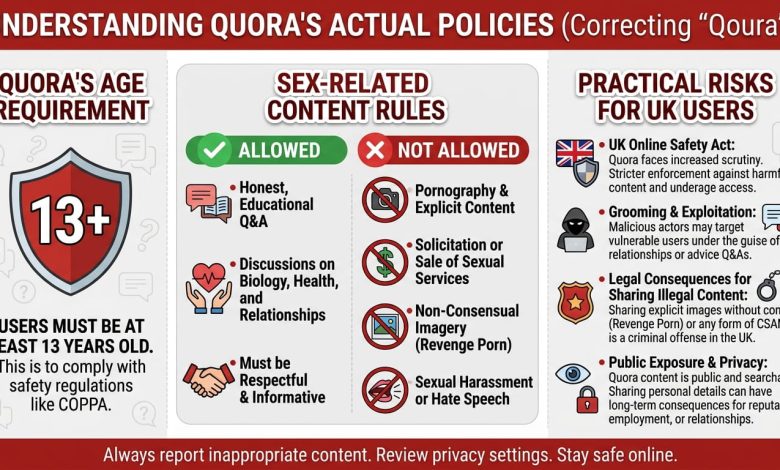
“Qoura sex” is almost certainly a misspelling of Quora, the question-and-answer platform. There is no separate site called “Qoura”. If you are searching for it, you are probably looking for one of two things: discussions about sex on Quora, or Quora’s rules on sexual content. This article covers both, with a focus on what UK users should understand about the platform’s adult content policy, its age requirements, and the practical risks of relying on user-generated answers for sensitive topics.
The Spelling: Quora, Not Qoura
Quora is the correct name. The platform was founded in 2009 and is headquartered in Mountain View, California. It allows users to ask questions and receive answers from other users, who can display credentials to support their responses.
The misspelling “Qoura” appears frequently in search queries, likely because the letter “u” and “o” are adjacent on a keyboard and the word is unfamiliar to some users. There is no official Quora domain at “qoura.com“. If you encounter a site using that spelling, treat it with caution.
What Quora’s Adult Content Policy Actually Says
Quora does permit discussions about sex, but within defined boundaries. The platform’s help pages, available in multiple languages including Spanish, French and Japanese, set out the rules clearly .
What Counts as Adult Content
Quora defines adult content as material that is pornographic, depicts a sexual act, or is openly sexual. Specific examples from the platform’s own guidance include:
- Videos of sexual acts
- Representations of sexual acts, including anime or cartoon depictions and film captures, regardless of whether nudity is shown
- Provocative or sexually explicit content, including sexual fetishes or graphic language that is not educational in nature, such as detailed descriptions of sexual acts
- Nudity without an educational or journalistic purpose
- Sexually explicit or suggestive jokes
- Images that focus excessively on intimate body parts, even when clothed
- Non-professional media showing people posing provocatively in underwear or sheer clothing in private settings
- Non-educational discussions of pornographic websites
What Is Permitted
Quora explicitly allows several categories that might otherwise fall under a broad adult content definition:
- Videos of breasts with mastectomy scars, or a mother breastfeeding
- Artworks containing nudity, such as paintings and sculptures, where the primary purpose is not sexual arousal
- Tribal nudity shared for educational purposes
- Professional photoshoots with models in branded lingerie or swimwear
- Discussions about puberty or sex education
- Testimonies from victims of sexual violence
- General debates about the sex industry using academic terms
The distinction Quora draws is between content that serves a purpose (education, art, support, discussion) and content that exists for sexual gratification or shock value.
How Adult Content Is Controlled
Quora does not feed adult content to users by default. Questions about adult topics, including sex, appear in a user’s feed only if they have opted in through their settings or if they follow a specific adult content topic . Images of a sexual nature are permitted only on pages tagged with adult topics . Profile pictures cannot contain sexual imagery because they appear across the entire site.
The Practical Reality: What Users Actually Find
The policy on paper and the experience on the platform do not always match. A 2021 investigation by VICE described Quora as hosting a “thriving erotic community,” with users posting nude images and explicit content in answer to questions that solicit them . VICE noted that Quora’s rules do not forbid nudes outright; the platform’s guidance states that content about sex should be “useful” and not “jokey, puerile, adversarial, or graphic” . The interpretation of “useful” is, as VICE pointed out, highly subjective.
Parent reviews on Common Sense Media include repeated complaints that explicit material is easily accessible despite the platform’s stated age rating of 13 and over . One reviewer described the app as “loaded with pornography” that is “very graphic and easily accessible” to children . These are user accounts rather than verified audits, but the volume of similar complaints suggests the moderation challenge is real.
Age Requirements and Safety for Younger Users
Quora is intended for users aged 13 and over . This is consistent with the age limits of many social platforms used in the UK, including Reddit, Snapchat, TikTok and Instagram (which requires 16 in some contexts) .
Meeting the minimum age does not make the platform suitable for every teenager. Bitdefender’s parental guide, updated in August 2026, warns that children may encounter inaccurate information, mature topics, bullying, scams and unwanted private messages from strangers . The guide recommends that parents disable search engine indexing of a child’s profile, turn off adult content in recommendations, restrict who can send messages, and disable comments .
A Quora thread from February 2025, in which a parent asked whether their 12-year-old daughter should be allowed on the platform, drew responses advising against it. One respondent cited the age limit of 13, the presence of “inappropriate sexual content,” and the risk of sexual predators, recommending that if a teenager does use the site, they should avoid posting selfies, use a gender-neutral name, and disable messaging .
Should You Use Quora for Sex-Related Questions?
Quora can be useful for general information. You may find discussions about sexual health, relationships, consent and education that are accurate and thoughtful. But the platform is not a substitute for professional advice, and it is not regulated as a health or advisory service.
For UK readers, the safer sources for sexual health questions are the NHS website, a GP or sexual health clinic, and organisations such as Brook or the Family Planning Association. These provide verified, evidence-based information tailored to UK residents, including guidance on contraception, STI testing and consent law.
If you do read Quora answers on sexual topics, treat them as personal opinions rather than medical or legal facts. The platform’s own content policy acknowledges that users may encounter mature material, and its moderation is not perfect. The same caution applies to any user-generated platform.
Frequently Asked Questions
What is “Qoura sex”?
“Qoura sex” is a misspelling of Quora, the question-and-answer platform. There is no separate site called Qoura. The search likely refers to discussions about sex on Quora or to the platform’s adult content policy. Quora permits sex-related discussions within limits, but does not allow pornographic content, explicit depictions of sexual acts, or non-educational graphic descriptions.
Does Quora allow adult content?
Quora allows discussions about sex and some adult topics, but with restrictions. Pornographic content, explicit depictions of sexual acts, and non-educational graphic descriptions are not permitted. Adult content is only shown to users who have opted in through their settings or who follow specific adult topics. Images of a sexual nature are confined to pages tagged with adult topics .
What is the age limit for Quora?
Quora is intended for users aged 13 and over . This is the platform’s stated minimum age. However, the age limit does not guarantee that all content is suitable for younger teenagers. Parental guidance and privacy settings are recommended, including disabling adult content in recommendations and restricting private messages .
Is Quora safe for children?
Quora is not designed specifically for children. Users aged 13 and over may encounter mature content, misinformation, strong opinions and unwanted contact from strangers. Bitdefender’s parental guide recommends adjusting privacy settings, disabling adult content recommendations, restricting messaging, and maintaining open conversations about online safety . Some parents on Quora itself have advised against allowing children under 16 to use the platform unsupervised.