What Is the Time for Evening? Why the Answer Depends on Where You Are and What You Mean

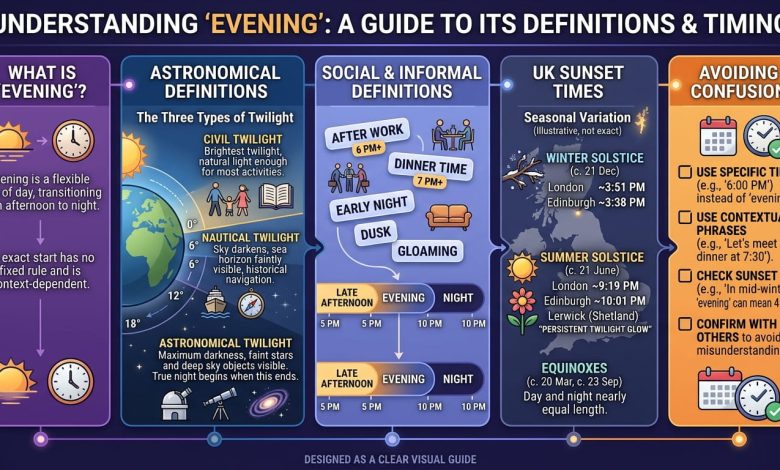
There is no single, fixed time when evening begins. In everyday social usage, many people in the UK consider evening to start around 5pm or 6pm, but the Oxford English Dictionary defines it as “the time from about 5 p.m., or sunset if earlier” . This means the answer shifts with the seasons, your location, and whether you are talking about daylight or social arrangements. This article explains the competing definitions, what “evening” means in a UK context across the year, and how to avoid confusion when making plans.
The Two Main Ways Evening Is Defined
The confusion around “what time is evening” comes from two different systems being used at once. One is astronomical, based on the sun. The other is social, based on the working day and meal times.
The Social Definition: Around 5pm to 6pm
The Oxford English Dictionary’s entry, cited by Wikipedia, gives the social definition: evening is “the time from about 5 p.m., or sunset if earlier” . Encyclopædia Britannica similarly notes that many people consider evening to begin at 5pm .
This is the definition most people use when making plans. If someone says “let’s meet this evening”, they usually mean sometime after the working day ends, typically between 5pm and 8pm. QuillBot’s guide to the word puts the practical window at roughly 5pm or 6pm until about 11pm or midnight, describing it as “from when most people finish their working day until when most people go to bed” .
The Astronomical Definition: Sunset and Twilight
The other definition ties evening to the sun. Wikipedia notes that evening “generally indicates the period of time when the sun is close to the horizon and comprises the periods of civil, nautical and astronomical twilight” . Under this system, evening begins when the sun starts to set and lasts until full darkness.
This is where the UK’s seasonal variation becomes significant. In London in late October, sunset can be around 4:37pm . In midsummer, it can be after 9pm . If evening begins at sunset, then evening starts at very different times across the year.
What Evening Means in the UK Across the Year
The UK’s high latitude means daylight hours swing dramatically between summer and winter. This affects both the astronomical and social experience of evening.
Winter: Evening Starts Early
In the depths of winter, sunset in London can be before 4pm. Under the astronomical definition, evening begins in the mid-afternoon. Under the social definition, it still begins around 5pm or 6pm, but by that time it has been dark for an hour or more.
This is why, on a dark December afternoon, someone might say “good evening” at 4:30pm. It feels like evening because the light has gone, even though the clock says it is late afternoon .
Summer: Evening Stretches Late
In June and July, the UK enjoys long daylight hours. The Daily Express reported in March 2026 that from late May onwards, the sun will start setting after 9pm in the UK, with roughly 60 sunsets at or after 9pm in London .
Under the astronomical definition, evening does not begin until late. Under the social definition, it still starts around 5pm or 6pm, but it is bright daylight. A person might say “good afternoon” at 6pm in July if the sun is still high, or “good evening” if they are leaving work or heading to dinner .
Evening Versus Night: Where the Boundary Sits
If evening has no fixed start, its end is equally fuzzy. The common understanding is that evening transitions into night when darkness is complete, or when people go to bed.
A WordReference forum discussion among UK speakers put “good evening” at roughly 6pm to 10pm, with “good night” reserved for when someone is going to sleep or the day has clearly ended . QuillBot notes that “night” is often used for arrangements that start in the evening and continue late, and that we say “good night” rather than “good evening” when someone is heading to bed .
A useful distinction: evening is the period of winding down, night is the period of sleep or full darkness. The boundary is behavioural as much as astronomical.
How to Avoid Confusion When Making Plans
Because “evening” is imprecise, the practical solution is to give a time. “Tomorrow evening” could mean 6pm or 9pm, and the gap matters.
QuillBot’s guidance is direct: clarify statements like “Let’s meet tomorrow evening” with exact times, and if an event starts after about 9:30pm, describe it as “late evening” rather than “evening” . This is simple and effective. “Early evening” is generally understood as 5pm to 7pm. “Late evening” is roughly 9pm onwards.
For UK readers, it is also worth noting that “evening” in a work context often means after 5pm or 6pm, while “evening” in a social context can start earlier if the days are short. If you are unsure, ask.
Frequently Asked Questions
What time does evening start?
There is no fixed time. The Oxford English Dictionary defines evening as beginning “from about 5 p.m., or sunset if earlier” . In summer, sunset is late, so the social definition of 5pm or 6pm applies. In winter, sunset can be before 4pm, so evening may feel like it has started by mid-afternoon. For plans, give an exact time rather than relying on the word alone.
Is 5pm considered evening?
In social usage, 5pm is often treated as the start of evening, or at least the boundary between late afternoon and early evening. QuillBot notes that around 5pm to 6pm, people may say “good evening” depending on context, such as leaving work or arriving for dinner . In summer daylight, some might still call 5pm afternoon. The word is flexible.
Is 4pm evening or afternoon?
4pm is generally considered afternoon, especially in summer when it is still bright. However, if it is already dark, as in a UK winter, 4pm can feel like early evening, and someone might use “evening” to describe the darkness rather than the clock . The social default is afternoon, but the astronomical experience can override it.
What is the difference between evening and night?
Evening is the transition period between the end of the day and full night. Night is the period of darkness when most people sleep. In practice, evening is when people have dinner, socialise, or wind down, while night is later and darker. We say “good evening” as a greeting and “good night” before sleep . The boundary is not fixed by the clock.