
RAF Alconbury, England: A Practical Guide to the US Air Force Base in Cambridgeshire

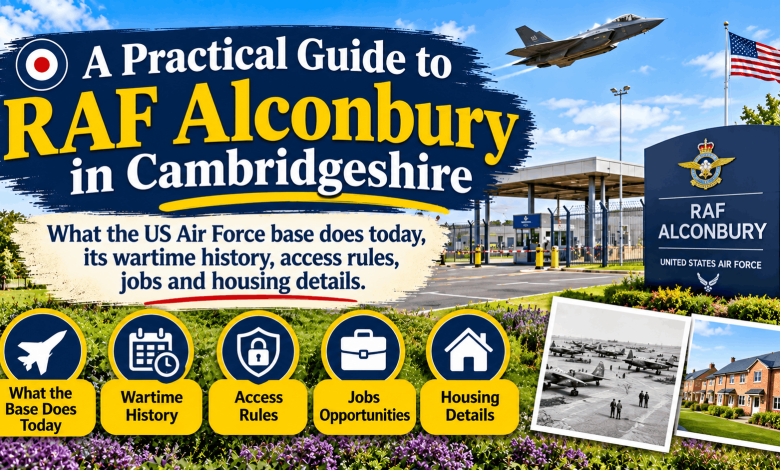
RAF Alconbury is a United States Air Force installation in Cambridgeshire, England, located near the town of Huntingdon roughly 60 minutes north of London and about 30 minutes north-west of Cambridge. Despite the “RAF” in its name, it is currently a US Air Force facility supporting the 423rd Air Base Group and the 501st Combat Support Wing’s Pathfinder mission. This guide covers what the base actually does today, its unusual history, who can access it, and the practical details for anyone posted there or living nearby.
What RAF Alconbury Is Today
The base is not a flying station in the traditional sense. Its current role is as a support hub. RAF Alconbury hosts the 423d Air Base Group as well as the 423d Civil Engineer Squadron, 423d Security Forces Squadron, 423d Communications Squadron, 423d Medical Squadron, 423d Force Support Squadron and various base support functions . It works alongside RAF Molesworth and RAF Wyton as part of a tri-base arrangement under the 501st Combat Support Wing, headquartered at RAF Mildenhall .
The day-to-day population is a mix of active-duty US Air Force personnel, US federal civilians, contractors, and their families. The base has its own commissary, a limited Base Exchange (AAFES) store, a bowling centre, and a school . Alconbury Elementary School and Alconbury Middle/High School operate under the Department of Defense Education Activity (DoDEA) system .
A Brief History: From Cornfield to Cold War Hub
RAF Alconbury opened in 1938 as a grass satellite airfield for RAF Upwood, a deliberate dispersal tactic so that aircraft were not concentrated at permanent airfields. During the Second World War it hosted US Army Air Force units, including the 93rd Bombardment Group and later the 482nd Bomb Group, part of the Pathfinders .
The base’s most notorious wartime incident occurred on 27 May 1943, when a bomb load on a B-17 detonated accidentally while the crew prepared for a mission. Contemporary records state that 18 men were killed and four B-17s destroyed, though the figure of 19 dead appears in some later accounts . The event is memorialised on the base.
After the war, the US Air Force returned in 1954. The 10th Tactical Reconnaissance Wing arrived in 1959 and stayed for nearly 30 years . In 1982 the Strategic Air Command activated the 17th Reconnaissance Wing at Alconbury, bringing TR-1 (U-2) reconnaissance aircraft. The last U-2 departed in March 1995, and the flightline was returned to the Ministry of Defence on 30 September 1995 . During the Cold War, Alconbury also served as the USAFE tactical atomic weapons reserve.
A planning record from January 2026 notes that the site had been allocated in Huntingdonshire’s Local Plan to 2036 for approximately 1,680 homes and a primary school, but that the USAF was “no longer looking to bring forward the site for redevelopment” . In plain English: a large-scale housing conversion of the base is not currently progressing.
Access and Employment: Who Can Actually Go There
RAF Alconbury is an active military installation and is not open to the general public. Access is controlled, and the base hosts civic engagement events, but these are invitation-based rather than public open days. A Freedom Fest in June 2026 was explicitly described as open to base personnel and their guests only .
For employment, the rules are specific and often misunderstood. US Non-Appropriated Fund (NAF) positions at RAF Alconbury are open to US citizens, permanent residents and legal residents of the United States who live within a 60-mile radius of the base. Applicants must be citizens of a NATO country unless they have UK residency as a dependent of someone serving with the US Visiting Forces. British citizens may not apply for US NAF positions under the Status of Forces Agreement, though they may be eligible for local national positions on base.
Recent UK Government job listings for the base include roles such as cook, recreation aid, sports specialist, firefighter and emergency vehicle dispatcher, with hourly pay ranging from roughly £13.42 to £20.08 . Facilities management roles such as painter and decorator have also been advertised through contractors, with salaries around £32,000 to £34,000 .
Housing and Living On Base
Unaccompanied personnel may be assigned to the permanent party dormitory campus, which consists of 120 rooms: 91 with shared bathrooms and 29 individual suites with a bedroom and living space plus a bathroom. There are 29 kitchenettes, each shared by four residents . Amenities include three common rooms, one with a projector and movie screen, a billiards table, ping pong and gaming consoles, plus a shared kitchen, BBQ pits and a laundry room .
The rules are strict. Cooking in rooms is prohibited, pets other than fish are not allowed, and non-residents must leave the facility by midnight . A separate dormitory brochure adds that the entire Building 652 is a non-tobacco facility, with smoking only permitted at a designated area, and that items including space heaters, candles, open flames, firearms, paintball guns and knives with locking blades or over three inches long are banned .
For families, the Air Force Housing website advises personnel to contact their sponsor and the Unaccompanied Housing Management Office as soon as an assignment is confirmed, rather than arriving without arrangements .
Common Misunderstandings and Sensible Expectations
The first trap is the name. RAF Alconbury is not a Royal Air Force station in operational terms, despite the retained name and the presence of an RAF commander for Alconbury, Croughton and Molesworth. It is a US Air Force installation on UK soil.
The second is that the base is a visitor attraction. It is not. There is no public museum and no casual entry. The heritage is real and significant, but it is not packaged for tourism.
The third is the housing plan. The 2026 planning record confirms that the large-scale residential redevelopment once allocated in the Local Plan is not being brought forward by the USAF . Anyone who read older reports about 1,680 homes on the site should treat that as stalled rather than imminent.
Frequently Asked Questions
Can the public visit RAF Alconbury?
No. RAF Alconbury is an active military installation with controlled access. Events held there, such as Freedom Fest in June 2026, are open to base personnel and their guests only, not the general public .
Can British citizens work at RAF Alconbury?
Yes, but not in US NAF positions. British citizens may be eligible for local national positions or contractor roles on base. Recent UK Government listings for roles such as cook, recreation aid and firefighter were open through the US Visiting Forces local hiring process .
What is RAF Alconbury used for now?
It is a support hub, not a flying station. It hosts the 423d Air Base Group and provides base support functions to mission partners including the Joint Intelligence Fusion Center and AFR Africa Command J2-M, under the 501st Combat Support Wing .
What are the dormitory rules at RAF Alconbury?
Cooking in rooms is banned, pets other than fish are not allowed, and non-residents must leave by midnight. Smoking is only permitted in a designated area outside Building 652. Prohibited items include space heaters, candles, open flames, firearms, paintball guns and knives with locking blades over three inches .
Is RAF Alconbury being redeveloped for housing?
Not currently. A January 2026 planning record confirms that while the site was allocated for approximately 1,680 homes in the Local Plan to 2036, the USAF is “no longer looking to bring forward the site for redevelopment” .
