
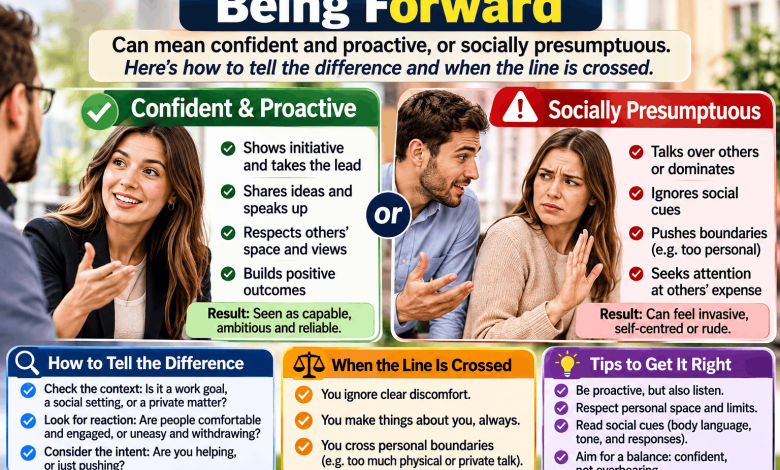
Being forward means being direct, bold, and willing to act without waiting for an invitation. In British English, it carries two very different tones. It can describe someone who is confident and proactive, which is generally admired. But it can also describe someone who is “overly bold, direct, or socially presumptuous,” which is a criticism . The difference is not in the word itself but in the context: who is being forward, to whom, and whether the other person welcomed it. This guide explains the two meanings, the situations where the line gets crossed, and how to tell the difference.
The Two Meanings of Being Forward
The dictionary definition gives both sides at once. “Forward” as an adjective can mean “ready, confident, bold,” but also “overready; too hasty” . The Accessible Dictionary adds the crucial phrase: “less reserved or modest than is proper” .
So the word contains its own tension. The same behaviour can be read as refreshing confidence or as a boundary violation, depending on who is watching.
The positive reading. A forward person is someone who takes initiative. They ask for what they want, propose ideas in meetings, and do not wait to be told what to do. A work advice source describes this as being “proactive” and “assertive” . In a professional context, this is usually a strength.
The negative reading. A forward person is someone who oversteps. They ask questions that are too personal, make comments that are too familiar, or pursue someone who has not shown interest. A HiNative explanation of the phrase “if that’s not too forward” describes it as a way of acknowledging that you might be “overstepping social boundaries” .
The Social Boundary: When Forward Becomes Too Forward
The clearest way to understand the negative meaning is through the phrase people use to soften it: “if that’s not too forward.” This phrase exists precisely because being forward carries a risk. You say it before asking a personal question, making a request, or offering an opinion that might be unwelcome .
The line is crossed when the other person has not consented to the level of intimacy or directness you are offering. A forward question about someone’s weekend is fine. A forward question about their relationship status, their salary, or their body is not, unless you know them well enough.
In dating, this distinction is especially sharp. A forum discussion about “forward women” reveals the double standard at work. One woman wrote that she is forward “because I am confident within myself and if I genuinely LIKE someone and I think they are worth getting to know” . But the same thread includes men describing forward women as “attention seekers” or as coming on “too strong.” One commenter pointed out the inconsistency: “a woman asking a man out, at least to me, is not coming on ‘too strong’ (if so, then a man asking a woman out on a date would be seen as ‘too strong’ but it isn’t)” .
The word is not neutral. It is applied unevenly, often to women and often as a criticism for behaviour that would be praised in a man.
How to Tell If You Are Being Too Forward
The question is not “am I being forward?” but “is this welcome?” Three tests help.
The relationship test. Do you know this person well enough to ask what you are asking? A colleague you have spoken to twice is not the same as a friend of five years.
The reciprocity test. Have they shown interest in this kind of conversation before? If you have to guess, the answer is probably no.
The exit test. If they wanted to end this conversation or decline this request, would they feel able to? If your directness puts them in an awkward position, it is too forward.
How to Be Forward Well
Being forward is not a flaw. It is a skill, and like any skill it can be practised with care.
Be direct about your own feelings, not about their obligations. “I’d like to see you again” is forward and respectful. “Why haven’t you texted me back?” is forward and pressure.
Use the softening phrase when you are unsure. “If that’s not too forward” signals that you are aware of the boundary and are giving them room to decline .
Read the response. A forward move that is welcomed will be met with engagement. A forward move that is not welcomed will be met with hesitation, a change of subject, or a polite deflection. Stop at the first sign.
Frequently Asked Questions
What does “being forward” mean?
It means being direct, bold, and willing to take initiative. It can be positive (confident, proactive) or negative (overstepping social boundaries, too presumptuous) depending on context .
Is being forward a bad thing?
Not necessarily. In a work context, being forward is often valued as assertiveness. In a personal context, it becomes a problem when it makes someone uncomfortable or ignores their lack of interest .
What does “if that’s not too forward” mean?
It is a polite phrase used before a request or comment that might be seen as bold or presumptuous. It shows that you are aware you might be overstepping and gives the other person room to decline .
Why is being forward judged differently for men and women?
The word is applied unevenly. A woman asking a man out may be called “forward” in a way that a man asking a woman out is not. The behaviour is the same; the judgement is not .