
Let’s be honest about something. Most people who start a fitness journey don’t fail because they’re lazy. They fail because they picked the wrong workout routines for their goals, their schedule, or their body and then blamed themselves when results didn’t come.
You’ve probably been there. You followed a program someone posted online, went hard for two weeks, felt nothing, and quietly stopped. Or you watched someone with a completely different body type swear by a routine that did absolutely nothing for you. It’s not a motivation problem. It’s an information problem.
This guide cuts through that noise. We’re going to cover what the best workout routines actually look like depending on what you want, why the same program doesn’t work for everyone, and how to build something that sticks long enough to produce real results.
Why Most People Choose the Wrong Workout Routines
Before building anything, it’s worth understanding why so many people start strong and stall out.
The biggest mistake isn’t effort. Most people who hit the gym regularly are putting in effort. The problem is effort without structure or worse, a structure borrowed from someone with completely different goals.
A bodybuilder’s split routine won’t serve someone trying to lose 20 pounds and get off blood pressure medication. A marathon runner’s weekly plan won’t build the upper body strength a desk worker needs to fix their posture. Yet people swap programs constantly without asking whether the program was designed for someone with their goals in mind.
The second common mistake is ignoring recovery. The best workout routines in the world stop working when you train seven days a week without proper rest. Muscle isn’t built during training it’s built during the 24 to 48 hours after. Skipping rest doesn’t show dedication. It shows a misunderstanding of how adaptation works.
The third mistake: chasing variety too fast. There’s a concept called progressive overload gradually increasing the demand on your muscles over time — that is the single most important driver of physical results. Switching programs every three weeks to “keep the muscles guessing” is largely a fitness myth. What you actually need is enough consistency to track progress and push slightly harder each week.
The Foundation Understanding What You Actually Want
Before picking any specific workout routine, you need an honest answer to one question: what result are you actually after?
Not “I want to get in shape.” That’s not specific enough to build around. What does “in shape” look like for you?
Here are the most common real goals, and why they require different approaches:
Fat loss: Requires a caloric deficit supported by training that preserves muscle mass. The best workout routines for fat loss combine resistance training with enough activity to burn calories not just cardio.
Muscle building (hypertrophy): Requires progressive overload through resistance training, adequate protein intake, and consistent rest periods. Volume and intensity matter more than variety.
Strength: Requires training at higher percentages of your maximum capacity with longer rest periods. Compound lifts squats, deadlifts, bench press, overhead press are the backbone of best workout routines built for strength.
Athletic performance: Requires sport-specific training, conditioning work, and often mobility and injury prevention protocols that purely aesthetic programs skip entirely.
General health and longevity: Requires a mix of cardiovascular health, strength maintenance, flexibility, and consistency over years. This is actually the goal most people should have but rarely admit.
Be honest about which category you’re actually in. Your program will look very different depending on your answer.
The Best Workout Routines by Goal
Best Workout Routines for Fat Loss
The research on fat loss training is clearer than the fitness industry wants it to be. Cardio burns calories in the moment. Resistance training builds muscle that burns calories around the clock. The best workout routines for fat loss do both.
A proven structure for fat loss looks like this:
Three to four days of resistance training per week, focused on compound movements that work multiple muscle groups simultaneously. Think squats, Romanian deadlifts, push-ups or bench press, rows, and overhead presses. These movements burn more calories than isolation exercises and build more functional muscle.
Two days of moderate-intensity cardio this could be a brisk walk, a bike ride, swimming, or anything that keeps your heart rate elevated for 30 to 45 minutes without destroying your recovery.
One to two full rest days. Not active recovery days disguised as rest actual rest.
The missing piece most people skip: diet. No workout routine outworks a poor diet for fat loss. The training creates the environment; what you eat determines whether you actually lose fat. High protein intake (0.7 to 1 gram per pound of body weight) helps preserve muscle during a caloric deficit, which keeps your metabolism from slowing down as you lose weight.
Best Workout Routines for Building Muscle
Muscle building requires volume. That means enough sets and reps over the week, applied to each muscle group, to create the stimulus for growth.
The most effective structures for hypertrophy are either full-body training three days per week, or a push/pull/legs split across four to six days. Full-body works particularly well for beginners and intermediates. Advanced lifters often need higher volume per muscle group, which a split handles better.
A sample push/pull/legs structure:
Push (chest, shoulders, triceps): Bench press, overhead press, lateral raises, tricep work 3 to 5 sets per exercise, 8 to 12 reps.
Pull (back, biceps): Barbell or dumbbell rows, lat pulldowns or pull-ups, bicep curls same rep and set structure.
Legs (quads, hamstrings, glutes, calves): Squats, Romanian deadlifts, leg press, calf raises.
Run through this twice a week (six training days) or once with additional full-body days. The key is progressively increasing the weight or reps over time. If you lifted the same weight for the same reps for six months and wondered why you stopped growing, progressive overload is the answer.
Best Workout Routines for Strength
Pure strength training looks different from muscle building training, even though both involve lifting weights. The rep ranges are lower, the rest periods are longer, and the movements are fewer but heavier.
The most respected beginner-to-intermediate strength programs StrongLifts 5×5, Starting Strength, and GZCLP all share a common structure: three training days per week, built around squat, deadlift, bench press, overhead press, and row variations. You train heavy, rest two to three minutes between sets, and add weight to the bar each session.
The reason these programs work isn’t because they’re complicated. It’s because they’re not. They force you to do the hard, unglamorous work of getting stronger at the movements that produce real-world strength and they give your body enough time to recover and adapt between sessions.
Strength training is where consistency and patience pay the biggest dividends. Going from squatting your bodyweight to squatting one and a half times your bodyweight takes months of disciplined training. But the carryover to everything else posture, energy, injury resistance, body composition is dramatic.
Best Workout Routines for Beginners
If you’re starting from scratch, here’s a truth most fitness content won’t tell you: any well-structured program works for beginners. Your body is new to the stimulus of resistance training and will adapt to almost anything applied consistently.
What beginners actually need isn’t an advanced program. They need:
A few compound movements done correctly. Squats, deadlifts, push-ups, rows, and overhead presses cover the full body with minimal complexity.
Enough frequency to practice the movements and build motor patterns. Two to three full-body sessions per week is enough.
Progressive overload applied conservatively. Add small amounts of weight or reps each week. Don’t try to set records every session.
A program you’ll actually keep doing. The best workout routine for a beginner is the one they’ll show up for consistently over twelve weeks. Not the most sophisticated, not the one the most muscular person at the gym uses the one that fits your schedule and feels manageable.
How to Structure Your Weekly Training Schedule
Most people either train too much or too randomly. The best workout routines are built around a predictable weekly structure that allows for both stimulus and recovery.
Here’s a framework that works across most goals:
Three days per week (Monday/Wednesday/Friday or Tuesday/Thursday/Saturday): Full-body resistance training. Best for beginners, people with busy schedules, and anyone whose primary goal is strength or general fitness.
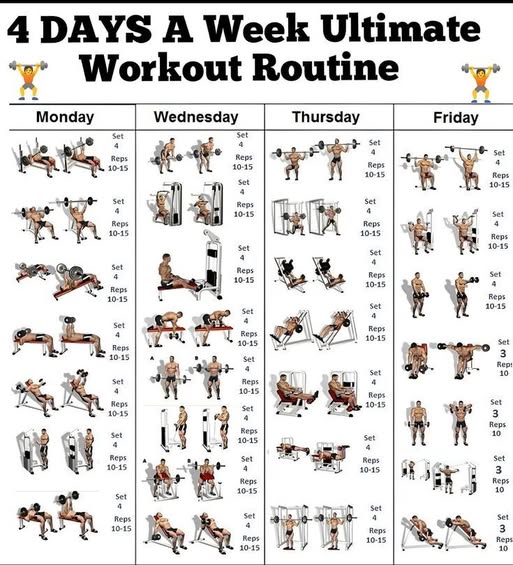
Four days per week (Upper/Lower split): Monday upper body, Tuesday lower body, Thursday upper body, Friday lower body. Works well for intermediate lifters who want more volume than a three-day program provides.
Five to six days per week (Push/Pull/Legs or body-part split): For people with specific hypertrophy goals and enough training experience to recover from higher volume. Not recommended for beginners, who won’t recover fast enough to benefit from the frequency.
One thing that makes or breaks any of these structures: sleep. Seven to nine hours of sleep per night is where the actual adaptation happens. No supplement, no protein shake, no recovery tool replaces proper sleep. If your workout routine is solid but your results are stalling, look at sleep before you change the program.
The Role of Cardio in the Best Workout Routines
Cardio gets a bad reputation in resistance training circles, and an overblown reputation in weight loss communities. Neither extreme is useful.
Here’s what cardio actually does: it improves cardiovascular efficiency, supports caloric expenditure, aids recovery by increasing blood flow, and maintains heart health over the long term. It does not “burn muscle” in any meaningful way when combined with adequate protein intake and resistance training.
The most practical approach to cardio within a weekly training structure:
Zone 2 cardio (low intensity, long duration): Walking, cycling, or swimming at a pace where you can hold a conversation. This is the type that supports cardiovascular health most directly and has essentially no negative impact on recovery. 150 minutes per week is the widely cited target for general health.
HIIT (high intensity interval training): Short, intense bursts with rest periods. Effective for caloric burn in a short time window but harder to recover from. One to two sessions per week is enough for most people. More than that, and it starts competing with your resistance training recovery.
The simplest approach: walk more. Walking is underrated in almost every fitness conversation. A person who walks 8,000 to 10,000 steps per day and lifts three times per week will outperform most complicated cardio programs for fat loss and general health.
Common Mistakes That Kill Results in Any Workout Routine
Even the best workout routines fail when a few consistent errors creep in. Here are the ones worth watching.
Not Tracking Progress
If you don’t track your lifts, you don’t know whether you’re progressing. Write down what you lifted, how many reps, and how it felt. This doesn’t need an app a notebook works. The point is accountability to the progressive overload principle.
Underestimating Nutrition
Training is the stimulus. Nutrition is the raw material. You can run the best workout routines in the world and get mediocre results if you’re not eating enough protein to support muscle repair. Aim for 0.7 to 1 gram of protein per pound of bodyweight daily. Everything else carbs, fats, meal timing matters less.
Changing Programs Too Often
Three weeks in, you feel like the program isn’t working. You find something new online. You switch. Three weeks later, same feeling. You switch again. This cycle keeps you permanently at beginner stimulus levels because you never push a program long enough to see what it can actually produce. Give any well-designed program at least eight to twelve weeks before evaluating whether it’s working.
Skipping the Warm-Up
A five to ten-minute warm-up dynamic stretching, light movement patterns relevant to what you’re training reduces injury risk and improves performance in the session that follows. People who skip warm-ups eventually pay for it with tweaks, strains, and setbacks that cost them weeks of training.
Training Through Pain (Not Discomfort)
There’s a difference between the discomfort of hard training and pain that signals tissue damage. Muscle fatigue and burning during a set is normal. Sharp pain, joint pain, or pain that persists after training is not something to push through. Training through real pain turns a minor issue into a serious one. Know the difference and respond accordingly.
Building a Home Workout Routine With No Equipment
A gym membership is not a prerequisite for results. Some of the most effective workout routines require no equipment at all just floor space and the willingness to work hard.
A bodyweight-only routine for someone training at home:
Push pattern: Push-ups (standard, wide, narrow, archer) multiple progressions exist from beginner to advanced.
Pull pattern: If you have a pull-up bar (around $20 to $30), rows and pull-ups. Without one, use a sturdy table edge for inverted rows.
Hinge pattern: Glute bridges, single-leg deadlifts with body weight, good mornings.
Squat pattern: Squats, Bulgarian split squats, lunges, step-ups.
Core: Planks, dead bugs, hollow holds, mountain climbers.
The limiting factor with bodyweight training is progressive overload eventually you run out of ways to make a push-up harder without adding weight. But for beginners and people building back after a break, a well-designed bodyweight program produces real results for three to six months before that ceiling becomes an issue.
Workout Routines for Specific Situations
H3: Workout Routines for People Over 40
Training after 40 isn’t about backing off. It’s about being smarter about recovery. Compound movements remain the most effective. Injury prevention proper warm-up, attention to joint health, foam rolling, and mobility work becomes more important than it was at 25.
Recovery time increases. What took 24 hours to recover from at 22 might take 48 hours at 45. Building that into the schedule, rather than ignoring it, keeps you training consistently for years rather than cycling in and out of injury.
The goal after 40 shifts slightly toward maintaining muscle mass (which declines naturally with age), keeping bone density strong, and preserving functional movement patterns. Resistance training is one of the most evidence-backed interventions for healthy aging.
H3: Workout Routines for Busy People
If you have 30 minutes, three times a week, you can produce meaningful results. The key is eliminating anything that isn’t producing value.
A 30-minute full-body session built around four compound exercises squat, hinge, push, pull with minimal rest between sets covers the full body effectively. Supersets (doing two non-competing exercises back to back) keep the heart rate up and cut down on time spent waiting.
Three consistent 30-minute sessions per week, applied for a year, will produce more visible results than six inconsistent one-hour sessions per week for four months followed by nothing.
How Long Before Workout Routines Produce Visible Results?
This is the question everyone has and nobody answers honestly.
Beginners can feel stronger within two to three weeks of starting resistance training. Visible muscle changes take longer typically six to twelve weeks of consistent training and proper nutrition before most people notice a difference in the mirror. Others around you often notice before you do.
Fat loss has a similar timeline. The scale might not reflect dramatic changes in the first few weeks because muscle gain and fat loss can happen simultaneously. Body composition is changing even when the number isn’t. Progress photos every four weeks are more useful than daily weigh-ins for tracking what’s actually happening.
The honest answer: most people who are disappointed with results at eight weeks were actually on the edge of seeing real change. The fourth, fifth, and sixth months of consistent training tend to produce disproportionately visible results compared to the first two months. Stopping at month two is the most common way to stay stuck.
Putting It Together Your Next Step
You’ve now got a solid picture of what the best workout routines look like across different goals, schedules, and experience levels. The next step is not finding a more perfect program. It’s picking one and starting.
Here’s a simple decision path:
- Beginner with no equipment? Start with a bodyweight full-body routine three days a week.
- Beginner with gym access? Start with StrongLifts 5×5 or a similar beginner strength program.
- Intermediate lifter wanting more muscle? Move to a push/pull/legs split, four to six days per week.
- Fat loss as the primary goal? Three days of resistance training plus two days of cardio, and sort out your nutrition.
- Limited time? Three full-body sessions of 30 minutes, built around compound movements.
Track your progress. Eat enough protein. Sleep. Give your program at least twelve weeks before judging it.
The best workout routines are not the most complicated ones. They’re the ones you show up for consistently, apply progressively, and give enough time to work. That’s it. Everything else is details.