
You’re scrolling through your messages and someone drops a lone “of” no context, no emoji, nothing else. Or maybe you see “OF” all over TikTok comments and Instagram bios and you’re not sure if it’s a typo or actually means something. You’re not alone. The meaning of “of” trips people up more than you’d think, partly because this tiny word lives two completely different lives at once.
In standard English, “of” is one of the most used words in the entire language. In texting and internet culture, “OF” has picked up a whole separate identity that has nothing to do with grammar. This guide breaks down every meaning from the basics of standard English usage to the slang versions you’ll find on TikTok, Snapchat, and in group chats so you always know exactly what’s being said.
What Does “Of” Mean in Standard English?
At its most basic level, “of” is a preposition. It’s one of those words that quietly holds sentences together without getting much credit for it.
Merriam-Webster lists it among the most common prepositions in the English language, alongside words like “to,” “for,” “with,” and “at.” It shows up in phrases like “a glass of water,” “a friend of mine,” or “the sound of music.” In each case, it’s connecting one idea to another showing possession, relationship, or composition.
The Core Uses of “Of” in Grammar
Possession or relationship: “The roof of the house” or “a friend of the family.” Here, “of” shows that one thing belongs to or relates to another.
Made from / composition: “A wall of stone” or “a bowl of rice.” You’re describing what something consists of.
Measurement or quantity: “A cup of flour” or “a dozen of them.” This use shows how much or how many.
Distance or time: “North of the city” or “a moment of silence.” Position and timing both lean on “of” constantly.
Cause or reason: “He died of old age” or “she was afraid of the dark.” The preposition marks what caused something.
It’s worth knowing that “of” is classified as a “closed class” word in English meaning no new words get added to this category over time. It’s been doing the same job for centuries.
Why “Of” Gets Confused with “Have”
One of the most common grammar mistakes in English involves “of” and “have.” People write “could of” when they mean “could have” and it’s not random. When you say “could’ve” out loud, the contracted “ve” sounds exactly like “of.” So the ear hears one thing while the grammar calls for another. “Could have,” “would have,” and “should have” are always correct. “Could of,” “would of,” and “should of” are never right in formal writing, even though they sound identical in speech.
What Does “OF” Mean in Slang and Texting?
Now for the version that’s actually confusing people online. When someone uses “OF” in a text message, a TikTok comment, or an Instagram bio, they’re almost certainly not talking about grammar.
OF = OnlyFans (The Most Common Meaning)
The most widely recognized slang meaning of “OF” is OnlyFans the subscription-based content platform that lets creators charge fans for exclusive access to their posts, photos, and videos. The abbreviation took off around 2020 when the platform went mainstream and the term “OnlyFans” started getting suppressed by social media algorithms on Instagram and TikTok. Creators realized that spelling it out could get their posts flagged or their accounts shadowbanned, so “OF” became the go-to workaround.
You’ll spot it most often in:
- Instagram and TikTok bios (“Link in bio / OF link below”)
- Twitter threads and replies
- DMs where someone’s sharing or asking about a creator’s page
- Reddit posts discussing content creators
Context matters a lot here. If someone says “check her OF” or “she has an OF page,” they mean OnlyFans without question.
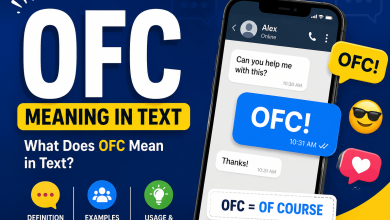
OF = Of Course (Casual Texting)
A less common but still real use of “OF” in texting is as a shortened form of “of course.” You won’t see this one as often as the OnlyFans meaning, but it does show up in quick back-and-forth conversations between friends where speed matters more than clarity.
For example:
- “You coming tonight?” / “OF”
- “You saw that, right?” / “OF 😂”
This usage is entirely about brevity. The person’s not abbreviating a platform they’re just saying yes, obviously, without the extra keystrokes. Context is everything: if the conversation has nothing to do with content creators, “of course” is probably what they mean.
OF = Odd Future (Hip-Hop Culture)
Before OnlyFans existed, “OF” meant something completely different in music circles. Odd Future full name Odd Future Wolf Gang Kill Them All, abbreviated OFWGKTA was a Los Angeles hip-hop collective that became a massive cultural force in the early 2010s. The group launched the careers of Tyler, the Creator, Earl Sweatshirt, and Frank Ocean, among others, and built a devoted fanbase that still uses “OF” as a shorthand for the group and its era.
If you’re in a conversation about early 2010s rap, alternative hip-hop, or Tyler, the Creator’s earlier work, “OF” almost certainly refers to Odd Future rather than anything else. The group was active from 2007 to 2016 and their cultural imprint on streetwear, skateboarding, and alternative rap is still felt today.
OF = “Only Friends” (Dating / Social Context)
This is the newest and least common usage, but it’s spreading in younger dating circles. Saying “we’re OF now” or “we’re just OF” means “only friends” and it’s usually delivered as a firm shutdown of any romantic possibility. It’s harsher than being friend-zoned in the traditional sense because it signals finality. This usage stays mostly within very casual texting between people who already have a close or humorous rapport.
OF = “Oh F***!” (Exclamation)
Some slang dictionaries also list “OF” as a shorthand for the exclamation “Oh F***!” used to express shock, surprise, or sympathy. It’s not particularly common in everyday texting, but it does appear in certain corners of the internet where strong reactions need a quick outlet. The context here would be something like a reaction to bad news or an unexpected reveal.
How to Tell Which Meaning Someone Intends
With four or five possible meanings, reading context correctly is the only way to know what someone actually means by “OF.”
If the conversation is about content creators, social media, or subscriptions: OF = OnlyFans.
If someone’s replying to a yes/no question with nothing but “OF”: OF = of course.
If the conversation is about music, specifically early 2010s rap or Tyler, the Creator: OF = Odd Future.
If someone’s shutting down a romantic situation with “we’re OF”: OF = only friends.
If it appears after something shocking: OF = Oh F***!
Platform matters too. On TikTok and Instagram, OnlyFans is almost always the assumed meaning for anyone under 30. In older or more mixed-age group chats, people might not catch the reference at all and just read it as a typo or abbreviation for “of course.”
Is “OF” Appropriate to Use?
That depends entirely on who’s in the conversation.
The OnlyFans meaning carries adult connotations since the platform is heavily associated with mature content. Using “OF” casually with friends your own age is generally fine, but it’s not something you’d want to drop into a work message, a family group chat, or any professional setting. Even though it’s just two letters, the implication is clear to anyone who knows internet culture.
The “of course” version is completely neutral and can be used anywhere informal language is acceptable.
The Odd Future reference is entirely harmless and is more of a cultural nod than anything provocative.
Real Conversation Examples
Seeing it in context makes the difference clearer than any explanation:
Example 1 (OnlyFans): Person A: “She’s been posting on her OF every day this week.” Person B: “Yeah, I subscribed last month.”
Example 2 (Of course): Person A: “You’re not mad at me, right?” Person B: “OF not 😅”
Example 3 (Odd Future): Person A: “I’ve been on a huge OF kick lately.” Person B: “Bro, Igor is so much better than anything from the early days though.”
Example 4 (Only friends): Person A: “So are we a thing or…?” Person B: “We’re OF, that’s it.”
Frequently Asked Questions About the Meaning of “Of”
What is the most common meaning of “OF” in text?
OnlyFans is the most common meaning by a wide margin, especially on platforms like TikTok, Instagram, and Twitter. If you see “OF” in the context of social media, content creators, or subscriptions, that’s almost certainly what it refers to.
Does “of” always mean OnlyFans in texting?
No. Context determines the meaning. “OF” can also mean “of course,” refer to the hip-hop group Odd Future, or stand for “only friends” depending on the conversation. Reading the surrounding messages usually makes it obvious.
What does “of” mean in grammar?
In standard English grammar, “of” is a preposition that shows relationships between words including possession, composition, measurement, and cause. It’s one of the ten most frequently used words in the English language.
What’s the difference between “of” and “have” in phrases like “could of”?
“Could of” is a grammatical error. The correct phrase is “could have” or the contraction “could’ve.” The mistake happens because “could’ve” sounds like “could of” when spoken aloud. In any formal or written context, always use “could have,” “should have,” or “would have.”
Why do TikTok creators use “OF” instead of spelling out OnlyFans?
Social media platforms like TikTok and Instagram have been known to suppress or limit the reach of posts that directly mention “OnlyFans.” To avoid getting shadowbanned or having their content flagged, creators use “OF” as a coded reference that their audience understands without triggering the algorithm.
What does OF mean from a girl in a text?
Without more context, it’s impossible to say for certain. If she’s talking about social media or her content, she likely means OnlyFans. If she’s responding to a question or agreeing with something, she might mean “of course.” If she’s setting boundaries in a romantic context, she may mean “only friends.”
What does OF mean in hip-hop?
In hip-hop culture, “OF” stands for Odd Future (also known as OFWGKTA Odd Future Wolf Gang Kill Them All), the influential Los Angeles rap collective led by Tyler, the Creator. The group was active mainly between 2007 and 2016 and launched the careers of several now-major artists including Frank Ocean and Earl Sweatshirt.
Can “OF” be offensive?
The word itself isn’t offensive. The OnlyFans association means using “OF” in the wrong setting could be awkward or inappropriate. Skip it in professional, family, or formal contexts to be safe.
What does $OF mean?
The “$OF” format is occasionally seen on social media where the dollar sign acts as an attention marker or stylized prefix. In most cases, it still refers to OnlyFans sometimes pointing to a specific creator’s page or payment link.
Is “of” one of the most used words in English?
Yes. “Of” consistently ranks among the top five to ten most frequently used words in written English, according to multiple corpus linguistics studies. It’s second only to “the” and “be” in terms of raw frequency across most large text databases.
The Word That Does More Than You Think
“Of” might look like nothing on its own two letters, no drama. But it carries enormous weight in both standard English and in online communication. In grammar, it’s doing the quiet structural work of connecting ideas across millions of sentences every day. In slang, it’s doing something entirely different: compressing a platform name, an agreement, a group’s identity, or a social signal into a pair of letters that anyone in the know will understand instantly.
The next time you see “OF” in a message, you’ll have the context to read it correctly. And if you want to keep building your slang vocabulary, check out our guides to other two-letter abbreviations and texting shorthand that are reshaping how people talk online.