
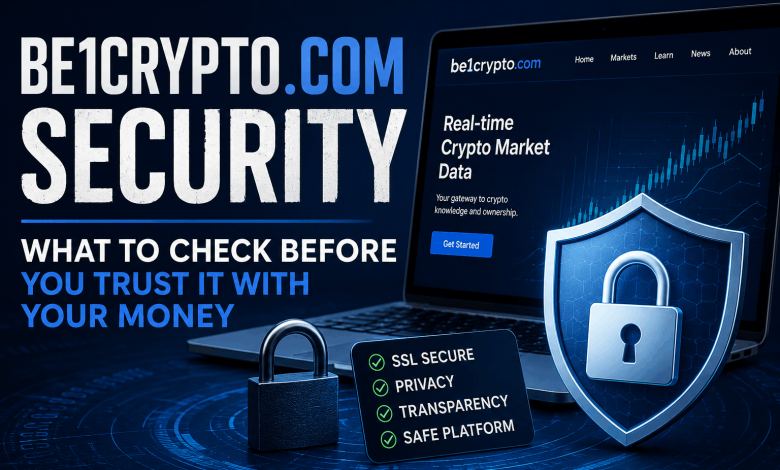
Picture this: you type “be1crypto.com” into Google, land on a slick page promising real-time market data and a smooth path from “learning” to “owning” crypto, and your very next thought is, “okay, but is this actually safe?” That question is exactly why you’re here. Be1crypto.com security comes up in searches from people who want a straight answer, not a sales pitch, so that’s what this guide gives you. You’ll get a plain look at what the site claims about its protections, what independent trust checks say, and a step-by-step way to verify any crypto platform on your own before you send it a dollar or your ID.
What Is Be1Crypto.com?
Be1crypto.com presents itself as a crypto information and education hub, covering blockchain basics, market news, and buying guides for beginners and experienced traders alike. Some pages tied to the domain also describe onboarding steps like account registration, identity verification (KYC), and guided crypto purchases. That mix matters because “an educational blog” and “a platform that handles your money and ID” call for very different levels of scrutiny, and a quick look at the site shows it’s positioning itself as both.
How Be1Crypto.com Security Claims Stack Up
A handful of pages describing be1crypto.com mention specific protections: two-factor authentication (2FA), cold storage integrations, SSL encryption, and a KYC process for new accounts. Here’s a plain breakdown of what each of those actually means and what to watch for.
Two-Factor Authentication (2FA)
2FA adds a second login step beyond your password, usually a rotating code from an app like Google Authenticator or Authy. That’s a real, meaningful protection when it’s implemented correctly. The catch: any site can claim it offers 2FA. Before you trust the claim, log in (or check the sign-up flow) and confirm the option actually appears and works, and skip SMS-based codes if you’re given a choice, since those are far easier for an attacker to intercept through a SIM swap.
SSL Encryption
A valid SSL certificate encrypts the connection between your browser and the site, which you can confirm yourself by checking for the padlock icon in your browser’s address bar. Be careful here: SSL only protects data in transit. It says nothing about how the company stores your data once it reaches their servers, and free SSL certificates are used by legitimate businesses and scam pages alike.
Cold Storage and Custody
Some pages describing be1crypto.com mention cold storage integrations for holding crypto offline, away from internet-connected systems. Cold storage is a genuinely stronger way to hold funds than a hot wallet, but a marketing claim isn’t proof. Legitimate exchanges typically publish proof-of-reserves reports or third-party audits confirming how much of user funds actually sit in cold storage. If you can’t find that kind of documentation, treat the claim as unverified.
KYC (Know Your Customer)
A KYC process, where you submit ID documents to open an account, is standard across regulated exchanges and isn’t a red flag by itself. It does mean you’re handing over sensitive personal information, so it raises the stakes on everything else: if the platform’s security around that data is weak, KYC just gives attackers more to steal.
Red Flags Worth Knowing About
Independent site-trust tools have flagged be1crypto.com with a low trust score. A few specific reasons tend to drive scores like that down, and they’re worth understanding regardless of which crypto site you’re evaluating.
- Recent domain registration. A young domain isn’t automatic proof of a scam, but scam sites are disproportionately new, since most get shut down within months once complaints pile up.
- Registrar reputation. Some domain registrars have a documented history of hosting a disproportionate share of spam and fraud sites. That alone doesn’t condemn a site registered through one, but it’s a factor trust-checking tools weigh.
- Mixed or generic marketing copy. Several pages describing be1crypto.com’s “blockchain” use oddly specific but unverifiable performance numbers (transaction speeds, fee amounts) without linking to a technical whitepaper, GitHub repository with real commit history, or third-party audit. That pattern is common in AI-generated or templated crypto marketing content, and it’s not something you should take at face value.
None of this proves be1crypto.com is fraudulent. It does mean the honest answer to “is it secure” is “unverified, and here’s how you check it yourself,” not “yes, don’t worry about it.”
How to Vet Any Crypto Platform’s Security Yourself
Whether you’re looking at be1crypto.com or any other crypto site, run through these steps before you deposit funds or submit ID.
- Check the domain age and registration history. Free tools like WHOIS lookups show when a domain was registered and by whom.
- Run the URL through an independent trust checker. Sites built for this purpose score domains on registrar reputation, complaint history, and technical red flags.
- Look for regulatory registration. In the US, legitimate exchanges typically register with FinCEN as a money services business, and some register with the SEC or CFTC depending on what they offer. Search the relevant regulator’s public database directly rather than trusting a badge on the platform’s own site.
- Search for independent reviews outside the platform’s own blog. Forums, Reddit threads, and consumer complaint boards surface user experiences a company’s own marketing won’t.
- Confirm 2FA and withdrawal limits actually exist by testing the account settings, not just reading a features page.
- Start small. Send a minimal test deposit and attempt a withdrawal before moving significant funds, regardless of how established a platform appears.
- Never store more than you need for active trading on any exchange or platform; move the rest to a hardware wallet you control.
Green Flags vs. Red Flags at a Glance
| What to Check | Green Flag | Red Flag |
| Domain age | Registered for several years | Registered within the last year |
| Regulatory status | Verifiable registration with FinCEN, SEC, or a comparable body | No regulatory registration found, or vague claims of compliance |
| Proof of reserves | Published, third-party audited reports | No audit, or audit claims with no linked documentation |
| 2FA | App-based 2FA confirmed by testing | 2FA mentioned only in marketing copy |
| Independent reviews | Consistent reviews across multiple unaffiliated sources | Reviews only on the platform’s own site or affiliate blogs |
| Trust score | Rated favorably by independent checkers | Flagged with a low trust score |
Frequently Asked Questions About Be1Crypto.com Security
Is be1crypto.com safe to use?
There’s no single verified answer, since independent trust checkers have flagged the domain with a low trust score while some marketing pages describe standard security features like 2FA and SSL. Treat it as unverified and run the vetting steps above before depositing funds or submitting ID.
Does be1crypto.com have two-factor authentication?
Some pages describing the platform mention 2FA as a feature, but that claim hasn’t been independently confirmed here. Test the sign-up and account settings yourself, and prefer an authenticator app over SMS codes if 2FA is available.
Is be1crypto.com regulated?
No independent regulatory registration for be1crypto.com was confirmed during this research. Search FinCEN’s, the SEC’s, or the CFTC’s public databases directly to check for any registered entity tied to the platform before trusting it with funds.
Why does be1crypto.com have a low trust score?
Independent checkers cite factors including a recently registered domain and a registrar associated with a higher rate of spam and fraud sites. Neither factor proves fraud on its own, but both are common patterns among scam platforms.
What’s the difference between be1crypto.com’s blog content and its trading features?
The domain hosts educational content about blockchain and crypto alongside pages describing account registration and crypto purchase features. Evaluate the informational content and the financial features separately, since a well-written blog post says nothing about how safely the platform handles your money.
How can I check if a crypto site is legitimate before signing up?
Run the domain through an independent trust-checking tool, search for regulatory registration in your country’s financial database, and look for reviews on sites the platform doesn’t control. Confirm claimed security features like 2FA by testing them yourself rather than trusting a features page.
What should I do if I already signed up and shared my ID?
Change your password immediately, enable app-based 2FA if you haven’t, and monitor your email and financial accounts for unusual activity. If you’re uneasy about how your data was handled, consider a credit freeze and watch for phishing attempts referencing the platform.
Are cold storage claims from crypto platforms trustworthy?
Only when backed by a published, third-party audit or proof-of-reserves report. A claim of cold storage with no supporting documentation is a marketing statement, not proof.
Check Before You Trust Any Platform With Your Crypto
Be1crypto.com’s own pages describe standard security features, but independent checks flag the domain with a low trust score tied to its age and registrar. The safest move is to run the domain through an independent trust checker, confirm any regulatory registration directly with FinCEN, the SEC, or the CFTC, and test claimed features like 2FA yourself before you deposit funds or hand over ID. Start with a small test transaction on any platform you’re still unsure about, and keep the bulk of your holdings in a hardware wallet you control.