
You added too much acid to your pool last week, and now the water looks dull, your eyes burn after every swim, and the chlorine just isn’t doing its job. Sound familiar? The fix might already be sitting in your kitchen cabinet. Baking soda for a pool isn’t some old wives’ tale — it’s a legitimate, affordable water chemistry tool that pool owners across the country use to keep their water balanced, clear, and comfortable. This guide covers exactly what baking soda does in a pool, when to use it, how much to add, and what mistakes to avoid.
What Baking Soda Actually Does for a Pool
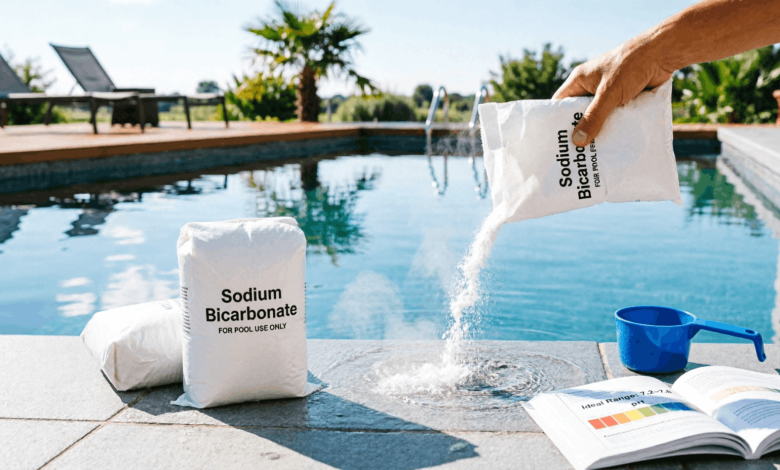
Baking soda — the same sodium bicarbonate you use in baking — works as a pH and alkalinity buffer in pool water. Its primary job is raising total alkalinity (TA), which is the measurement of how resistant your water is to pH swings.
When alkalinity is too low, your pool’s pH bounces around unpredictably. One day it’s too acidic, the next it’s too basic. That instability causes cloudy water, eye irritation, and chlorine that burns through fast without sanitizing properly. Adding baking soda brings alkalinity up and gives your pH somewhere stable to sit.
It’s worth being clear here: baking soda raises alkalinity first. It does raise pH too, but if your goal is only to lift pH, soda ash (sodium carbonate) does that job more directly. Baking soda is your go-to when both alkalinity and pH need a lift, or when alkalinity is the main problem.
Understanding Pool Water Chemistry Before You Add Anything
Before you reach for baking soda, you need to know your numbers. Pouring chemicals into unbalanced water without testing first is how pools go from cloudy to green.
The Numbers You’re Working With
These are the ranges you want your pool sitting in:
- Total Alkalinity: 80–120 ppm (parts per million)
- pH: 7.2–7.6
- Free Chlorine: 1–3 ppm
- Calcium Hardness: 200–400 ppm
Baking soda and swimming pools go hand in hand specifically when total alkalinity drops below 80 ppm. At that point, your water turns aggressive — it starts corroding metal fittings, etching plaster surfaces, and making chlorine work less efficiently.
How to Test Your Pool Water
Pick up a reliable test kit or test strips from any pool supply store. Brands like Taylor Technologies and LaMotte make liquid test kits that give you accurate readings for pH, alkalinity, and chlorine. Digital testers like the LaMotte ColorQ are popular for people who want quick, consistent results without color-matching strips.
Test your water before adding baking soda, then test again 4–6 hours after adding it. Don’t skip that second test.
How Much Baking Soda to Add to Your Pool
The amount depends on your pool size and how far your alkalinity has dropped. A standard rule of thumb used by most pool professionals:
1.5 pounds of baking soda raises total alkalinity by about 10 ppm in a 10,000-gallon pool.
Use this to calculate what you need:
- Test your current alkalinity level.
- Subtract it from 100 ppm (the middle of the target range).
- Multiply that difference by 1.5 for every 10,000 gallons your pool holds.
For example: Your pool holds 20,000 gallons and your alkalinity reads 60 ppm. You need to raise it by 40 ppm. That’s 4 × 1.5 = 6 pounds of baking soda.
Never add more than 2.5 pounds per 10,000 gallons in a single dose. Adding too much at once can overshoot your target and push pH too high. Go in smaller increments, test, and adjust.
Step-by-Step: How to Add Baking Soda to a Swimming Pool
This process takes about 20 minutes of active work and a few hours of patience.
- Test your water first. Confirm your total alkalinity is below 80 ppm and note the exact reading. Check pH too, so you know where you’re starting.
- Calculate your dose. Use the formula above. Round down slightly — you can always add more, but you can’t easily take it out.
- Turn on your pool pump. Run it on the circulation setting so the water is moving. This helps baking soda dissolve and spread evenly.
- Walk the perimeter of your pool. Slowly broadcast the baking soda across the surface of the water as you walk around the edge. Don’t dump it all in one spot — that can leave undissolved clumps on the pool floor.
- Let the pump run for at least 6 hours. Overnight is better. The longer the water circulates, the more evenly the baking soda distributes.
- Test again. Check alkalinity and pH. If alkalinity is still below 80 ppm, repeat the process with a smaller dose.
- Check chlorine levels. Raising alkalinity often affects how chlorine behaves. Make sure free chlorine is still in range before you declare the job done.
When You Should Use Baking Soda for a Swimming Pool
Not every pool problem calls for baking soda. Use it when:
- Your total alkalinity reads below 80 ppm on a test
- Your pH is low and unstable (bouncing around rather than holding steady)
- Your eyes and skin feel irritated after swimming, which often points to low pH
- Your pool water looks dull or slightly greenish despite having adequate chlorine
- Your pool has recently received heavy rain, which dilutes and acidifies water
- You’ve added a lot of muriatic acid or pH reducer and now alkalinity has dropped
Don’t use it if your alkalinity is already in range. Adding more baking soda when alkalinity is at 100 ppm or higher will push it too far and you’ll end up with scale deposits on tile and pool equipment.
Baking Soda vs. Alkalinity Increaser: Is There a Real Difference?
Walk into any pool store and you’ll see products labeled “Alkalinity Increaser,” “Alkalinity Up,” or similar names from brands like Clorox Pool&Spa, BioGuard, HTH, and Robarb. Most of these products are essentially sodium bicarbonate — the same compound as baking soda — just packaged with pool-specific labeling and instructions.
The difference is price. Pool store alkalinity increasers typically cost 2–4 times more per pound than plain baking soda from a grocery or warehouse store. ARM & HAMMER baking soda, bought in bulk from Costco or Sam’s Club, works just as well.
That said, read the label before assuming. Some alkalinity products include added ingredients. If the label says “sodium bicarbonate” as the only or primary active ingredient, you’re buying the same thing at a higher price.
For a large pool or frequent adjustments, using standard baking soda can save you $50–$100 or more per season.
What Happens If You Add Too Much Baking Soda to Your Pool
Overshooting is a real risk, especially for first-time pool owners. If you dump in too much at once or miscalculate, you’ll push total alkalinity above 120 ppm and pH above 7.8. At that point:
- Chlorine loses much of its effectiveness
- Water becomes cloudy or milky-looking
- Calcium scale starts forming on tile, the waterline, and inside the filter
- Your pump and heater work harder as scale builds up inside them
To bring alkalinity back down after overshooting, you add muriatic acid or sodium bisulfate (dry acid) in small doses. It’s a pain to correct, which is why the “add less than you think, test, and repeat” approach saves you trouble.
Baking Soda and Chlorine: How They Work Together
Chlorine is your pool’s primary sanitizer. It kills bacteria, algae, and other contaminants. But chlorine’s ability to do that depends on your water’s pH. When pH drops too low (below 7.2), chlorine becomes highly reactive — it works fast but burns off quickly and irritates swimmers. When pH rises too high (above 7.8), chlorine becomes sluggish and barely sanitizes at all.
Baking soda supports chlorine by stabilizing the pH range where chlorine operates at peak efficiency. A pool sitting at pH 7.4–7.6 with alkalinity around 100 ppm gets the most out of every dollar spent on chlorine. You’ll use less, and it’ll last longer between treatments.
This is why experienced pool owners treat alkalinity as the foundation. Get that right first, then fine-tune pH, then let your chlorine do its job.
Pool Types and Baking Soda: Does It Work the Same Everywhere?
Concrete and Plaster Pools
These pool surfaces are susceptible to etching when water becomes acidic. Low alkalinity accelerates that damage. Baking soda is especially useful here because keeping alkalinity stable protects the plaster finish from the kind of pitting that leads to costly resurfacing jobs.
Vinyl Liner Pools
Vinyl liners are sensitive to both acidic and highly alkaline water. Either extreme can cause the liner to wrinkle, stretch, or fade faster than it should. Keeping alkalinity in the 80–100 ppm range helps the liner last longer.
Fiberglass Pools
Fiberglass surfaces are more forgiving, but they’re not immune to chemistry problems. High pH can cause calcium scale to form on the gelcoat surface, and low alkalinity still causes pH instability. Baking soda works the same way here.
Saltwater Pools
Saltwater pools use a chlorine generator that produces chlorine from salt. The water chemistry fundamentals are identical to traditional chlorine pools. You still need to test and adjust alkalinity regularly, and baking soda works just as well in saltwater systems.
How Often Should You Check and Adjust Alkalinity?
For most pool owners, testing weekly is the right cadence. A few situations call for more frequent checks:
- After heavy rain (rain is slightly acidic and dilutes the water)
- After a pool party with heavy bather load
- After adding shock or other chemicals
- When your pool gets a lot of direct sun and heat
Keep a small log of your test results. After a season, you’ll recognize your pool’s patterns — how fast it burns through alkalinity, whether pH tends to drift up or down, and how much baking soda your setup typically needs per month.
Common Mistakes Pool Owners Make With Baking Soda
- Adding it without testing first. You don’t know how much to add until you know where you’re starting. Skipping the test is the most common error.
- Pouring it all in one spot. Baking soda can settle and clump on the pool floor, leaving white deposits that are harder to dissolve. Always broadcast it across the surface while moving.
- Adding too much at once. Stick to the 2.5 pounds per 10,000 gallons maximum per dose. Patience here saves you from having to add acid to correct an overshoot.
- Confusing baking soda with baking powder. Baking powder contains other compounds and is not appropriate for pool use. Use pure sodium bicarbonate only.
- Not running the pump. Baking soda needs circulation to dissolve fully and distribute evenly. Always run the pump during and after adding it.
Frequently Asked Questions About Baking Soda for a Pool
What does baking soda do for a pool?
Baking soda raises total alkalinity in pool water, which stabilizes pH and prevents it from swinging up and down unpredictably. Stable alkalinity makes chlorine work more efficiently, reduces eye and skin irritation, and protects pool surfaces and equipment from corrosive, acidic water.
How much baking soda do I add to my pool?
Add 1.5 pounds of baking soda per 10,000 gallons of pool water to raise alkalinity by 10 ppm. Test your water first, calculate the gap between your current reading and your target (80–120 ppm), and dose accordingly. Never add more than 2.5 pounds per 10,000 gallons in a single treatment.
Can I use regular baking soda in my swimming pool?
Yes. Plain sodium bicarbonate — the kind sold in grocery stores and warehouse clubs — works exactly the same as pool-branded “alkalinity increaser” products. Just make sure it’s pure baking soda with no added ingredients.
How long after adding baking soda can you swim?
Wait at least 6 hours after adding baking soda before swimming. This gives the pump time to fully circulate and dissolve the baking soda throughout the water. Test the water before getting in to confirm pH and alkalinity are in range.
Will baking soda clear up a cloudy pool?
Baking soda can clear up cloudy water if low alkalinity or unstable pH is the cause. If your pool is cloudy from algae, debris, or inadequate filtration, baking soda alone won’t fix it. Test first to identify the actual cause.
Does baking soda raise pH in a pool?
Baking soda raises both alkalinity and pH slightly. It’s better at raising alkalinity than pH. If you only need to raise pH without significantly affecting alkalinity, soda ash (sodium carbonate) is the more direct choice.
Can you add too much baking soda to a pool?
Yes. Adding too much baking soda pushes total alkalinity above 120 ppm and can spike pH above 7.8. This makes chlorine less effective, causes cloudy water, and promotes scale formation on surfaces and equipment. Add baking soda in stages and test between doses.
What happens if pool alkalinity is too low?
Low alkalinity (below 80 ppm) causes pH to fluctuate wildly. This leads to eye and skin irritation, rapid chlorine consumption, corrosion of metal parts, and etching of plaster surfaces. Low alkalinity also makes your pool harder and more expensive to maintain over time.
How is baking soda different from shock?
They do completely different things. Baking soda adjusts water chemistry (alkalinity and pH). Pool shock is a large dose of chlorine or non-chlorine oxidizer that kills bacteria, algae, and organic contaminants. You’ll often use both, but not interchangeably.
How often should I add baking soda to my pool?
There’s no fixed schedule. Add baking soda only when testing shows your alkalinity has dropped below 80 ppm. For most pools, this happens every 2–4 weeks, more often after heavy rain or high bather load.
Keep Your Pool Balanced All Season
Getting your alkalinity dialed in with baking soda is one of the easiest and cheapest wins in pool maintenance. Once you’re in the 80–120 ppm range, your pH holds steady, your chlorine stretches further, and your water feels noticeably better. The whole system works the way it’s supposed to.
Test weekly, adjust in small doses, and keep a record of what you add. That habit alone puts you ahead of most pool owners who only react when something looks wrong. For more on keeping your pool in shape, explore guides on pool shock timing, how to lower pH naturally, and seasonal pool opening checklists on Reuterings.com.