How Many Miles on a 5K Run? The Exact Answer and What It Means for UK Runners

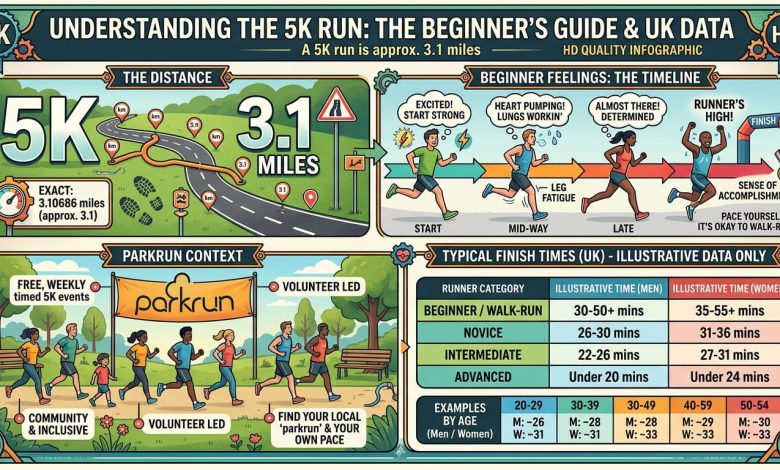
A 5K run is 3.1 miles. The “K” stands for kilometres, so 5K means five kilometres. Converted to miles, that is 3.10686 miles, which is rounded to 3.1 for everyday use . This article explains the conversion precisely, puts the distance in context for UK runners, and covers the practical details that matter when you are training for or entering your first 5K, from parkrun to race day.
The Exact Conversion
The maths is straightforward once you know the conversion factor. One kilometre equals approximately 0.621371 miles. Multiply that by five, and you get 3.106855 miles.
For most purposes, 3.1 miles is accurate enough. A 5K race is certified at exactly 5,000 metres, and the mile equivalent is a derived figure rather than a measured one. If you are tracking your training in miles, you will see 3.1 on your watch or app.
Why the Two Systems Coexist in the UK
The UK is unusual in its measurement habits. Road signs use miles, but running races are almost always measured in kilometres. Parkrun, the free weekly timed event held across the country, is a 5K. Most charity runs and organised races advertise 5K, 10K, or half marathon distances rather than mile-based equivalents.
This means UK runners routinely switch between the two systems. You might drive three miles to a parkrun, then run 5K, then check your pace in minutes per mile. Knowing that 5K equals 3.1 miles is the basic conversion that makes sense of the numbers.
Putting 3.1 Miles in Context
Abstract distance figures are hard to judge. Here are some comparisons that help.
A standard running track lap is 400 metres. A 5K is 12.5 laps of the track. If you have ever watched a track race, the 5,000 metres is the same distance, and it is one of the classic long-distance events.
In terms of time, a 5K is achievable for most people who can walk briskly or jog. The median finish time for a 5K race in a large 2024 dataset from the United States was about 36 minutes, with a median of 32 minutes for men and 39 minutes for women . These are recreational runners, not athletes. A beginner following a couch-to-5K plan will typically aim to complete the distance in 30 to 40 minutes, often with walking breaks.
For a sense of the elite level, the men’s 5K road world record is 12:49 . At the other end of the scale, many parkrun participants take 45 minutes or more, and walking the whole distance is entirely acceptable.
Training for a 5K: What 3.1 Miles Actually Feels Like
If you are new to running, 3.1 miles can sound daunting. It is worth knowing that the distance is manageable with a structured approach.
A common beginner plan, such as NHS Couch to 5K, builds up over nine weeks using alternating intervals of walking and running. The programme does not require you to run the full 3.1 miles until the final week. By the end, you are running continuously for 30 minutes, which for most beginners covers the 5K distance at a comfortable pace.
The key point is that 3.1 miles is short enough to train for without a huge time commitment. Three runs a week of 20 to 30 minutes is enough to build up to the distance. It is also long enough to be a meaningful goal, which is why it remains the most popular race distance for new runners.
Pace and Time: What to Expect
Your 5K time will depend on your fitness, age, and how consistently you train. The tables below give a rough guide based on commonly cited recreational running standards.
| Runner level | Typical 5K time (minutes) |
| Beginner (new to running, completing the distance) | 30 to 40 |
| Novice (running regularly, building fitness) | 25 to 30 |
| Intermediate recreational | 20 to 25 |
| Club-level runner | 17 to 20 |
| Elite | Under 15 |
These are approximate ranges. Age matters: a beginner in their 20s will generally progress faster than a beginner in their 50s, but the finishing times for recreational runners span a wide spectrum at every age .
Parkrun: The UK’s Most Accessible 5K
For UK runners, parkrun is often the first experience of a timed 5K. It is free, held every Saturday morning in parks across the country, and open to walkers, joggers, and runners of all abilities. You register once, print a barcode, and scan it at the finish to get an official time.
The atmosphere is deliberately non-competitive. Parkrun describes itself as “a run, not a race,” and the emphasis is on participation rather than speed. That said, fast runners do attend, and course records are noted informally even though parkrun no longer officially tracks them .
If you are nervous about your first 5K, parkrun is the least intimidating environment to try it. There is no cut-off time, no pressure to run the whole way, and no entry fee. You can walk the entire 3.1 miles if you prefer.
Common Misunderstandings
“5K is exactly 3 miles.” It is not. Three miles is 4.83 kilometres. The difference between 5K and 3 miles is about 0.1 miles, or roughly 170 metres. In a race, that gap is noticeable. Do not assume a 3-mile route is a 5K.
“A 5K is too short to count as real running.” This is a matter of opinion rather than fact. A 5K is an official race distance, a parkrun standard, and a meaningful training goal for millions of people. Distance snobbery serves no one.
“You need special equipment.” You need a pair of running shoes that fit well and are comfortable. Everything else is optional. A watch or phone to track your time is useful but not essential.
Frequently Asked Questions
How many miles is a 5K run exactly?
A 5K run is 5 kilometres, which converts to 3.10686 miles. For everyday use, 3.1 miles is the standard figure. The conversion factor is 1 kilometre equals approximately 0.621371 miles. Race distances are certified in metres, so the mile figure is a derived equivalent rather than a measured one.
Is 3.1 miles the same as 5K?
Yes. A 5K is 5,000 metres, and 5,000 metres equals approximately 3.1 miles. The two figures describe the same distance. If a route is described as 3.1 miles, it is effectively a 5K, though race courses are officially measured in metric units for certification purposes.
How long does it take to run 5K?
It depends on your pace and fitness. A beginner might take 30 to 40 minutes, often with walking breaks. Recreational runners typically finish in 25 to 35 minutes. More experienced runners may complete the distance in 20 to 25 minutes, and club-level runners in under 20. The median 5K finish time in a large recreational dataset was around 36 minutes .
How many laps of a track is a 5K?
A standard running track is 400 metres per lap. A 5K is 5,000 metres, which is 12.5 laps. The 5,000 metres is a standard track event, and the distance is the same whether run on a track, a road, or a parkrun course.