Mujahideen: What the Word Actually Means and Why Its History Matters

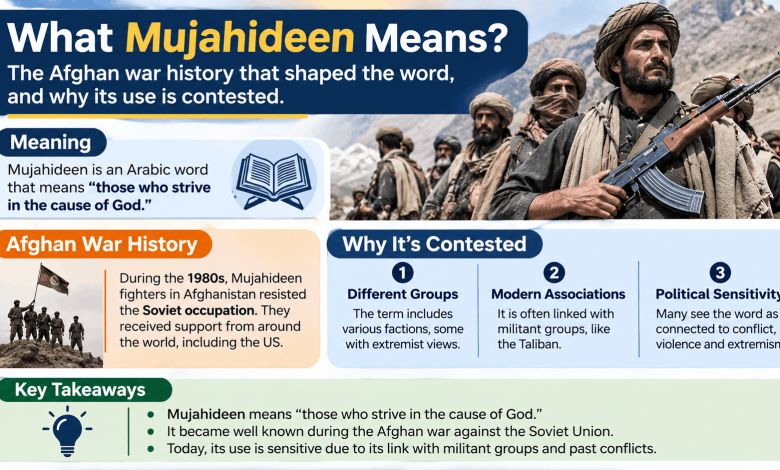
Mujahideen is the plural form of the Arabic word mujahid, which means “one who struggles” or “one who fights.” It comes from the root jahada, meaning to strive or struggle . In its broadest religious sense, it refers to Muslims engaged in jihad, which can mean an inner spiritual struggle or an armed struggle in defence of the faith . The word is not a synonym for “terrorist.” It has a long and varied history, from anti-colonial resistance to the Afghan war against the Soviet Union, and its meaning has shifted depending on who is using it and why. This guide explains the etymology, the historical contexts that gave the word its modern associations, and the important distinction between the term itself and the groups that have adopted it.
The Etymology: Struggle, Not Simply War
The word mujahideen is an Arabic plural. Its singular, mujahid, is an active participle derived from the verb jahada, which means to exert effort, to strive, or to struggle . The same root gives us the word jihad, which in Islamic tradition is often described as having two dimensions: the “greater jihad,” which is the internal struggle against one’s own spiritual and moral failings, and the “lesser jihad,” which is armed struggle in defence of Islam .
A mujahid, therefore, is someone engaged in struggle. In the classical tradition, a person who dies in the course of legitimate jihad is considered a martyr, or shahid . The word carries a moral and religious weight that is entirely absent from neutral terms like “fighter” or “combatant.” This is precisely why its use is contested.
The Historical Contexts That Shaped the Word
The term has been applied to a wide range of movements across the Muslim world, and the historical record shows how varied those movements have been.
Anti-colonial resistance. In the era of European colonialism, mujahideen was often used to describe those engaged in national liberation struggles . The word carried connotations of legitimate resistance against foreign occupation, not of extremism.
The Afghan War (1979-1989). This is the context that gave the word its most widespread modern usage in the West. When the Soviet Union invaded Afghanistan, the various resistance groups fighting the occupation were collectively known as the mujahideen . They were funded and armed by a coalition that included the United States, Saudi Arabia, Pakistan and others . The war was costly for the Soviets, and the mujahideen played a significant role in the eventual Soviet withdrawal in 1989 .
After the Soviet withdrawal, the mujahideen factions failed to establish a unified government. They fought among themselves for control of Kabul, and out of that chaos the Taliban emerged . This is a crucial point: the Taliban were not simply the mujahideen. They were a new movement that grew out of the post-war instability and eventually confronted the veteran mujahideen commanders .
Other conflicts. The term has also been used by groups in Iran (such as the People’s Mujahedin of Iran), in Myanmar, in the Philippines, and by foreign volunteers who travelled to Bosnia during the 1992-1995 war . Not all of these groups share the same ideology, and some have been involved in violence against civilians.
The Important Distinction: The Word vs. The Groups
The UK government maintains a list of proscribed terrorist organisations. Several groups on that list use variations of the word mujahideen in their names, including Harakat Mujahideen, Harakat-ul-Mujahideen/Alami, Jammat-ul Mujahideen Bangladesh, and Indian Mujahideen .
This does not mean that the word mujahideen itself is a proscribed term, or that every person described as a mujahid is a terrorist. It means that specific organisations that have adopted the name have been banned under UK law. The distinction matters for accuracy and for fair description.
There is also a linguistic argument that Western usage of the word is counterproductive. A 2006 analysis published by the US military’s DVIDS argued that calling al-Qaeda fighters mujahideen inadvertently legitimises them, because the word means “holy warrior” and carries a positive moral connotation in Arabic. The authors suggested the more accurate term for such people is mufsidun, meaning “evil or corrupt person” . This is an opinion, not a settled fact, but it illustrates why the language around this word is so sensitive.
How the Word Is Used Today
In contemporary usage, the term appears in several distinct ways.
In historical writing, it refers specifically to the Afghan resistance fighters of the 1980s. Books such as The Other Side of the Mountain: Mujahideen Tactics in the Soviet-Afghan War use the term in this descriptive, historical sense .
In news reporting, it is sometimes used loosely to describe any Islamist insurgent group, including the Taliban and al-Qaeda . This usage is imprecise, because the Taliban and al-Qaeda are distinct from the original mujahideen factions, even though there are historical connections.
In political discourse, the term is contested. Some Muslims reject its use by violent extremist groups, arguing that such groups are not engaged in legitimate jihad. Others use it to describe themselves and their actions positively.
The practical rule is to pay attention to the modifier. “The Afghan mujahideen” refers to a specific historical coalition. “A mujahideen group” is vague and should prompt the question: which group, in which country, and at what time?
Frequently Asked Questions
What does mujahideen mean literally?
It is the plural of the Arabic mujahid, meaning “one who struggles” or “one who fights.” It comes from the root jahada, meaning to strive. In Islamic tradition, it refers to someone engaged in jihad, which can be understood as spiritual struggle or armed struggle .
Are mujahideen the same as the Taliban?
No. The mujahideen were the various factions that fought the Soviet occupation of Afghanistan in the 1980s. After the Soviets withdrew, those factions fought among themselves. The Taliban emerged later, in the mid-1990s, as a new movement that grew out of the instability and eventually confronted the veteran mujahideen commanders .
Is mujahideen a banned term in the UK?
No. The word itself is not proscribed. However, several specific organisations that use the word in their names are on the UK government’s list of proscribed terrorist groups, including Harakat Mujahideen and Indian Mujahideen . The proscription applies to the organisations, not to the word.
Why is the word controversial in the West?
Because it carries a positive religious connotation in Arabic that is absent from neutral terms like “fighter.” Some analysts argue that applying it to groups like al-Qaeda inadvertently legitimises them, and suggest alternative terms like mufsidun (evil-doers) instead . The controversy is about how language shapes perception, not about the literal meaning of the word.is being described, and by whom.” That question will tell you more than the dictionary definition ever could.