
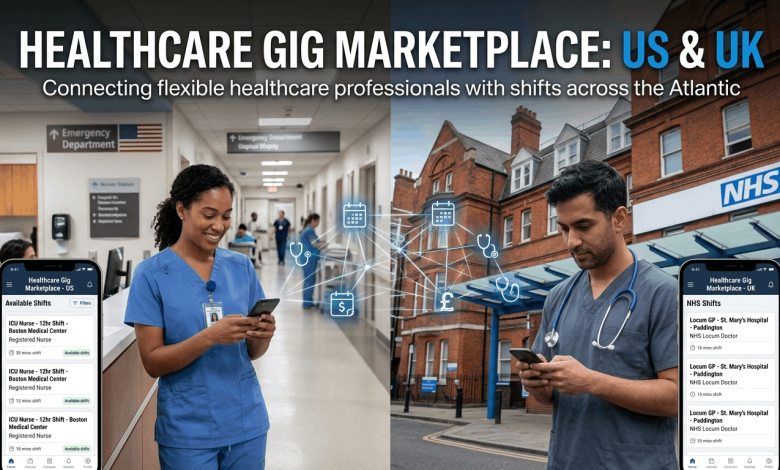
Imagine finishing a 12-hour hospital shift, opening an app on your phone, and picking up another shift at a different clinic across town before your next day off. No recruiter calls. No paperwork ping-pong. Just you, the platform, and a list of open shifts with posted pay rates. That’s exactly what healthcare gig marketplace companies have made possible for millions of nurses, nursing assistants, and allied health professionals across the US and UK.
But the picture isn’t all convenience and flexibility. Some of these platforms hide fees in fine print, let facilities cancel your shift two hours before it starts, and have you bidding against your own colleagues to undercut each other on pay. This guide covers the biggest healthcare gig marketplace companies operating in both countries, how each one works, what they pay, and where they fall short, so you can make a genuinely informed decision.
What Is a Healthcare Gig Marketplace?
A healthcare gig marketplace is a digital platform that connects healthcare professionals with facilities needing shift coverage. Think of it as a two-sided marketplace: on one side you have hospitals, nursing homes, surgical centers, and clinics; on the other, you have registered nurses, certified nursing assistants, medical assistants, allied health workers, and sometimes physicians.
The platform handles credentialing verification, scheduling, and payment processing. The worker picks up shifts on demand, typically classified as an independent contractor rather than a full-time employee. That contractor status is the central point of debate around the entire industry, and we’ll come back to it.
How These Platforms Are Different From Staffing Agencies
Traditional healthcare staffing agencies assign you to facilities, negotiate your contracts, and often handle your benefits. Gig marketplaces flip that model. You’re the one browsing available shifts, setting your availability, and in some cases bidding on pay rates. The platform acts as a middleman that takes a cut of the transaction, but it generally does not employ you in the legal sense.
The practical difference matters a lot. With an agency, someone advocates for you. On a gig platform, an algorithm manages your access to shifts, your performance ratings, and sometimes even your paycheck deductions.
The Biggest Healthcare Gig Marketplace Companies in the US
The US market has the most developed ecosystem of healthcare gig platforms. Here are the major players you’ll encounter.
Clipboard Health
Clipboard Health operates as a two-sided marketplace connecting healthcare professionals with understaffed facilities for open shifts. Workers browse postings by location, pay rate, and timing, then request the shift. Facilities can either set a fixed rate or enable rate negotiation, where workers propose a different rate before committing.
As of early 2025, the platform served tens of thousands of healthcare professionals and over 1,000 facilities. It’s one of the fastest-growing names in the per-diem nursing space. Business Insider named it one of the most promising startups of 2023.
One thing to know: Clipboard Health classifies its workers as independent contractors, meaning no employer-sponsored health insurance, no paid time off, and no workers’ compensation through the platform itself. Workers are also required to indemnify the company and facilities from potential losses, which legal experts have flagged as unusual.
ShiftKey
ShiftKey, founded in 2016, has a distinct model that sets it apart. Instead of facilities setting pay rates, workers bid on shifts. You indicate the lowest hourly rate you’ll accept, and the facility picks from the bids. On paper, this sounds like worker control. In practice, it creates downward pressure on wages. Researchers have documented workers bidding well below living wage rates just to win a shift.
In January 2023, ShiftKey raised $300 million in a Series A round led by Lorient Capital, bringing its valuation past $2 billion. The platform also charges workers daily fees per shift: a safety fee covering background checks and drug screens, occupational accident insurance, and malpractice insurance. These fees were on track to hit $7 per shift by the end of 2024.
ShiftMed
Launched in 2019, ShiftMed focuses on per-diem nursing and healthcare workforce management. It markets itself as a full workforce management solution for hospitals and health systems, offering scheduling tools, credential verification, and real-time shift matching through a mobile app.
ShiftMed secured $200 million in a Series D round in February 2023, bringing its total funding to nearly $300 million. The platform has faced scrutiny for evaluating workers on “reliability” metrics tied to willingness to work overtime, which critics argue pressures workers in ways that traditional employment law would not permit.
Nomad Health
Nomad Health operates in a slightly different space: longer-term travel contracts rather than per-diem shifts. Contracts typically run around 13 weeks, often placing nurses in facilities across state lines. The platform also includes telehealth roles, which most per-diem platforms don’t offer.
Founded in 2015, Nomad Health has raised a total of $241 million across multiple funding rounds. It uses machine learning to match clinicians with available positions. Vivian Health, sometimes called the “LinkedIn for healthcare,” facilitates around 15% of all travel nursing placements nationally, representing about $1.5 billion in annual labor spend.
CareRev
CareRev is one of the three largest gig nursing platforms in the US, alongside Clipboard Health and ShiftMed. It connects nurses and nursing assistants with hospitals for on-demand shifts. One notable concern: CareRev’s policies allow facilities to cancel a shift as little as two hours before it starts. Workers who cancel shifts face rating penalties that can reduce their future earnings and access to jobs. That asymmetry has drawn significant criticism from labor researchers.
connectRN and IntelyCare
connectRN, launched in 2014, focuses specifically on nurses and certified nursing assistants, with a strong presence in home care and concierge nursing settings. Unlike most gig platforms, connectRN classifies its workers as W-2 employees, which means they receive some benefits that independent contractor workers don’t. The company raised $161 million by late 2021.
IntelyCare, also founded in 2014, offers per-diem, contract, full-time, and part-time positions and uses an algorithm-based matching system to connect nursing talent with open roles. Both companies have carved out niches by being slightly more worker-protective than the broader platform average.
Trusted Health and Incredible Health
Trusted Health, founded in 2017, caters to travel nurses and allied health professionals. Its model aggregates job opportunities alongside professional development resources, positioning itself less as a shift-fill tool and more as a career platform. It raised $174 million through 2021.
Incredible Health takes an even more worker-first approach. Rather than having nurses apply to hospitals, hospitals apply to nurses. The platform includes AI-driven job matching and even voice interview tools. It’s built for longer-term placements, not just shift coverage.
Healthcare Gig Marketplace Companies in the UK
The UK market for healthcare gig platforms has grown rapidly, especially given pressures on NHS staffing and the push from venture capital into digital health solutions.
Patchwork Health
Patchwork Health is one of the most established UK-based healthcare workforce platforms. It provides workforce management software designed specifically for NHS Trusts and other healthcare organizations, offering rota management, staff bank tools, and a digital clinician network.
In recent M&A activity that made waves in the UK healthtech space, Patchwork Health acquired L2P Enterprise Ltd, the UK’s leading provider of medical appraisal and job planning software. This consolidation reflects a broader trend in the UK medical workforce marketplace: larger platforms are absorbing specialized tools to offer more comprehensive solutions.
Lantum (Formerly Network Locum)
Lantum, previously known as Network Locum, serves integrated care systems, primary care networks, and healthcare organizations across the UK. Its platform includes rota management, a digital staff bank, and a clinician network. The NHS has been a significant customer base for Lantum as NHS Trusts look for ways to reduce reliance on expensive locum agencies.
Rota
Rota is a UK-based flexible staffing platform that operates across healthcare and other sectors. Within healthcare, it connects care workers and support staff with facilities needing cover. It focuses on quick onboarding and real-time availability matching, competing with traditional locum agencies on speed and cost.
The NHS Staff Bank Model
Separate from third-party platforms, many NHS Trusts have developed internal staff bank systems. These are essentially in-house gig marketplaces where NHS-employed staff can pick up additional shifts across departments or affiliated sites. Third-party platforms like Patchwork and Lantum often power the technology behind these banks, even when the brand appears NHS-facing.
How Pay Actually Works on These Platforms
Pay structures vary enough between platforms that you genuinely need to read the fine print before signing up.
On Clipboard Health, pay is typically set by the facility, with an option for rate negotiation in some cases. On ShiftKey, you bid, which creates competition between workers. ShiftMed and CareRev post shifts at set rates. In all cases, the platform takes a percentage of the total labor spend. Workers classified as independent contractors are responsible for their own self-employment taxes, typically 15.3% on top of income tax, which many first-time platform workers underestimate badly.
The average hourly rate for nursing assistants employed in traditional settings is around $18.33. On gig platforms, the average reported rate for nursing assistants is about $22 per hour. Gig nurses average around $59 per hour compared to $45 for traditionally employed nurses. Those numbers sound favorable until you account for the lack of benefits, the cost of maintaining your own equipment and uniforms for multiple facilities, the unpaid time spent bidding on or managing shifts, and the self-employment tax burden.
The Real Risks You Should Know About
Nobody in the healthcare gig marketplace space advertises these on the homepage, but they matter.
Worker Classification and Legal Protections
Independent contractor status means you’re outside most employment law protections. No minimum wage guarantee in most gig platform contracts. No right to challenge shift cancellations. No access to unemployment insurance if the platform deactivates your account. Several states have been pushing legislation to change this, including Ohio, where lawmakers held hearings in 2025 on classifying platform-based health workers as independent contractors, raising questions about workers’ compensation coverage.
Patient Safety Concerns
This one doesn’t get discussed enough. Gig nurses often arrive at facilities they’ve never worked in before, without orientation, without knowing the chain of command, and without access to the patient information systems that permanent staff use. Researchers who interviewed nurses across 27 US states found consistent reports of feeling isolated and under-resourced. One nurse described caring for patients as “a rotten situation because they just have all these random folks taking care of them.”
Hidden Fees and Algorithmic Pay Cuts
Platform fees that get deducted from your paycheck aren’t always clearly explained during signup. ShiftKey’s daily fees cover background checks that aren’t actually performed daily. CareRev and Clipboard Health have indemnification clauses that could expose workers to financial liability if something goes wrong at a facility. Read every line of your platform agreement before you accept your first shift.
Algorithmic Performance Management
Your access to shifts, the pay rates you’re offered, and your visibility on the platform are all controlled by algorithms you can’t see and can’t appeal to a human manager. A low rating from one facility can cascade into fewer shift offers and lower pay across the board. There’s no grievance process equivalent to what you’d find in a union-represented healthcare job.
Who These Platforms Actually Work For
Despite the legitimate concerns, these platforms do fill a real need and genuinely work well for certain workers.
If you’re a nurse with a full-time job who wants to pick up two or three extra shifts a month, a per-diem platform can add meaningful income without a long-term commitment. If you’re transitioning between positions and need income while you search, short-term platform work bridges that gap. If you’re in a high-demand specialty, you’ll attract competitive rates without having to negotiate through a recruiter.
For facilities, the pitch is speed. Last-minute coverage that would take a staffing agency days to arrange can be filled in hours through a platform. For smaller clinics or nursing homes that can’t afford long-term agency contracts, gig platforms offer a practical alternative.
The picture is more complicated for workers who rely on these platforms as a primary income source. That’s where the lack of benefits, the algorithmic pay pressure, and the absence of legal protections create real hardship.
Comparing the Top Healthcare Gig Marketplace Companies at a Glance
| Platform | Country | Focus | Worker Classification | Funding |
| Clipboard Health | US | Per-diem nursing | Independent contractor | Undisclosed |
| ShiftKey | US | Per-diem nursing | Independent contractor | $300M+ |
| ShiftMed | US | Per-diem + workforce mgmt | W-2 and contractor | $298M |
| Nomad Health | US | Travel nursing, telehealth | Independent contractor | $241M |
| CareRev | US | Per-diem nursing | Independent contractor | Undisclosed |
| connectRN | US | Nurses, CNAs, home care | W-2 employee | $161M |
| IntelyCare | US | Per-diem + contract nursing | W-2 and contractor | Undisclosed |
| Trusted Health | US | Travel nursing | Independent contractor | $174M |
| Incredible Health | US | Permanent placements | N/A | Undisclosed |
| Patchwork Health | UK | NHS workforce mgmt | Contractor | Undisclosed |
| Lantum | UK | NHS, primary care | Contractor | Undisclosed |
| Rota | UK | Care staff, flexible | Contractor | Undisclosed |
What to Look For When Choosing a Platform
Before you create a profile on any healthcare gig marketplace, run through this checklist.
Check how workers are classified. W-2 classification means some benefits and legal protections. Independent contractor status means you carry more financial risk. Ask whether there are daily or per-shift fees deducted from your pay. Read the indemnification clause carefully. Understand how shift cancellations work on both sides. Find out how the platform calculates your performance score and what happens if it drops. Look at whether your specialty actually has active postings in your region.
On the facility side, check whether the platform has a credentialing verification system and what the onboarding process looks like for new workers. A platform that doesn’t properly vet clinical credentials before a nurse walks into your facility is a liability risk.
Frequently Asked Questions About Healthcare Gig Marketplace Companies
What is a healthcare gig marketplace?
A healthcare gig marketplace is a digital platform that connects healthcare professionals with facilities needing temporary or per-diem shift coverage. The platform handles matching, credentialing verification, and payment. Workers typically browse and select shifts on demand rather than being assigned by a recruiter or employer.
Are healthcare gig workers employees or independent contractors?
Most healthcare gig platforms in the US classify workers as independent contractors. This means workers are responsible for their own taxes, benefits, and equipment. A few platforms, including connectRN, classify workers as W-2 employees, giving them access to some benefits. UK platforms operating within NHS frameworks often use different arrangements tied to NHS terms and conditions.
How much do healthcare gig workers earn?
Pay varies significantly by specialty, platform, and region. Gig nursing assistants report average rates of around $22 per hour compared to $18.33 for traditionally employed assistants. Gig nurses average around $59 per hour. However, these figures don’t account for self-employment taxes, platform fees, unpaid administrative time, or the cost of maintaining multiple facility-specific uniforms and equipment.
Which healthcare gig platform pays the most?
No single platform consistently pays the most across all specialties and regions. ShiftKey’s bidding model can produce higher rates for in-demand specialties when facilities compete for workers, but it can also push rates down. Nomad Health tends to offer higher gross pay for travel contracts, but those are longer commitments. Clipboard Health’s negotiation feature lets workers push back on posted rates when it’s enabled.
Are these platforms safe for patients?
Patient safety is a real and documented concern with gig nursing. Workers who pick up shifts at unfamiliar facilities often lack orientation, don’t know the chain of command, and may not have full access to patient records. Research involving nurses across 27 US states found consistent reports of feeling unprepared and unsupported. The platforms themselves acknowledge this challenge but argue that credentialing and performance systems help maintain standards.
What healthcare gig platforms operate in the UK?
The main healthcare gig marketplace platforms in the UK include Patchwork Health, Lantum (formerly Network Locum), and Rota. Many NHS Trusts also run internal staff bank systems, sometimes powered by these same platforms. The UK market is younger than the US market but has been growing fast, driven by NHS staffing pressures and increased venture capital interest.
Can doctors use healthcare gig platforms?
Yes, though the market is more developed for nurses and allied health professionals. Locum doctors in the UK have used platforms like Lantum for flexible placements. In the US, platforms like Nomad Health list some physician roles, and companies like Wheel specialize in telehealth physician placements. The credentialing requirements for physicians are more complex, which adds friction to the gig model.
What is the difference between per-diem and travel nursing platforms?
Per-diem platforms like Clipboard Health and ShiftKey are built for single-shift or short-notice coverage, usually within a worker’s local area. Travel nursing platforms like Nomad Health and Trusted Health focus on multi-week contracts, often crossing state lines, with higher pay rates but longer commitments and more complex licensing requirements.
Do gig healthcare platforms provide malpractice insurance?
Some platforms include malpractice insurance as part of per-shift fees. ShiftKey, for example, includes medical malpractice insurance in its daily fee structure. You should always verify the coverage limits and understand whether the policy covers you specifically or only the facility. Some platforms have moved toward indemnification clauses that actually shift liability back to the worker.
Is the healthcare gig economy growing?
The broader gig economy was valued at over $450 billion in 2024, and healthcare is one of the fastest-growing segments within it. Factors driving growth include post-pandemic nursing shortages, an aging population requiring more care, and workers’ demand for schedule flexibility. Both the US and UK markets are expected to see continued investment and consolidation among platforms through 2025 and beyond.
Making the Right Call for Your Situation
The healthcare gig marketplace sector is real, growing, and genuinely useful for the right people in the right circumstances. For supplemental income, schedule flexibility, or bridging employment gaps, platforms like Clipboard Health, ShiftMed, connectRN, Nomad Health, and Patchwork Health offer something traditional staffing channels can’t match on speed and convenience.
But going in without reading the terms of service is a mistake. The fee structures, performance scoring systems, contractor classifications, and indemnification clauses vary enough between platforms that the one with the highest posted rate isn’t always the one that puts the most money in your pocket.
Before you create your first profile, know your specialty’s typical market rate, understand the tax implications of contractor status, and check whether your target platform has strong shift availability in your area. For facilities, do the math on true cost per shift versus traditional agency fees, and make sure your onboarding process accounts for workers who’ve never set foot in your building before.
If you want to go deeper on how technology is reshaping healthcare staffing and workforce trends, explore our related coverage on healthcare technology trends and the future of flexible work across industries at reuterings.com.