
Your neighbor ran a regular ethernet cable across his backyard two summers ago. By fall, the jacket had cracked. By spring, the connection was dropping every time it rained. Last summer, it stopped working entirely.
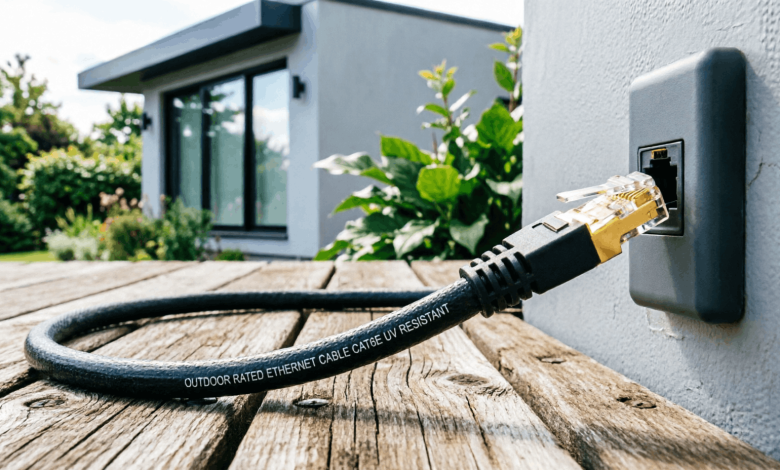
That’s what happens when you use indoor cable outside. Outdoor rated ethernet cable is built to survive UV exposure, moisture, temperature swings, and physical stress that would destroy a standard cable in months. This guide breaks down exactly what makes a cable truly outdoor-rated, which categories and jacket types actually matter, how to install it correctly, and what connectors to use so your outdoor network stays solid for years, not seasons.
What Makes an Ethernet Cable “Outdoor Rated”?
Not every cable labeled “outdoor” is actually built for long-term outdoor use. The rating comes down to four things: the jacket material, UV resistance, moisture protection, and temperature tolerance. If a cable is missing any of these, it’s going to fail faster than the manufacturer wants to admit.
Jacket Material
Indoor ethernet cables use PVC jackets. PVC is fine inside a wall where it’s protected, but it becomes brittle and cracks when exposed to sunlight and temperature swings. Outdoor-rated cables use polyethylene (PE) or similar compounds that stay flexible across a much wider temperature range and resist UV radiation far better.
A PE jacket can last 10 to 20 years outdoors. A PVC jacket exposed to direct sun often starts showing cracks within 12 to 18 months.
UV Resistance
UV exposure breaks down the molecular structure of plastic over time. Outdoor-rated cables are manufactured with UV stabilizers mixed into the jacket compound. Without this, the jacket becomes brittle, cracks, and allows moisture to reach the copper pairs inside.
Moisture Protection
Basic outdoor cables resist water on the outside. Cables rated for direct burial go further — they’re either flooded with a petroleum-based gel that prevents water from traveling along the cable’s length, or they have an additional moisture barrier layer. This matters a lot if you’re burying the cable or running it in a low-lying area where water can pool.
Temperature Tolerance
Standard indoor cables are rated for roughly 0°C to 60°C. A proper outdoor cable handles -20°C to 75°C or better. If you’re in Minnesota, Montana, or anywhere that sees serious winters, this isn’t optional.
Understanding Cable Ratings: CMX, CMR, CMP, and Direct Burial
Cable ratings trip up a lot of people. You’ll see these codes on the jacket of the cable itself, and knowing what they mean saves you from buying the wrong product.
CMX (Communications Multipurpose, Exterior)
CMX is the standard outdoor rating. It means the cable is designed for outdoor use, has a UV-resistant jacket, and can handle moisture. Most outdoor ethernet cables you’ll find at hardware stores carry a CMX rating. It’s the baseline you need for any exterior run.
CMR and CMP
These are indoor ratings (riser and plenum respectively). CMR cables run vertically inside walls. CMP cables go into air-handling spaces. Neither is designed for outdoor exposure. Ignore these when shopping for outdoor cable.
Direct Burial
Direct burial cable goes a step further than standard CMX. These cables are designed to be placed directly in the ground without a conduit. They typically have a gel-filled core that blocks moisture migration, a thicker jacket, and sometimes an armored layer for rodent resistance. Not all CMX cables are rated for direct burial, so check the label specifically.
Aerial/Messenger Cable
Some outdoor cables are designed to be strung between buildings or poles without additional support. These have a steel messenger wire bonded to the jacket that carries the mechanical load so the cable itself isn’t under tension. If you’re running cable across open air between structures, this is the type you want.
Outdoor Ethernet Cable Categories: Cat5e, Cat6, Cat6a, and Cat8
The category of the cable determines its speed and frequency performance. For most outdoor runs, Cat6 hits the sweet spot, but the right choice depends on your distance and speed requirements.
Cat5e Outdoor
Cat5e supports up to 1 Gbps at 100 meters. It’s widely available in outdoor-rated versions and costs less than Cat6. If you’re running a short distance to a security camera, an outbuilding, or an access point and you don’t need more than 1 Gbps, Cat5e does the job. The downside is that it’s more susceptible to crosstalk compared to Cat6, and if you’re running near power lines or other sources of interference, you’ll feel it.
Cat6 Outdoor
Cat6 supports 1 Gbps at 100 meters and 10 Gbps at shorter distances (up to about 55 meters). The tighter twist and better shielding specs make it more resistant to interference than Cat5e. For most residential and small business outdoor runs, Cat6 is the right call. It costs a bit more than Cat5e but the performance improvement is real.
Cat6a Outdoor
Cat6a supports 10 Gbps at the full 100-meter distance. The cables are thicker and heavier, which makes installation in tight spaces or long conduit runs more work. If you’re connecting buildings where you need maximum throughput, Cat6a is worth the effort. It’s also the better choice if you’re future-proofing an installation you’d rather not redo in five years.
Cat8 Outdoor
Cat8 is overkill for almost every outdoor use case. It’s designed for data center environments with very short runs (up to 30 meters). You won’t find many genuine outdoor-rated Cat8 options because there’s almost no scenario where you need Cat8 speeds over a cable run long enough to go outdoors. Skip it for exterior installations.
Shielded vs. Unshielded: Does It Matter Outdoors?
Outdoor cable comes in both STP (shielded twisted pair) and UTP (unshielded twisted pair) versions.
When UTP Works Fine
If your outdoor run is away from electrical lines, motors, HVAC equipment, and other interference sources, unshielded cable works well. Most residential installations running cable to a detached garage, shed, or garden-mounted access point don’t need shielding.
When STP Is Worth It
If your cable runs parallel to power lines, near a generator, or through an industrial or semi-industrial environment, get shielded cable. STP cable has a foil or braid shield around the twisted pairs that blocks electromagnetic interference. The catch is that STP requires proper grounding at both ends to work correctly. If you don’t ground it, the shield can actually make interference worse by acting as an antenna.
For most homeowners, UTP outdoor Cat6 is the right product. For commercial or industrial setups, go STP.
Installation Methods: Conduit, Direct Burial, and Aerial
How you install the cable matters as much as which cable you pick.
Running Cable in Conduit
Conduit gives your cable the most protection. You bury PVC or HDPE conduit and pull the cable through it. This method protects against physical damage, rodents, and moisture. It also makes future cable replacement much easier since you can pull new cable through the same conduit without digging.
For conduit runs, you don’t necessarily need a direct burial cable. A standard CMX-rated cable pulled through a sealed conduit is well protected. Use conduit whenever you can.
Direct Burial Without Conduit
Direct burial cable goes straight in the ground. It’s faster and cheaper to install than conduit but harder to replace. Dig your trench at least 6 inches deep for ethernet cable (12 inches or more is better for protection against garden tools and frost). Use actual direct burial rated cable with a gel-filled jacket or armored outer layer.
Don’t bury standard CMX cable without conduit expecting it to survive long-term. The soil moisture and ground pressure will eventually compromise it.
Aerial Runs
Stringing cable between buildings means the cable needs to handle its own weight, wind load, and UV exposure. Use aerial messenger cable for any run over a few feet. Self-supporting aerial cables have a steel strand bonded to the jacket. You can also use a catenary wire and zip-tie standard outdoor cable to it, but the bonded messenger design is cleaner and more reliable.
Keep aerial runs tight to avoid excessive sag. A drooping cable collects water in the U-shape and puts mechanical stress on the terminations.
Waterproof RJ45 Connectors: The Part Most People Get Wrong
You can run the best outdoor rated ethernet cable available, and a standard RJ45 connector will undo all of it. Standard RJ45 connectors are not sealed. Moisture gets in through the crimp opening, causes corrosion on the contacts, and you lose your connection.
What Waterproof RJ45 Connectors Are
Waterproof RJ45 connectors are either pre-filled with sealant, covered with a rubber boot that compresses against the cable jacket to form a seal, or designed with an IP-rated housing that screws together around the connection. Look for connectors rated at IP67 or IP68. IP67 means protected against temporary immersion. IP68 means it handles continuous submersion.
Where to Use Them
Any outdoor connection point needs waterproof connectors. This includes the jack mounted on your building exterior, the connector going into an outdoor access point, and any junction you make in a weather-exposed location. If the connection is inside a properly sealed weatherproof enclosure, standard connectors inside the enclosure are acceptable, but the entry point still needs a sealed fitting.
Brands Worth Knowing
Ubiquiti makes a well-regarded weatherproof RJ45 connector designed for their outdoor access points and is a common choice for outdoor Wi-Fi deployments. Leviton and Panduit both make outdoor-rated keystones and jacks for permanent installations. For field-terminated waterproof connectors, look at Platinum Tools and Greenlee options that include the rubber boot seal.
Terminating in the Field
If you’re crimping your own connectors outdoors, keep moisture away from the termination until the connector is fully seated and the boot compressed. Some waterproof connectors include a small amount of dielectric grease inside the boot. Don’t wipe it out; it’s there to protect the connection.
For permanent outdoor jack installations, seal the cable entry with silicone or use a weatherproof wall plate rated for outdoor use.
How Long Can Your Outdoor Ethernet Run Be?
Ethernet over copper has a hard distance limit: 100 meters (328 feet) regardless of cable category. That’s end to end, including patch cables on both sides.
Most residential outdoor runs are well under this limit. A run to a detached garage 60 feet away or a camera mounted 80 feet from your router has plenty of headroom.
When You Need More Than 100 Meters
If your run exceeds 100 meters, you have two options:
A media converter or outdoor-rated switch can act as a repeater. You run ethernet to the switch, the switch regenerates the signal, and you run a second ethernet segment from there. This approach works but adds a piece of hardware that needs to be powered and housed.
Fiber optic cable has no meaningful distance limit for runs under a kilometer and is completely immune to electrical interference. Media converters that convert ethernet to fiber and back are inexpensive and widely available. For very long outdoor runs, like connecting buildings across a large property, fiber is the cleaner solution.
Temperature, Climate, and What No One Else Tells You
Most guides skip temperature specs. That’s a mistake if you live somewhere with real winters or extremely hot summers.
Outdoor cable jacketed in standard PE is typically rated from -20°C to 75°C (-4°F to 167°F). If you’re in a region where temperatures drop below that, check the spec sheet for your specific cable, not just the generic category spec.
Cold temperatures make cables brittle. Never install outdoor cable when temperatures are below -10°C unless the cable is specifically rated for it. Bending a cold cable can crack the jacket even before you notice any visible damage.
Heat is an issue in enclosed spaces. Cable running across a roof surface or through a metal conduit in direct sun can see temperatures well above ambient air temperature. A dark-colored conduit in Arizona summer sun can hit 70°C internally even when the air temperature is 40°C. Account for this when picking your cable.
For above-average heat environments, look for cables with a LLDPE (linear low-density polyethylene) jacket, which handles elevated temperatures better than standard PE.
Common Mistakes to Avoid
- Using indoor cable for a temporary run that becomes permanent. It starts as “just for now” and ends with a cable run you forgot about that fails at the worst possible moment.
- Buying CMX cable and burying it without conduit. CMX outdoor means UV and moisture resistant. It doesn’t mean direct burial ready unless the label specifically says so.
- Skipping the waterproof connector. The cable survives. The connection point corrodes. You lose the link and spend an afternoon wondering why.
- Running the cable across a roof without strain relief. Thermal expansion and contraction on a rooftop pulls at terminations over time. Use cable clips rated for exterior use and leave a small service loop at each end.
- Ignoring grounding on shielded cable. As mentioned above, an ungrounded shield causes more problems than it solves.
Frequently Asked Questions About Outdoor Rated Ethernet Cable
What is the difference between outdoor and indoor ethernet cable?
Outdoor ethernet cable uses a UV-resistant polyethylene (PE) jacket that stays flexible in cold and resists cracking in sunlight. Indoor cables use PVC, which becomes brittle outdoors within one to two years. Outdoor cables also handle wider temperature ranges and may include gel-filling or additional moisture barriers depending on the rating.
Can I use Cat6 cable outdoors?
Yes, but only if it’s specifically labeled as outdoor-rated or CMX. Standard Cat6 cable uses a PVC jacket designed for indoor use. You need Cat6 cable with a PE outdoor jacket to get reliable long-term performance outside. The category (Cat6, Cat5e, etc.) and the outdoor rating are separate specs.
What does CMX rating mean for ethernet cable?
CMX stands for Communications Multipurpose, Exterior. It’s the standard rating for outdoor ethernet cable, indicating the cable is built with a UV-resistant jacket suitable for exterior environments. CMX doesn’t automatically mean the cable is rated for direct burial. Check the label for direct burial designation separately.
Do I need conduit for outdoor ethernet cable?
You don’t always need conduit, but it’s the best option when you can use it. Direct burial cable can go in the ground without conduit. Conduit adds protection against physical damage and rodents, and it makes cable replacement much easier. Above ground runs exposed to sunlight and weather can use outdoor cable without conduit, but you’ll want to secure it properly with exterior-rated cable clips.
How long can an outdoor ethernet cable run be?
The maximum run length for ethernet over copper is 100 meters (328 feet) end to end. This applies regardless of cable category. For runs longer than 100 meters, use a powered switch or media converter to regenerate the signal, or switch to fiber optic cable, which handles distances up to several kilometers without signal loss.
Are waterproof RJ45 connectors necessary outdoors?
For any connection point exposed to weather, yes. Standard RJ45 connectors let moisture reach the contacts, causing corrosion and connection failure. Waterproof connectors rated IP67 or higher keep moisture out of the connection. If you’re terminating inside a completely sealed weatherproof enclosure, standard connectors inside are acceptable, but the cable entry still needs to be sealed.
What is direct burial ethernet cable?
Direct burial ethernet cable is designed to be placed directly in the ground without conduit. It typically has a gel-filled core that prevents water from migrating along the cable’s length, a thicker jacket, and sometimes armored sheathing for rodent resistance. Standard outdoor CMX cable is not the same as direct burial cable, even if it’s UV resistant.
Can I run outdoor ethernet cable underground?
Yes. Use either direct burial rated cable or run any CMX outdoor cable through a buried conduit. For direct burial, dig at least 6 inches deep. Twelve inches or more gives better protection against frost and accidental digging. Mark the cable path so you don’t cut it later with garden tools.
How do I weatherproof an ethernet connection outdoors?
Use waterproof RJ45 connectors or weatherproof keystone jacks for any exposed connection point. Apply silicone sealant around cable entry points on wall-mounted jacks. Use weatherproof outdoor enclosures for any junction points or network hardware mounted outside. Seal the end of unused conduit to prevent water and insects from traveling through.
What gauge or type of ethernet cable is best for long outdoor runs?
For runs approaching the 100-meter limit, use Cat6 or Cat6a to minimize signal degradation. At shorter distances under 50 meters, Cat5e performs fine. For runs over 100 meters, consider switching to fiber optic cable with media converters at each end, which eliminates the distance limit and the interference vulnerability of copper entirely.
Ready to Build an Outdoor Network That Actually Lasts?
Getting this right the first time saves you from re-doing the run in two years. Pick a genuine CMX or direct burial cable rated for your installation method, use waterproof RJ45 connectors at every exposed termination, stay under 100 meters per copper segment, and seal every point where the cable enters a building or enclosure.
If you want to go deeper on related outdoor networking topics, Reuterings.com covers everything from running cable through walls and attics to setting up outdoor Wi-Fi access points that stay connected in every season. Start with our guides on whole-home networking and outdoor Wi-Fi placement for a complete picture of what you need.